
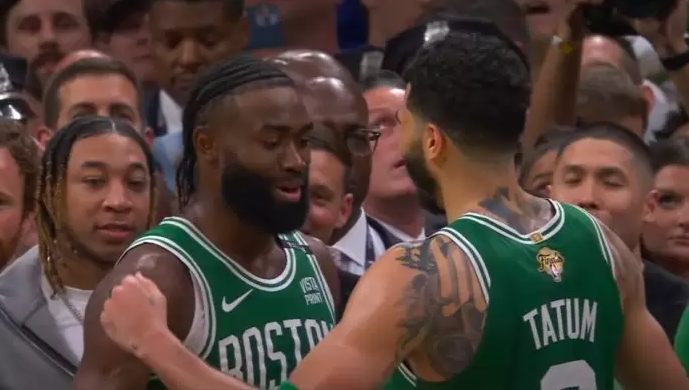
Jayson Tatum did not try to make it sound normal. He did not hide behind the usual NBA business clichés, either. When asked about Jaylen Brown being traded away from the Boston Celtics, Tatum gave the only honest answer that really fits.
It is weird.
“Let’s be honest, it’s weird,” Tatum said. “You play on a team with a guy for nine years. I was lucky enough to go to the Finals with him twice and win the NBA.”
Tatum and Brown were not just two stars who happened to share a locker room. They were Boston’s timeline. They were the argument. They were the patience test. They were the duo fans debated, defended, criticized, doubted and eventually celebrated when the Celtics broke through and won the 2024 championship.
For years, the basketball world asked whether they could win together. Then they did. And somehow, less than two years later, the partnership ended anyway.
Tatum made it clear that he does not view the split as failure.
“We pushed each other to become the players we are today,” he said, adding that the trade made him appreciate all the time he had by Brown’s side.
That is the right perspective, because no matter how abruptly it ended, the Tatum-Brown era delivered something real. Two Finals trips. A championship. Years of deep playoff runs. A standard of winning that most franchises would take immediately.
“But the NBA is weird, right?” Tatum said. “It’s business, we ended abruptly. For me, this trade doesn’t mean we failed.”
Tatum also revealed that he was not warned beforehand that Brown would be moved.
“I wasn’t warned,” he said. “I kind of just saw the news like everyone else. I was completely shocked.”
That is a wild detail, even in the modern NBA. Tatum is not just another player on the roster. He is the face of the Celtics, a franchise cornerstone and the other half of the partnership Boston just broke apart. For him to learn about Brown’s trade the same way fans did says plenty about how sudden and ruthless the business side can be.
Brown is now headed to the Philadelphia 76ers, while Boston brings in Paul George and draft assets in a move that instantly reshapes the Eastern Conference. On paper, the Celtics can explain it through roster flexibility, money, age curves, fit and future planning. That is what front offices do. They turn emotion into spreadsheets and call it direction.
But Tatum’s reaction reminds everyone that players do not experience trades as clean transactions. They experience them as endings. Brown was there for the losses, the criticism, the almosts, the breakthrough and the banner. He was there when Boston was still trying to prove the experiment could work. He was there when it finally did.
That history does not disappear because a trade call was made.
