
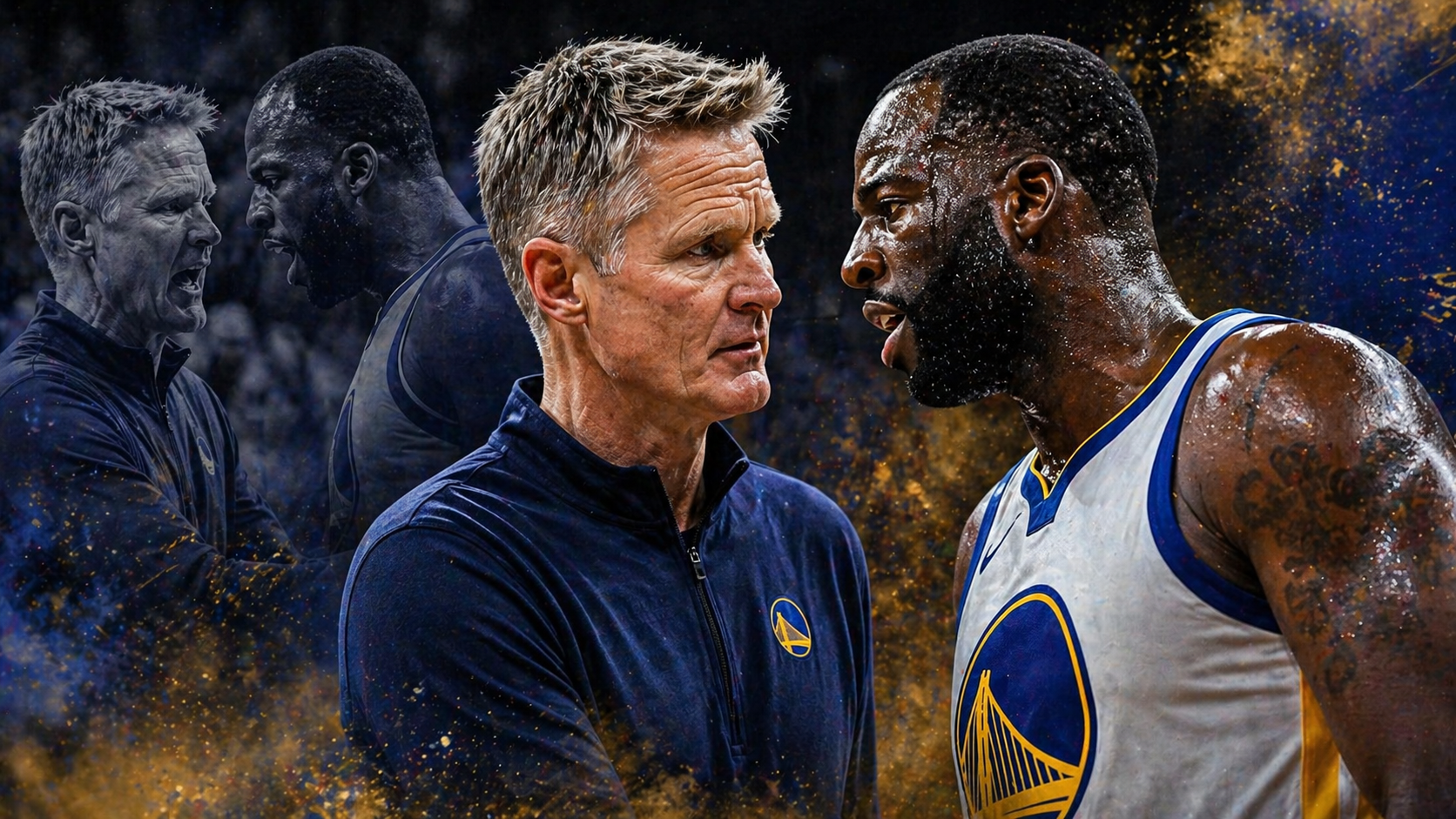
Draymond Green’s greatness has always lived inside a contradiction: the Warriors needed him to be everything, but not always in the ways he may have wanted.
His latest reflection on Steve Kerr cuts into that tension with unusual honesty. Green did not attack Kerr. He did not reduce their relationship to bitterness. In fact, the quote works because he keeps both truths alive at once. Kerr helped make him Draymond Green, the defensive genius, the connector, the emotional engine of a dynasty. But Green also wonders whether Kerr’s system narrowed the offensive version of him, especially after Kevin Durant arrived in 2016.
“When [Kevin Durant] came from 2016 on, I have not had a play in our playbook. Not a single play that we run for me in our playbook since 2016,” Green said. “You think that would hinder someone as an offensive player? Of course.”
That is not a small gripe. It is a window into the cost of winning at the highest level. Green became indispensable because he accepted a role most stars would reject. He screened, passed, defended, directed traffic, absorbed physical punishment and kept the Warriors’ machine humming around Stephen Curry, Klay Thompson and Durant. His offense became less about scoring and more about interpretation. He was not the destination. He was the map.
But maps do not get many plays called for them.
That is the ache inside Green’s comments. Before he became a symbol of elite role mastery, there was a player with more offensive curiosity: a transition handler, short-roll passer, post facilitator, occasional scorer, someone who could punish chaos rather than merely organize it. The Warriors did not need that version every night. They needed his brain, his voice, his defense, his willingness to become the connective tissue between more glamorous weapons.
Green seems to understand the bargain. He says he is grateful. He says he does not hate Kerr. He says one gripe cannot erase everything else. That maturity matters. But so does the question he is asking now: what happens to a player’s imagination when winning asks him to stop imagining?
Maybe Green never would have become a 20-point scorer. Maybe the dynasty only worked because he sacrificed that possibility. But his point is not fantasy. It is legacy. He is looking back at a career full of rings, respect and conflict, and still wondering what part of himself was left unused.
That is the strange cruelty of team greatness. Sometimes becoming exactly what a dynasty needs means never fully finding out what else you could have been.
