
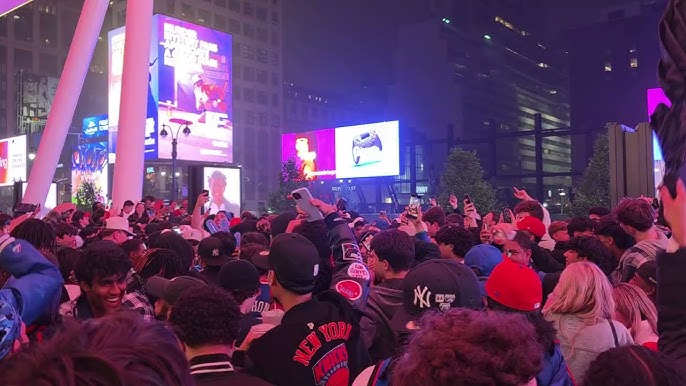
There are few fan bases in American sports that turn joy into a weather event quite like Knicks fans. A win at Madison Square Garden does not simply end when the buzzer sounds. It leaks into Seventh Avenue, shakes the pavement, turns strangers into relatives and makes the city feel like it has been waiting twenty-five years to exhale at the same time.
J.R. Smith knew that energy. Of course he did. He was once one of its favorite sons, the tattooed, heat-checking, no-conscience Sixth Man of the Year who made chaos feel like a valid offensive system. Smith played for the Knicks from 2012 to 2015, won the NBA’s Sixth Man of the Year award in 2013, and became one of those players New York never really forgets because he never felt manufactured for the place. He was streaky, wild, brilliant, flawed and entirely human. In other words, he fit.
So when Smith came out of the Garden after the Knicks’ 137-98 Game 1 win over Philadelphia in the second round, saw his hotel to the left and the roaring mob to the right, the decision was almost spiritual. The safe thing was the hotel. The New York thing was the mob. Smith chose the mob.
His retelling is perfect because it begins with confidence and ends with physics. He saw the crowd and thought,
“I’m one with the people.”
Then, step by step, the sound changed. Every few feet, more fans recognized him. The cheers grew louder, the circle tighter, the celebration less like a party and more like a living organism. Smith realized, just a little too late, that this might not be the best idea. Then somebody fell. Then another. Then the whole thing turned into what he called a domino effect.
“So, when I came out the Garden, bro my hotel was to the left and I looked to the right and the big a** mob was right there. And I was just like, man, I’m one with the people. So, I’m like man, let’s see what this about. As I’m walking over there, the closer I get, I keep realizing like everybody’s noticing that I’m coming over there or whatever. So, as every step I take it’s getting louder. It’s getting louder. I’m sitting there like, as I get closer, I’m like, “Yeah this probably not as good, bro. No bullsh*t dog.” It was, as I’m think that sh*t somebody 20 feet in front of me fall. And then that sh*t was a domino effect.”
J. R. Smith on when he was outside the Garden with the Knicks fans:
“So, when I came out the Garden, bro my hotel was to the left and I looked to the right and the big a** mob was right there. And I was just like, man, I’m one with the people. So, I’m like man, let’s see what… pic.twitter.com/ELOnoBr8H9
— NBA Courtside (@NBA__Courtside) May 21, 2026
That is the thin line with New York basketball. The Garden can make a player immortal, but the sidewalk outside can still swallow him whole. Smith was not attacked in the traditional sense. He was consumed by affection, by noise, by playoff delirium, by thousands of people who had waited so long to believe in something that they nearly tackled one of their own memories.
And somehow, it made sense that it was J.R. Smith. Not Patrick Ewing in a suit. Not Walt Frazier in immaculate leather. J.R. Smith, forever balanced between legend and meme, danger and charm, basketball and street theatre. The man who once gave Knicks fans instant offense had given them one more viral moment without even touching a ball.
In a quieter city, this would be a cautionary tale. In New York, it becomes folklore. J.R. saw the mob, walked toward it, heard the volume rise with every step, reconsidered his life choices in real time, and then got folded into the human avalanche of Knicks happiness.
