
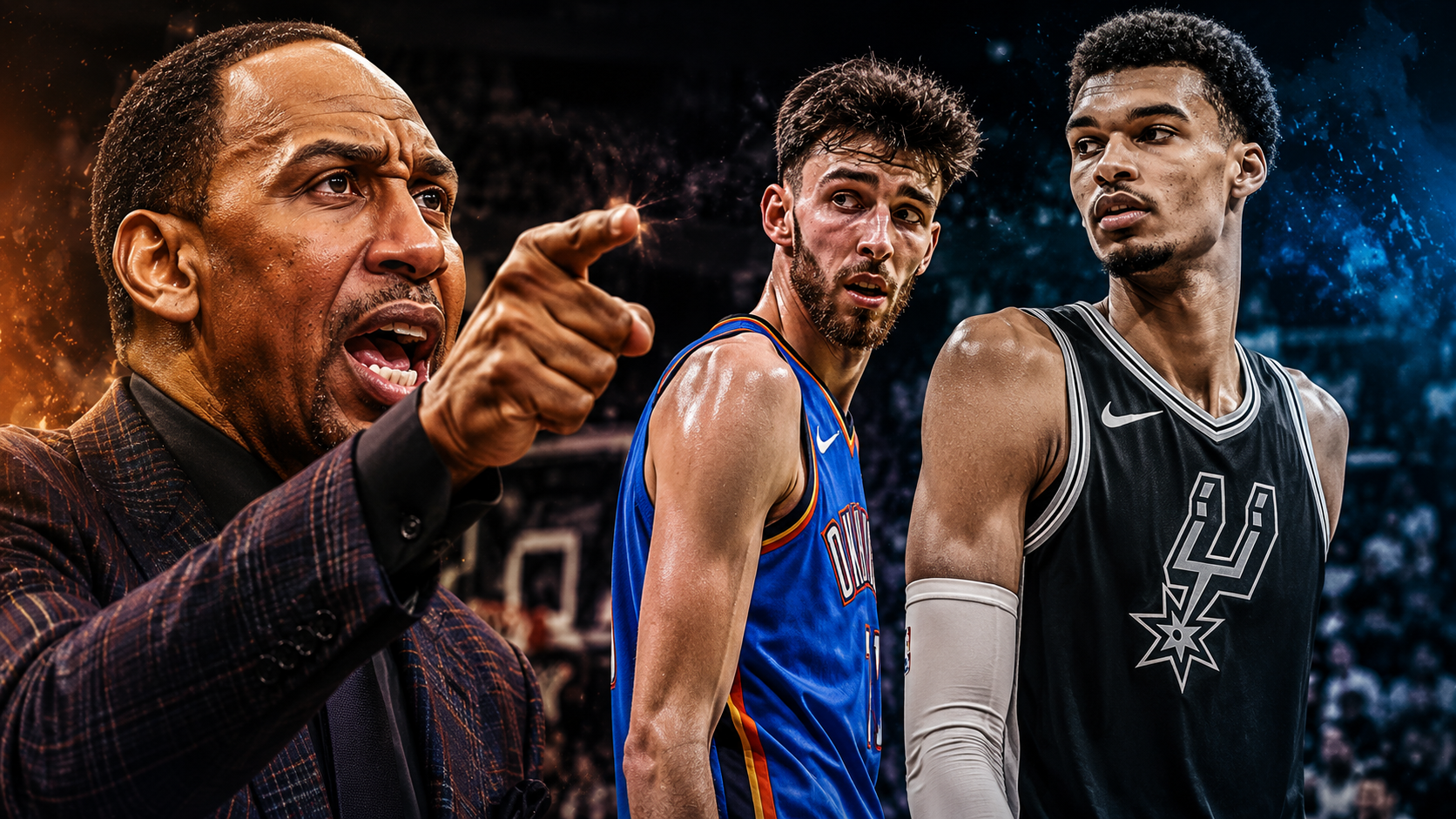
Stephen A. Smith did not need a complicated thesis after Game 1. He watched Victor Wembanyama rip open the Western Conference Finals, watched Oklahoma City throw different bodies at him, watched Alex Caruso battle above his weight class, watched Jalen Williams take turns in the fire, and came away with one demand for Chet Holmgren.
Go guard him.
After San Antonio’s 122-115 double-overtime win over the Thunder, Wembanyama’s line looked almost fictional: 41 points, 24 rebounds and three blocks in 49 minutes. He became the youngest player in NBA playoff history with a 40-point, 20-rebound game, and the Spurs stole home court from the defending champions in Oklahoma City. For Smith, that made Holmgren’s role in the series impossible to ignore.
“Chet Holmgren, what’s up? We heard all this noise all these years that y’all don’t like each other…. Chet Holmgren, you have to want this! You don’t like him right? You’re the champion and he’s coming to take what you got! What are you going to do about it? Leave it to Alex Caruso? Leave it to Jalen Williams? You gotta guard that man! At some point, he gotta embrace that challenge.”
Stephen A Smith calls out Chet Holmgren for not guarding Wemby:
“Chet Holmgren, what’s up? We heard all this noise all these years that y’all don’t like each other…. Chet Holmgren, you have to want this! You don’t like him right? You’re the champion and he’s coming to take what… pic.twitter.com/h9RfpSlXYG
— NBA Courtside (@NBA__Courtside) May 19, 2026
That is the emotional core of the matchup. Wembanyama and Holmgren have been linked for years because of their bodies, their skill sets, their timing and the natural temptation to frame them as mirror images from different basketball futures. But Game 1 changed the conversation. Wembanyama was not just another big on the scouting report. He was the problem that swallowed the night.
And Smith’s argument was less about tactics than ownership. Yes, playoff defenses switch. Yes, matchups are scripted by schemes, foul trouble, help principles and coaching decisions. But in a series this large, between the reigning champions and the sport’s most terrifying young force, Smith wanted to see Holmgren ask for the assignment. Not every possession. Not recklessly. But symbolically and competitively, he wanted Chet to step into the center of the storm.
That is what makes this series so fascinating. Oklahoma City still has Shai Gilgeous-Alexander, the league MVP. It still has depth, defensive IQ and championship memory. Caruso scored a playoff career-high 31 points in Game 1, and Jalen Williams is capable of swinging games on both ends. But Wembanyama’s presence creates a different kind of pressure. He makes every defensive choice feel like a public referendum.
Holmgren does not have to “stop” Wembanyama. Nobody really stops that version of Wemby. But Stephen A.’s point is that Holmgren has to make the fight visible. He has to show that the champion is not outsourcing the challenge. Because Wembanyama is not waiting for permission anymore. He is coming for the league’s biggest rooms, and Game 1 was the sound of him kicking one open.
Now the question moves to Game 2.
Does Oklahoma City adjust?
And does Chet Holmgren answer the challenge himself?
