
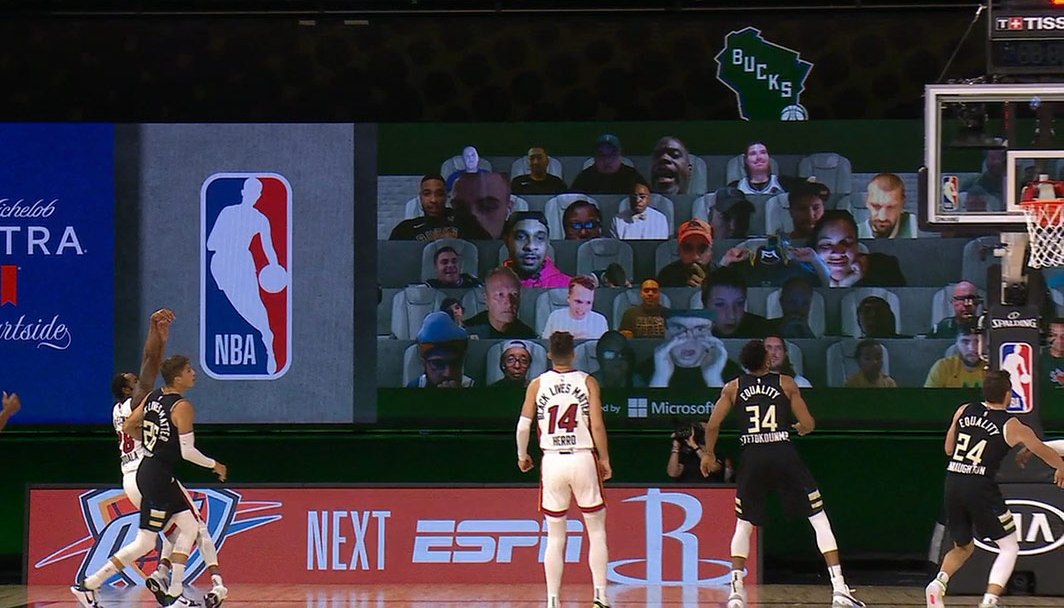
For Quinn Cook, the NBA bubble was not just a championship environment or a pandemic-era necessity. It was, in his telling, something far more personal and almost surreal: a sealed basketball world where proximity replaced distance and everyday life suddenly included some of the biggest names in the sport.
Reflecting on that 2020 experience, Cook said,
“I was so close with the guys, that was the best part. Just having fun with my teammates. You go downstairs & see players I grew up idolizing, CP3 walking, it felt like a big basketball camp.” He added, “You walk outside and Bron zoom past on a bike. It was like NBA University.”
“You walk outside and Bron zoom past on a bike. It was like NBA University.” – Lou Williams
Surrounded by players he idolized like Chris Paul, Quinn Cook enjoyed his time in the NBA Bubble 💯@QCook323 | @MichelleDBeadle | @ChandlerParsons | @TeamLou23 pic.twitter.com/Lz7yBuECBt
— Run It Back (@RunItBackFDTV) April 7, 2026
Officially, the 2020 NBA bubble at Walt Disney World was the league’s controlled environment for restarting the season after the COVID-19 shutdown, with 22 teams isolated in one campus setting and the Los Angeles Lakers eventually winning the title. But Cook’s recollection gets at the texture of the place: the strange intimacy of sharing space with stars, the reduced distance between young role players and all-time greats, and the sense that basketball had temporarily become its own closed-off campus.
That is why “NBA University” is such an effective phrase. It makes the bubble sound less like a quarantine and more like an immersion program, a place where players were around one another constantly, absorbing habits, routines, and personalities up close. Cook was on the Lakers team that won the 2020 championship, so his perspective carries the authority of someone who lived the experience all the way to the end. When he describes seeing Chris Paul in passing or LeBron James flying by on a bike, he is describing an environment where the league’s hierarchy suddenly felt unusually accessible.
There is also something revealing in the tone of Cook’s memories. The bubble is often remembered through arguments about legitimacy, isolation, mental strain, and the competitive pressure of finishing a season under extraordinary conditions. Cook’s version does not deny any of that, but it emphasizes something else: camaraderie, curiosity, and the almost childlike joy of being surrounded by basketball all day. “it felt like a big basketball camp” is not a line that minimizes the stakes. It is a reminder that even inside one of the most unusual chapters in league history, players could still find wonder in the game and in each other.
