
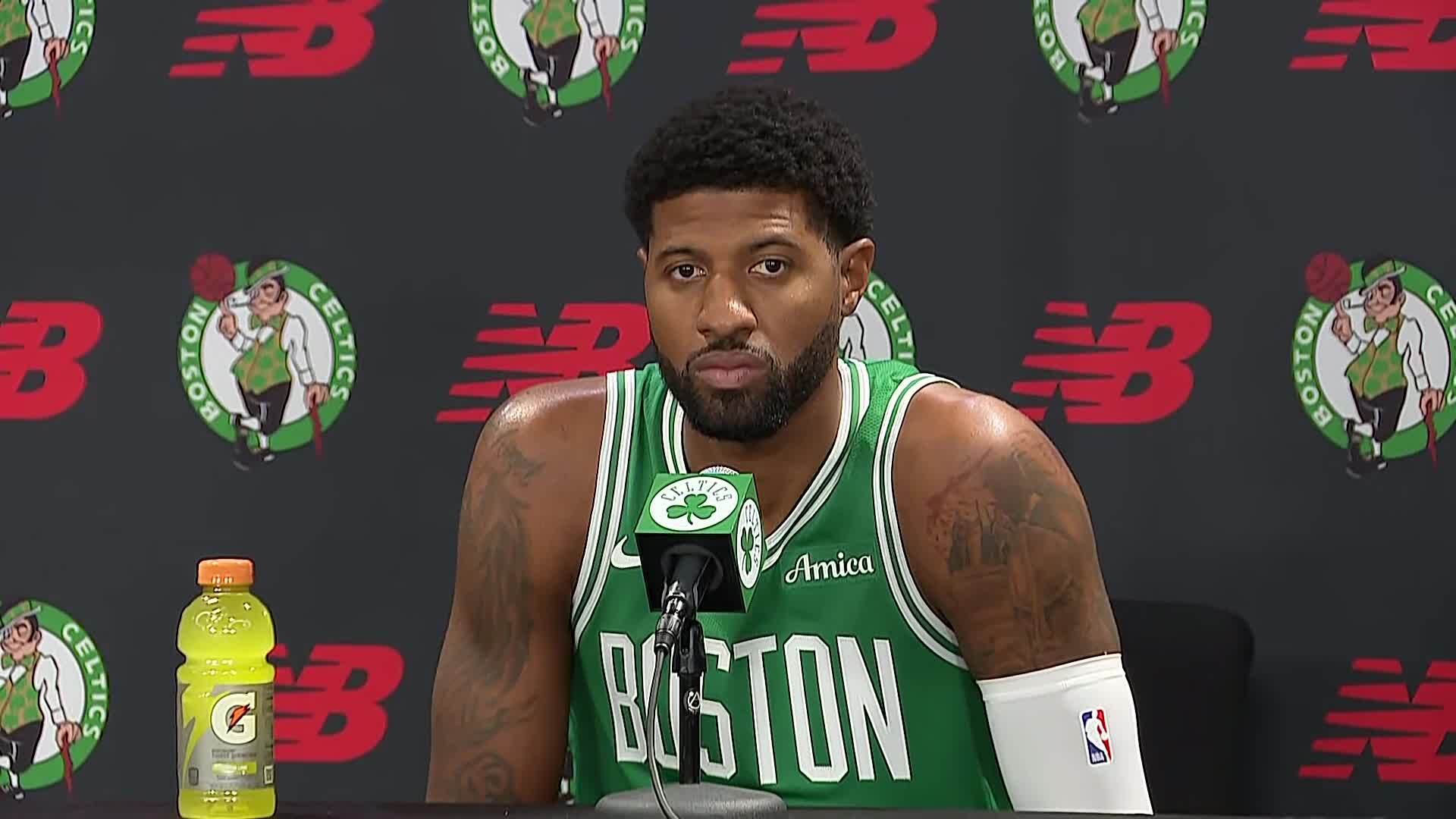
For two years, Paul George listened as critics questioned whether he was finished as an elite NBA player. Too old. Too injury-prone. Too far removed from the superstar who once competed for MVP awards.
Now, at 36 years old, the nine-time All-Star is delivering his answer in a Boston Celtics uniform.
And on Tuesday night, he made sure his former team heard it.
George erupted for 36 points on 14-of-22 shooting, including six three-pointers, leading Boston to a convincing 123-101 victory over the Philadelphia 76ers in his first game back in Philadelphia since the blockbuster trade that sent him to the Celtics.
Afterward, George addressed the criticism that followed him throughout his disappointing two-year stint with the Sixers.
“People thinking that I lost my game. I just wasn’t healthy, and I was trying to play through stuff,” George explained.
It was a simple statement, but one that perfectly captured the frustration of a player who believes his decline had been greatly exaggerated.
George arrived in Philadelphia in 2024 on a four-year, $212 million contract, expected to form a championship-caliber trio alongside Joel Embiid and Tyrese Maxey. Instead, injuries, inconsistent availability and difficulty establishing a rhythm defined his tenure. He appeared in just 78 regular-season games across two seasons, averaging 16.2 points in 2024-25 and 17.3 the following year.
For someone who had spent most of his career among the NBA’s premier two-way wings, the decline was difficult to ignore. But George insists the problem was never a lack of ability. It was his inability to remain healthy enough to perform at his accustomed level.
Boston has given him an opportunity to prove himself once again. Through his first ten appearances with the Celtics, George is averaging 22.0 points, 5.2 rebounds and 3.8 assists, shooting 44 percent from three-point range.
His resurgence began immediately. In his Celtics debut against Detroit, George exploded for 38 points, five rebounds, five steals and seven three-pointers, establishing a franchise record for points scored in a Boston debut.
He followed that performance with a series of impressive all-around outings, including 25 points and four steals against Milwaukee on November 4 and another 27-point performance against the Bucks four days later.
Then came Tuesday’s emotional return to Philadelphia. The game had been advertised primarily as the first confrontation between former Celtics teammates Jayson Tatum and Jaylen Brown, whose partnership ended with the summer trade involving George.
Instead, the veteran forward stole the spotlight. George scored 14 points during a devastating fourth-quarter stretch, helping Boston turn a competitive game into a rout. Brown, meanwhile, finished with 13 points for Philadelphia, while Tatum contributed 21.
For George, however, the difference goes beyond improved health. He also believes Boston’s offensive system allows him to play more naturally.
His usage rate has increased from approximately 23.4 percent during his Philadelphia tenure to 28.5 percent in Boston, giving him greater responsibility as a scorer and creator.
Under Joe Mazzulla, George has been encouraged to attack mismatches, make decisions with the ball and take advantage of the offensive freedom that helped define his best seasons.
The result is a player who looks considerably closer to the perennial All-Star he once was.
His shot creation is sharper, his perimeter shooting has returned to an elite level, and his defensive versatility remains valuable alongside Tatum and Derrick White.
Importantly, Boston isn’t asking him to carry the entire franchise. Instead, George can operate within a talented, established system while still receiving enough touches to establish his offensive rhythm. And the arrangement is working.
The Celtics have opened the season 9-2, sitting atop the Eastern Conference standings following Tuesday’s victory.
Of course, ten games cannot erase two seasons of health concerns. Maintaining his availability throughout an 82-game campaign and into the playoffs remains the greatest challenge.
But George has already demonstrated something important.
His disappointing years in Philadelphia weren’t necessarily evidence that his basketball abilities had disappeared.
Sometimes, injuries don’t just take away games. They take away rhythm, confidence and the physical freedom that separates good players from great ones.
Now, George is beginning to rediscover all three.
