
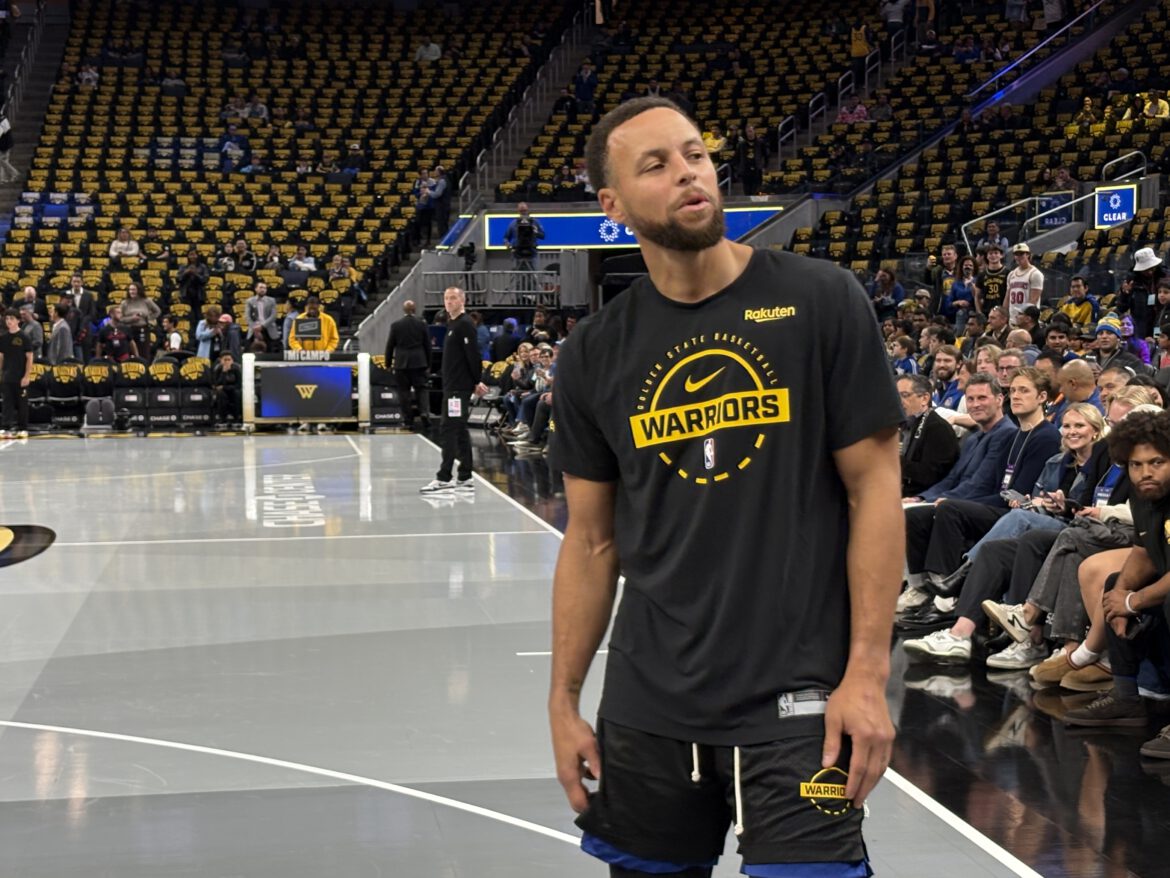
At 38 years old, Stephen Curry is still running defenders into exhaustion, sprinting around screens, changing directions at full speed and producing scoring performances that seem to defy the natural aging process.
But the secret behind his remarkable longevity isn’t simply how hard he trains. Increasingly, it’s how intelligently he manages the physical demands of training.
In a new behind-the-scenes video released on Curry’s official YouTube channel, his director of performance, Carl Bergstrom, offered a fascinating look at the Golden State Warriors superstar’s conditioning routine, including an unusual piece of equipment that has become particularly important: an underwater treadmill.
And the reasoning is considerably more sophisticated than simply giving Curry’s legs a break.
“Steph just finished his court work,” Bergstrom explained before introducing the aquatic portion of the workout.
By running underwater, Curry can continue improving his cardiovascular fitness while substantially reducing the impact on his joints.
Water buoyancy supports part of his body weight, allowing him to perform additional conditioning without subjecting his knees and ankles to the same pounding they experience on a basketball court.
For a player entering his 18th NBA season, this has become increasingly important. However, the underwater sessions aren’t leisurely recovery exercises.
Bergstrom explained that Curry performs demanding intervals with a one-to-one work-to-recovery ratio. Rather than stopping completely between efforts, he remains active, forcing his body to recover while continuing to move.
The trainer estimated that Curry’s heart rate could climb into the 150-to-165-beats-per-minute range during the later repetitions. But the number that matters most isn’t necessarily how high his heart rate climbs. It’s how quickly it drops afterward.
Bergstrom emphasized the importance of heart-rate recovery over approximately 60 to 90 seconds, a window that closely resembles the brief interruptions during an NBA game. Timeouts, free throws and other stoppages provide opportunities for players to recover before the next demanding sequence.
Curry’s ability to take advantage of those moments is exceptional.
“His ability to respond, get back to what’s a zone two or below compared to most humans or athletes, he’s astronomical,” Bergstrom explained.
The concept is very relevant to Curry’s playing style. Unlike traditional superstars who conserve energy while controlling the basketball, Curry creates much of his offensive value through constant off-ball movement. He sprints through screens, cuts repeatedly, changes direction and immediately accelerates again whenever a defender loses concentration. That relentless movement requires more than ordinary endurance. It requires the ability to recover quickly between repeated bursts of intense activity.
Bergstrom considers that one of Curry’s greatest physical advantages, and something his training staff continues working to preserve.
After a troublesome right knee condition limited him to just 43 appearances during the 2025-26 season, the four-time NBA champion entered this offseason determined to rethink his approach. Curry described his new philosophy as “less is more.”
That doesn’t mean reducing the commitment. It means reducing unnecessary wear. His training staff, including longtime skills coach Brandon Payne and the Warriors’ medical team, has placed greater emphasis on workout quality, recovery periods and carefully managing the amount of impact his body absorbs.
Payne explained that Curry’s sessions now prioritize high-quality repetitions rather than simply maximizing volume. His basketball-specific training remains demanding, however.
For years, Payne has incorporated unconventional exercises designed to challenge Curry’s coordination and decision-making under physical stress. These have included simultaneous ballhandling drills, tennis-ball reaction exercises, visual-disruption goggles and cognitive challenges that force Curry to process information while performing basketball movements.
Recent training has continued emphasizing rapid reactions and unpredictable situations rather than allowing Curry to settle into familiar routines.
The objective is to improve not only how his body moves, but how quickly his mind processes the game when fatigue begins to accumulate. What has changed is the distribution of physical stress surrounding those exercises. Instead of adding more hours of pounding on hardwood, Curry can maintain his aerobic conditioning underwater, preserve strength through carefully managed workouts and arrive at games with less accumulated fatigue.
And the results are difficult to argue with.
Curry has opened the 2026-27 campaign playing some of the best basketball of his career, averaging more than 30 points per game while leading Golden State on an eight-game winning streak after an 0-3 start.
Against Orlando, he exploded for 41 points, becoming the NBA’s all-time leader in 40-point games after turning 35. Three nights later, he helped the Warriors dismantle New Orleans by 51 points, scoring 25 points in just 21 minutes.
Of course, no training program can completely eliminate the effects of aging or guarantee that injuries won’t occur. But Curry’s approach offers an intriguing explanation for why his decline has been so difficult to detect. The greatest shooter in basketball history has spent his career finding new ways to become more efficient on the court. Now, he’s applying the same philosophy to the way he prepares his body.
At 38, Stephen Curry isn’t necessarily training harder than everyone else. He’s learning how to get more out of his body while asking it to absorb less punishment. And that might be the most important adjustment of his extraordinary career.
