
Players complain about officiating every season. Coaches explode about it. Fans build entire conspiracy theories around it. But every once in a while, somebody inside the league says the quiet part out loud in a way that cuts deeper than the usual postgame frustration.
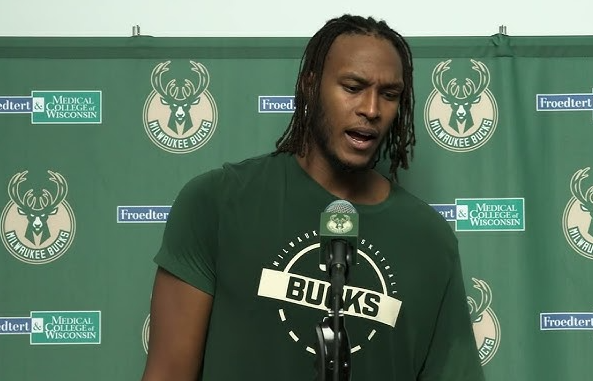
This time, it was Myles Turner.
During a candid conversation discussing NBA referees and player-ref dynamics, Turner compared officials to police officers, saying that once one referee feels attacked, the entire group tends to close ranks. According to Turner, that solidarity can directly affect how games are called. He went even further, suggesting that veteran officials will protect younger or female referees aggressively if they believe a player is crossing the line, potentially leading to fewer calls for that player throughout the game.
It was one of the bluntest public descriptions of NBA officiating culture a current player has offered in years.
And the reason the comments hit so hard is because they sounded less like a rant and more like insider testimony.
“The refs are like the police. If you fuck with one of them, you fuck with all of them. They band together, and it’s like, ‘Nah, he’s not getting no calls.’ If you go after a rookie ref or a female ref the veteran refs will step in and fuck you out of the game.”
Myles Turner on the NBA refs: “The refs are like the police. If you fuck with one of them, you fuck with all of them. They band together, and it’s like, ‘Nah, he’s not getting no calls.’ If you go after a rookie ref or a female ref the veteran refs will step in and fuck you… pic.twitter.com/88ZVS0tXOs
— MrBuckBuck (@MrBuckBuckNBA) May 17, 2026
The NBA has spent decades trying to convince the basketball world that officiating is objective, clinical and untouched by emotion. But players have long believed the game is far more human than that. Reputation matters. Tone matters. Body language matters. Relationships matter. Turner’s comments essentially confirmed what many players quietly believe: officials are not isolated individuals operating independently every night. They are a fraternity.
That idea became especially relevant this season after the NBPA released its massive referee player survey, ranking officials into three tiers based on player feedback from all 30 teams. The survey grouped referees into “Elite & Top Performers,” “Solid Performers,” and “Needs Improvement,” while recommending that only Tier 1 and Tier 2 referees work playoff games and that the NBA Finals should exclusively feature Tier 1 officials.
Tier 1 included respected veterans such as Zach Zarba, Tony Brothers, Bill Kennedy, Marc Davis, Josh Tiven and James Capers. Tier 2 featured polarizing names like Scott Foster alongside Ashley Moyer-Gleich and Sha’Rae Mitchell, both of whom reportedly received strong marks for improvement from players. Tier 3 included younger and lower-rated officials still trying to establish themselves league-wide.
Turner’s comments unintentionally added another layer to that entire discussion. Because if players believe officiating crews operate collectively rather than individually, then referee evaluation becomes even more complicated. A “bad whistle” is no longer just one official missing a call. It becomes about ecosystem, hierarchy, protection and internal loyalty.
That does not mean Turner accused referees of fixing games. He did not. But he absolutely suggested that emotional dynamics influence outcomes inside NBA games more than the league publicly acknowledges.
And honestly, anyone who has watched the NBA long enough probably understands exactly what he means.
Players talk constantly about “earning” calls. Superstars clearly receive different whistles than rookies. Coaches know which officials allow physicality and which ones call games tighter. Entire playoff series develop reputations around officiating crews. The league may insist every game is governed neutrally, but basketball has always had personality baked into it.
Turner simply verbalized the uncomfortable reality.
The irony is that the NBA’s officiating situation may actually be improving. Veteran referees like Zarba and Kennedy are widely respected around the league for communication and consistency, while younger officials continue to gain experience in higher-pressure environments. Grant Williams, speaking during the NBPA’s “State of the Game” discussions, said players mostly want consistency and communication, not perfection.
But Turner’s quote reveals how fragile that balance still is. Because once players start believing referees are personally responding to criticism, every whistle becomes political. Every technical foul becomes suspicious. Every missed call becomes evidence.
And in today’s NBA, where every replay is clipped, slowed down, dissected and blasted across social media within seconds, trust between players and officials may be thinner than ever.
Myles Turner did not just criticize referees.
He described the invisible rules players think govern the people enforcing the visible ones.
