
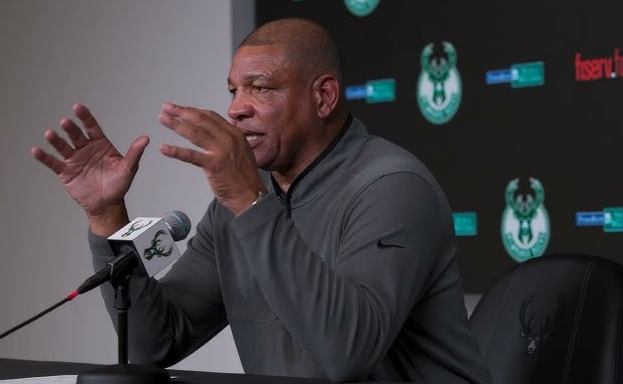
Doc Rivers did not frame flopping as one player’s crime. He framed it as the league’s shared language.
After Game 1 of the NBA Finals, with the Knicks beating the Spurs 105-95 and Victor Wembanyama’s foul-drawing, reactions and physical play under the microscope, Rivers pushed back against the idea that one star should carry the entire conversation. His point was blunt:
“Everyone flops around now.”
Doc Rivers says NBA players practice flopping:
“Everyone flops around now…. It’s not taught, players work on it. But it’s not taught really. The players just work on it. I thought Brunson flopped and Karl Anthony Towns flopped every bit as much as Wemby did” https://t.co/MyloHU4M8p pic.twitter.com/jbWBVNfuoA
— NBA Courtside (@NBA__Courtside) June 4, 2026
And in his view, it is not exactly taught by coaches in the traditional sense, but players absolutely work on it.
Rivers was not saying head coaches are stopping practice to install flopping drills. He was describing something more organic and more revealing. Players study how to sell contact. They learn how to fall, how to snap the head back, how to exaggerate a bump, how to make a referee see what they want seen. It becomes part of the player-development ecosystem, passed around through film, workouts, peer habits and survival instincts.
Rivers also rejected the idea that Wembanyama was uniquely guilty. He said Jalen Brunson and Karl-Anthony Towns flopped “every bit as much” as Wembanyama did. That is the uncomfortable truth of the modern NBA: almost every elite player knows how to perform contact when the moment calls for it.
Game 1 had already produced several overlapping debates. Brunson returned from injury scares and closed the game with another cold fourth quarter. Towns delivered 18 points, 12 rebounds and one of the most important defensive performances of his career against Wembanyama. Wembanyama finished with 26 points and 12 rebounds but shot just 6-for-21 as the Knicks turned a 14-point second-half deficit into a road win. (reuters.com)
Within that tension, every fall looked like evidence depending on which team you supported. Knicks fans saw Wembanyama selling calls. Spurs fans saw Brunson and Towns doing the same. Rivers’ point was essentially that both sides were right — and that is the league’s problem.
Flopping has become a basketball skill because free throws are valuable, officials are human and margins in the Finals are microscopic. Players are not just trying to score. They are trying to win possessions. Sometimes that means absorbing contact. Sometimes it means advertising it.
The NBA has tried to discourage obvious flopping with fines and in-game technicals, but enforcement will always be complicated because basketball is a violent, fast, awkward sport. Real contact and exaggerated contact often live in the same body movement. A player can be fouled and still sell it. A defender can be displaced and still embellish. The gray area is where modern stars operate.
That is what Rivers was really describing. Not scandal. Not corruption. Craft.
And if everyone is working on it, the league’s challenge is not identifying one villain. It is deciding how much acting it is willing to accept before the game starts looking less like competition and more like courtroom testimony.
