
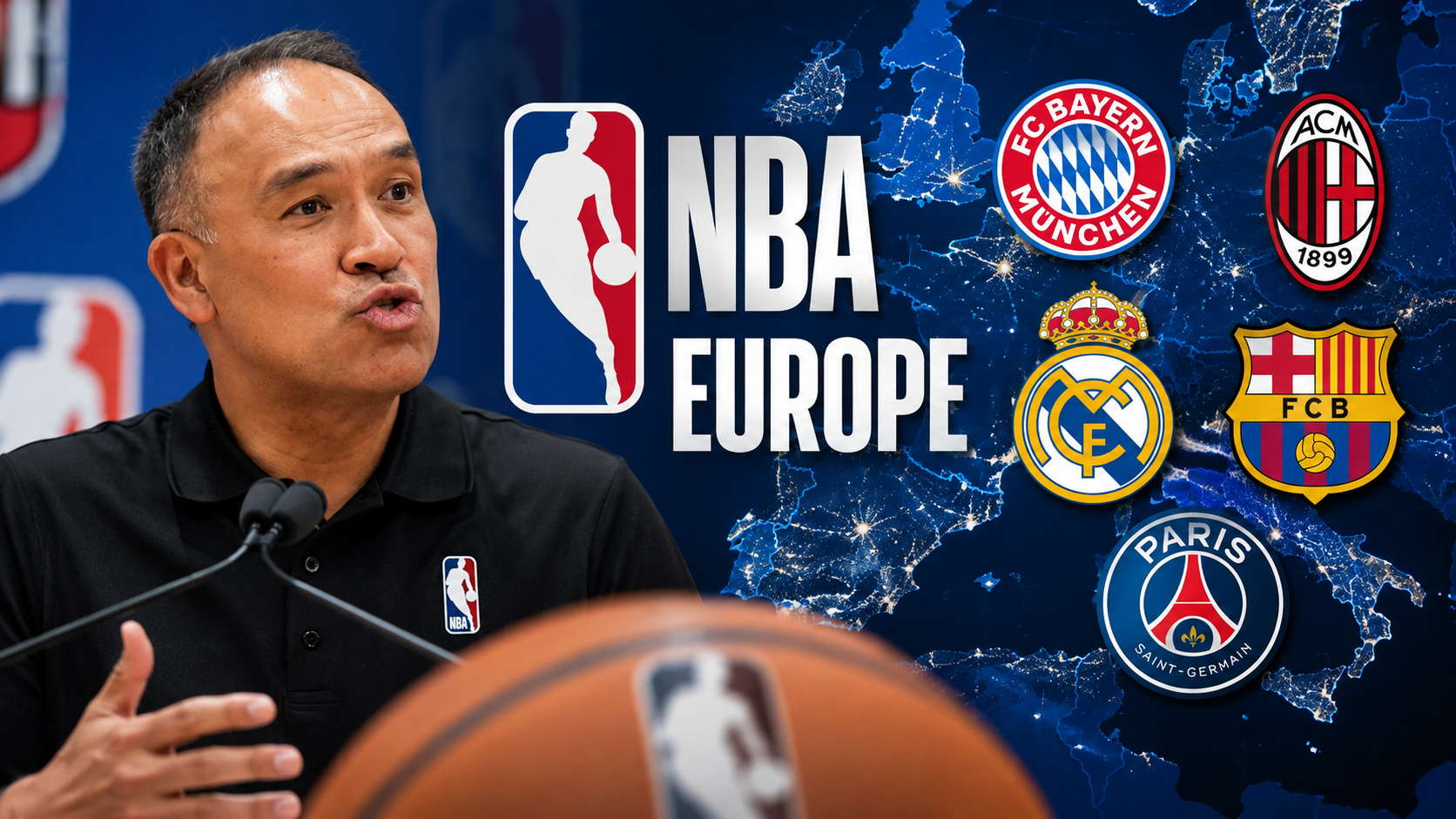
The NBA is pushing ahead with its ambitious plans to reshape European basketball, and not even the EuroLeague’s newly announced 10-year business strategy appears capable of slowing it down.
Speaking during an international media availability ahead of the 2026-27 NBA season, Deputy Commissioner Mark Tatum reaffirmed the league’s commitment to launching NBA Europe in October 2027, while making some remarkable financial promises and addressing the increasingly complicated relationship with the EuroLeague.
Days earlier, EuroLeague Basketball had unveiled a comprehensive 10-year business plan, approved by its 13 shareholder clubs, outlining a major expansion strategy and ambitious financial targets.
Under the proposal, the EuroLeague expects to distribute €3.4 billion to participating clubs over the next decade, consisting of €2.2 billion in commercial revenues and €1.2 billion in franchise fees. The league also projects annual commercial revenues of €648 million by the tenth year, with the combined valuation of the competition and its clubs potentially exceeding €13 billion.
However, Tatum made it clear that the NBA has considerably greater ambitions.
“The 10-year business plan by the EuroLeague doesn’t affect our plans,” Tatum said.
“Our model will provide clubs with a much quicker pathway to profitability. I saw some of the reports in terms of the teams that are not financially stable in the EuroLeague today. The average permanent team in our league is projected to be profitable by year three.”
The NBA executive went even further when discussing potential financial distributions, claiming that NBA Europe could significantly outperform the EuroLeague’s projections.
“I saw the amount of investment that the EuroLeague is going to put into or distribute back to its clubs. I will tell you that our projections show that we’re going to triple those projections – billions and billions of dollars in distributions over 10 years that will go back to these clubs and make them financially stable.”
Those are extraordinary numbers, particularly considering the financial difficulties that have historically affected European basketball clubs. While the figures remain NBA projections rather than guaranteed revenues, Tatum’s comments underline the scale of the organization’s ambitions and its confidence in the commercial potential of the European market.
Importantly, the NBA’s vision extends beyond simply establishing another basketball competition.
Tatum described the project as potentially the largest investment in European basketball history, with significant resources earmarked for youth academies, grassroots development, league operations, marketing and arena infrastructure.
The NBA intends to leverage its global reach, commercial expertise and experience in developing major sporting properties to create a more sustainable financial environment for European clubs.
“We’ll leverage the NBA’s global platform, our reach, and our expertise in premium IP to really unlock the full potential of European basketball and put the game on a stronger financial footing, which is going to be better for the clubs, which is going to be better for the players, which is going to be better for the fans,” Tatum explained.
Beyond the financial projections, one of the fundamental differences between NBA Europe and the existing EuroLeague concerns the proposed competitive structure.
Working alongside FIBA, the NBA envisions a system combining permanent franchises with qualification opportunities based on sporting merit, allowing clubs from domestic competitions to potentially earn their way into the highest European tier.
Tatum repeatedly emphasized the importance of this approach, arguing that European basketball currently lacks a sufficiently clear pathway for clubs and their supporters.
He acknowledged the extraordinary passion surrounding the sport across Europe, particularly the atmosphere inside its arenas, but suggested that the existing competition structure can be confusing for fans.
“What we believe is that our model is going to actually widen the opportunity for fans to actually understand the merit-based pathway of how their teams can play in the top-tier league,” Tatum explained.
The objective, according to the Deputy Commissioner, is to preserve the distinctive traditions of European basketball while creating a more transparent and accessible competitive system.
The EuroLeague, meanwhile, is pursuing its own structural changes, including a transition toward permanent franchises and expansion opportunities scheduled for 2027 and 2031.
Its new business plan identifies 15 binding investment offers worth a combined €1.2 billion, demonstrating considerable investor interest in the existing competition.
However, Tatum questioned whether expanding a league whose clubs are already facing financial challenges represents the right approach.
“When you add new teams to that and teams already are not financially sustainable, is that a model that you want to follow?” he asked.
His criticism highlights an increasingly visible philosophical divide between the two organizations. Both are promising greater financial stability and commercial growth, but their proposed methods and competitive structures differ considerably.
Despite the unresolved negotiations and the substantial work still required, Tatum remains confident that the NBA can begin rolling out its European project next October.
“We continue to target October 2027, which is, as you said, in 12 months. We target that to begin rolling out this project. And we believe that the timing is realistic here.”
The Deputy Commissioner acknowledged that establishing NBA Europe involves considerably more than organizing an inaugural season. The project is intended to transform the wider European basketball landscape, requiring agreements with participating clubs, commercial partners and other stakeholders.
Nevertheless, he indicated that concrete announcements are approaching.
“We definitely expect to begin announcing teams soon as agreements get finalized,” Tatum revealed.
While no specific franchises or announcement dates were confirmed during the call, his remarks suggest that negotiations with prospective participants have reached an advanced stage.
Perhaps the most important remaining question concerns the relationship between the NBA and EuroLeague Basketball.
Earlier in October, EuroLeague shareholders declined a proposed collaboration with the NBA. Reports subsequently suggested that disagreements over expansion plans and the financial terms of the proposed partnership played a significant role.
Asked directly about those reported sticking points, Tatum declined to reveal details of the private negotiations.
“I don’t want to disclose any private conversations with the EuroLeague. As we’ve said before, we continue to be hopeful that we’ll reach an agreement, but we’re prepared to proceed regardless.”
His response leaves the door open for a future partnership but also makes clear that the NBA does not consider EuroLeague participation essential to its plans.
That position became even more apparent when Tatum was asked whether the NBA had established a deadline for reaching an agreement.
“We’re not stopping. We’re moving and proceeding as quickly as we can as we just talked about. Our plan is to begin rolling out this project in October of 2027, which is a year from now. So, we’ve got a lot of work to do, but we’re moving quickly. And we’re not slowing down at all.”
A partnership between the NBA, FIBA and EuroLeague could potentially bring together significant commercial resources, established clubs and existing basketball structures under a more unified framework. Without an agreement, however, the continent could face two competing elite competitions, creating additional challenges involving scheduling, sponsorships, media rights and the distribution of talent.
EuroLeague leadership has previously expressed concerns about the consequences of further fragmenting European basketball, while the NBA believes its proposed system offers a clearer sporting structure and a stronger financial future.
For now, neither organization appears willing to abandon its respective ambitions.
What is becoming increasingly clear, however, is that the NBA considers October 2027 an achievable starting point rather than a distant possibility.
With promises of billions in club distributions, profitability for the average permanent franchise by its third year and unprecedented investments in basketball infrastructure, Tatum has laid out an ambitious vision for the future of the European game.
Whether those projections can ultimately be delivered remains to be seen. Equally uncertain is whether the NBA and EuroLeague will find enough common ground to avoid competing directly against one another.
But one thing is no longer in doubt: The NBA intends to move forward, with or without the EuroLeague.
And with only a year remaining until its targeted launch, European basketball is approaching what could become one of the most consequential transformations in its history.
