
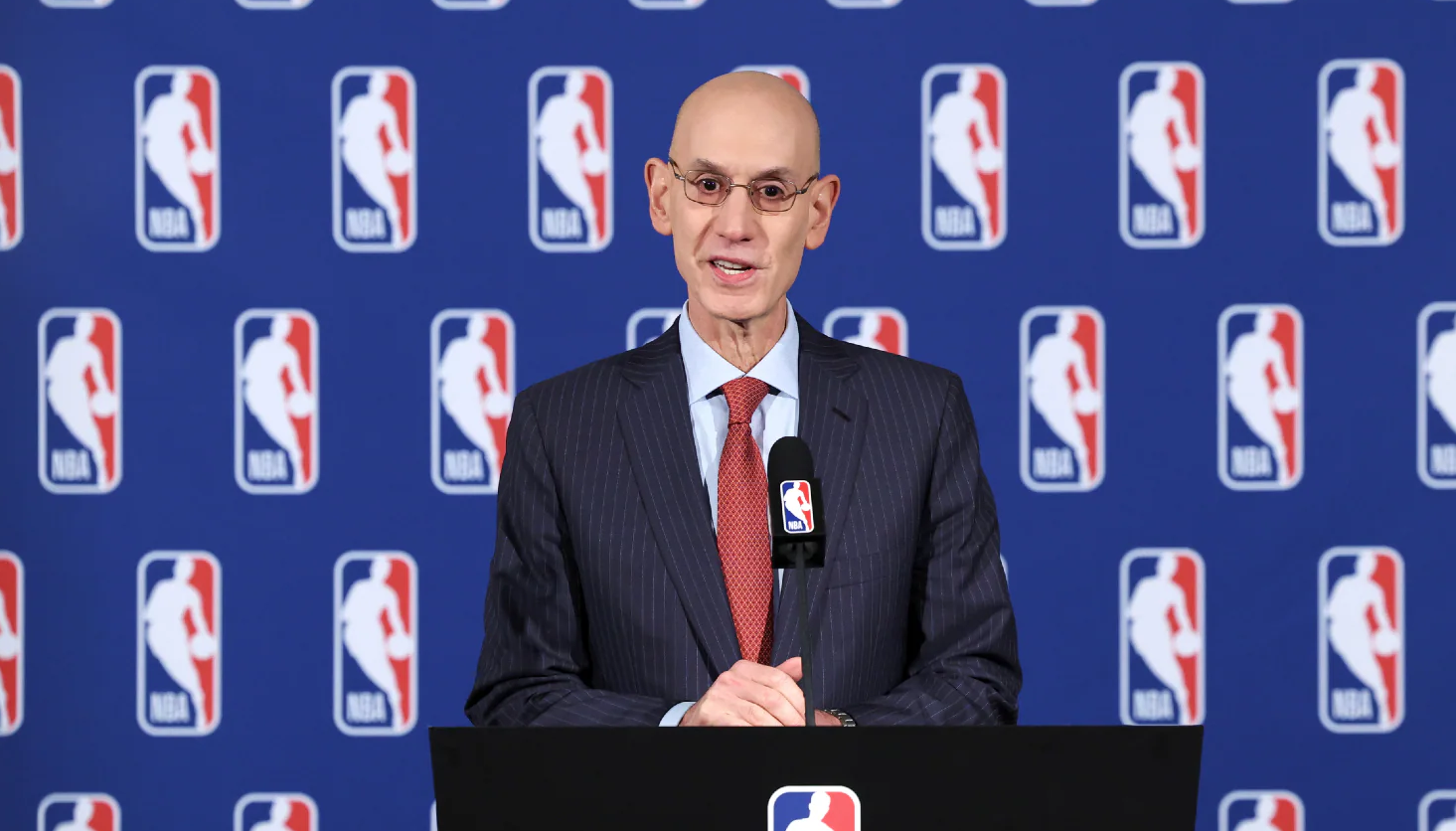
Adam Silver spent years arguing that legalized sports betting would bring gambling into the light. Now, with the NBA facing repeated integrity scares, the commissioner is admitting that the league cannot police the new landscape by itself.
Silver says the NBA has “remarkably little control” over which wagers sportsbooks offer on its games and wants a centralized federal regulator with investigative authority, including subpoena power. Instead of navigating a patchwork of rules across dozens of jurisdictions, he believes one national system could better coordinate leagues, operators and law enforcement.
“I think it puts the league in a difficult position when we’re dealing essentially now with 40 different jurisdictions and their different approaches to sports betting,” Silver said. “The idea of having a czar or commissioner … would be very helpful.”
The commissioner’s greatest concern is not necessarily a bet on which team wins. It is the increasingly detailed market built around individual players, particularly wagers on whether they will finish below a statistical line.
“I’ve said before, the unders are the most problematic right now in our league,” Silver said.
Adam Silver Admits NBA Has “Remarkably Little Control” Over Gambling. Wants Federal Czar With Subpoena Power To Oversee The League:
“I’ve said before, the unders are the most problematic right thing in our league… We need to make players understand how draconian the… pic.twitter.com/Kk7xQwFY42— MrBuckBuck (@MrBuckBuckNBA) July 15, 2026
The reason is obvious. A player cannot easily guarantee that his team will lose without involving several teammates and creating visible evidence. Influencing an individual under can be far simpler. Reduced minutes, an early exit or a few passed-up shots may be enough to affect a wager without changing the final result.
That possibility strikes directly at the league’s most valuable asset: public confidence that every player is competing honestly.
The NBA has already shown how seriously it treats proven violations. In 2024, Jontay Porter received a lifetime ban after the league concluded that he disclosed confidential information to bettors, limited his participation in games for betting purposes and wagered on NBA contests. The punishment established that gambling-related manipulation can end a career immediately.
Silver now wants that warning understood throughout the league.
“We need to make players understand how draconian the discipline will be,” he said.
The word “draconian” is intentional. The commissioner is signaling that ordinary fines and short suspensions are not sufficient when the integrity of the competition is threatened. A player who deliberately manipulates his performance for gambling purposes is not merely breaking a workplace rule. He is attacking the credibility of every game, teammate and result around him.
The challenge is that the NBA does not possess the tools of the federal government. The league can interview employees, examine certain records and issue basketball discipline, but it cannot compel every outside witness to cooperate or threaten prison for lying. Silver has previously noted that federal investigators have subpoena power and other enforcement abilities that the NBA office simply does not have.
That is why his call for federal oversight is significant. Silver is effectively conceding that legal sports betting has expanded into something too large and fragmented for leagues to supervise through private monitoring alone.
There is some irony here. Silver was one of the earliest major American sports commissioners to support legalized betting, arguing that a regulated market would be safer and easier to track than an underground one. He still maintains that legal transparency is preferable to illegal gambling, but he now says the regulatory structure left behind after states began setting their own rules has forced the NBA to operate with “one hand tied behind our back.”
That does not mean Silver is trying to remove gambling from basketball. Betting partnerships and sportsbook advertising have become deeply embedded in modern sports. He is asking for stronger limits, clearer authority and greater control over the kinds of bets that can be placed on NBA players.
The commissioner helped invite gambling into the arena. Now he wants a federal official standing at the door.
Because once fans begin wondering whether a missed shot, short appearance or mysterious early exit was influenced by a wager, the NBA has a problem no television contract can solve. It loses trust.
