
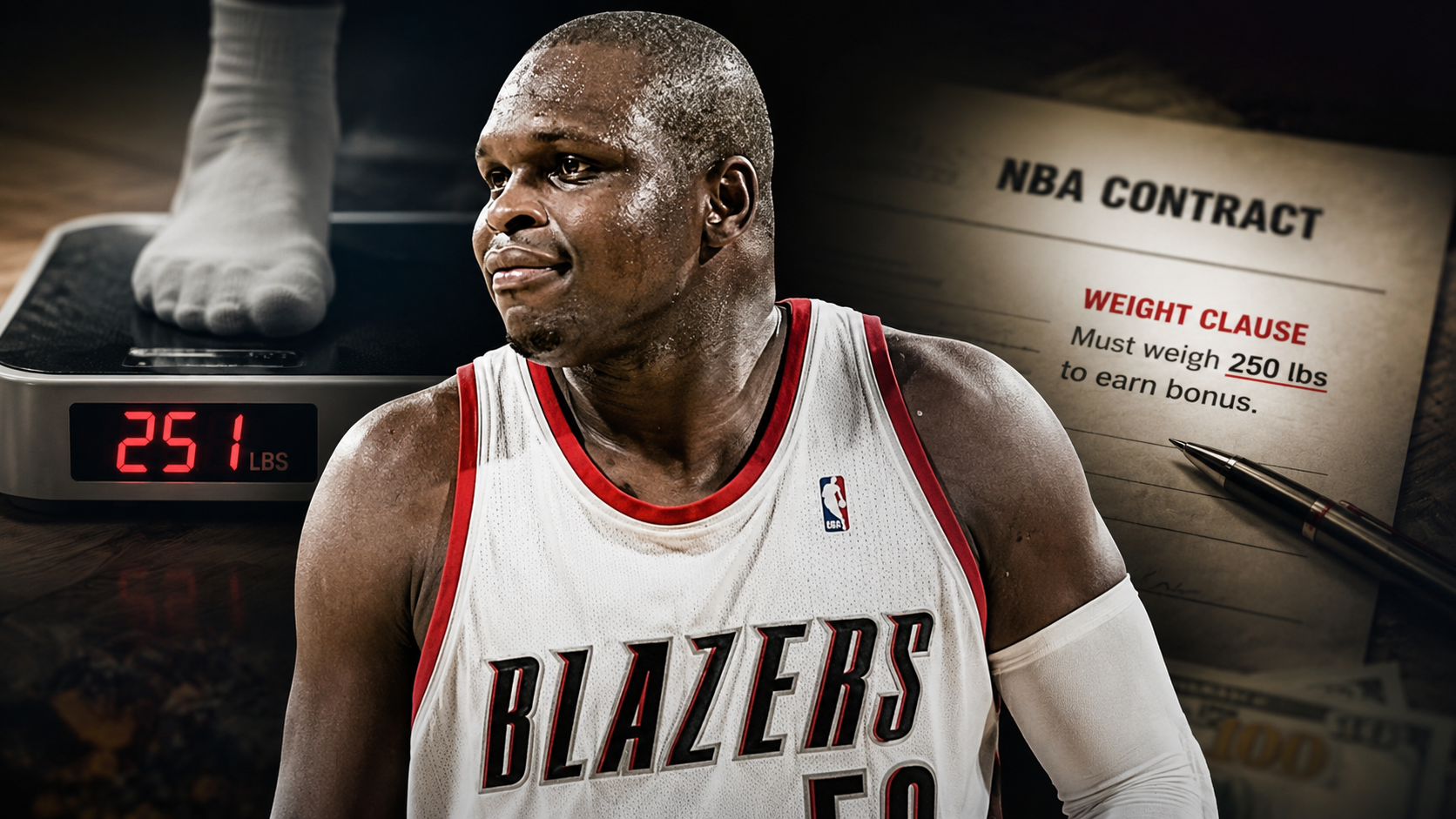
Zach Randolph built an NBA career by throwing his weight around. Early in that career, however, one extra pound reportedly cost him half a million dollars.
During an appearance on Tony Allen’s Out the Mud podcast, Randolph revealed the story behind his decision to fire his first agent. The problem was not a failed endorsement or a bad investment. It was a weight clause hidden inside his rookie contract.
“I never told this story why I switched my agent,” Randolph said. “I had a weight clause.”
Randolph entered the NBA as the 19th overall pick in the 2001 draft, selected by the Portland Trail Blazers after one season at Michigan State. Because first-round rookie salaries were already determined largely by draft position, there was limited room to negotiate. Teams could, however, include incentives that allowed players to earn additional money above the standard rookie-scale amount. Randolph said his contract included one worth roughly $500,000.
“I’m the 19th pick, so the money’s sliding already,” Randolph explained. “But you can get an extra percentage. Mine was half a million.”
The catch was painfully simple: Randolph had to report at 250 pounds to receive the bonus.
He weighed 251.
“I had to be 250 pounds to get the money,” Randolph said. “I didn’t know this, and I came in at 251.”
Zach Randolph says he lost $500,000 over a single pound because his agent never told him about a weight clause.😳
“I never told this story why I switched my agent. I had a weight clause…”
“I’m the 19th picking so the money’s sliding already. But you can get an extra… pic.twitter.com/LJ3JQnGpzx
— Tsoj (@TsojBall) July 12, 2026
That is one of the most expensive pounds in NBA history.
The story is funny now because Randolph ultimately earned far more than $500,000 during a long and successful career. He became a two-time All-Star, earned an All-NBA selection, helped define Memphis’ “Grit and Grind” era and eventually had his No. 50 retired by the Grizzlies. But for a rookie beginning his career on a scale-based contract, losing that kind of money was no small mistake.
Randolph’s anger was directed primarily at his representation. He said he had not been told about the exact requirement, leaving him unaware that a single trip to the scale could determine whether he earned an additional half-million dollars. Randolph believed that communicating a clause that significant was one of the most basic responsibilities of an agent.
He therefore changed agents.
There is, of course, a responsibility on both sides. Players sign contracts and are expected to understand their terms. But rookies also hire agents specifically to explain the fine print, negotiate protections and make sure no important deadline or incentive is missed. Randolph’s position was that he could have done something about his weight had he known exactly what was at stake.
One pound is not an enormous physical difference. Financially, it was enormous.
The experience also fits Randolph’s broader career story. His path was rarely smooth, particularly during his early years in Portland, but he eventually became one of the league’s most dependable and productive power forwards. He developed from a lightly used rookie into a 20-point, 10-rebound force and later signed major long-term contracts that made the lost bonus look tiny by comparison.
