
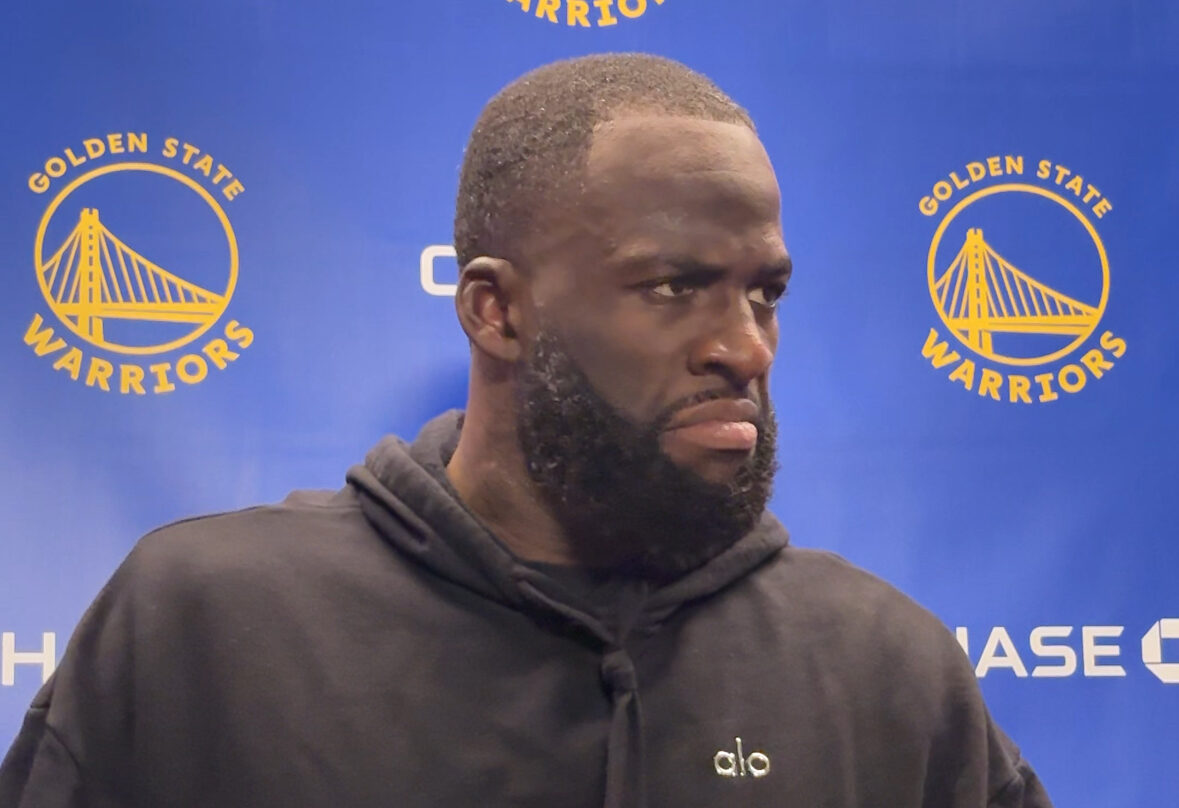
Draymond Green knows better than most how complicated Kevin Durant discourse can become. He has been Durant’s teammate, opponent, critic, defender and forever-linked co-star in one of the most dissected partnerships in modern NBA history. So when the conversation around Durant’s absence from Houston’s playoff series against the Lakers drifted toward the idea that he had quit on the Rockets, Green rejected it outright.
His defense was blunt.
“Kevin Durant loves to play basketball. If there’s anything Kevin loves, he loves to play basketball. To question a guy who’s injured that shows nothing but love for the game of basketball is bullsh*t. Regardless of what you think about the burner accounts, Rockets chemistry, for a guy who played 18 years and the love of the game KD has and people say he quit? I think it’s ridiculous. The respect around our game is at an all time low.”
Draymond Green says it’s ridiculous for people to say Kevin Durant quit on the Rockets:
“Kevin Durant loves to play basketball. If there’s anything Kevin loves, he loves to play basketball. To question a guy who’s injured that shows nothing but love for the game of basketball is… https://t.co/kOMtshBtUA pic.twitter.com/4d58C0sHiv
— NBA Courtside (@NBA__Courtside) April 28, 2026
The criticism around Durant has moved quickly from optics to character. Durant missed Game 4 with a bone bruise in a sprained ankle, an injury that would normally sideline a player for two to three weeks during the regular season, with Durant receiving around-the-clock treatment but not being cleared by doctors. He had also been absent from the Rockets’ bench during Game 3 while receiving treatment, which created a vacuum that speculation immediately filled.
Green’s point is not that Durant should be free from basketball criticism. The Rockets’ experiment has been messy, their 3-1 series deficit against Los Angeles remains a failure of expectation, and Durant’s availability is part of that story. But questioning a player’s production, fit or durability is different from questioning whether he wants to play. That is the line Green is trying to redraw.
There is also history inside the defense. Green and Durant have had one of the NBA’s most famous complicated relationships, but maybe that makes Green’s words carry more weight rather than less. He is not blindly protecting a former teammate from all scrutiny. He is protecting the idea that injury should not become a shortcut to character assassination.
In the age of instant judgment, an empty bench seat can become a referendum before the medical report even lands. Green’s frustration is with that reflex. Durant can be debated as a franchise bet, a late-career superstar, a chemistry question and a playoff absence. But calling him a quitter, Green argues, ignores the simplest and most durable truth about him: whatever else has followed Durant through his career, the man has always loved the game.
