
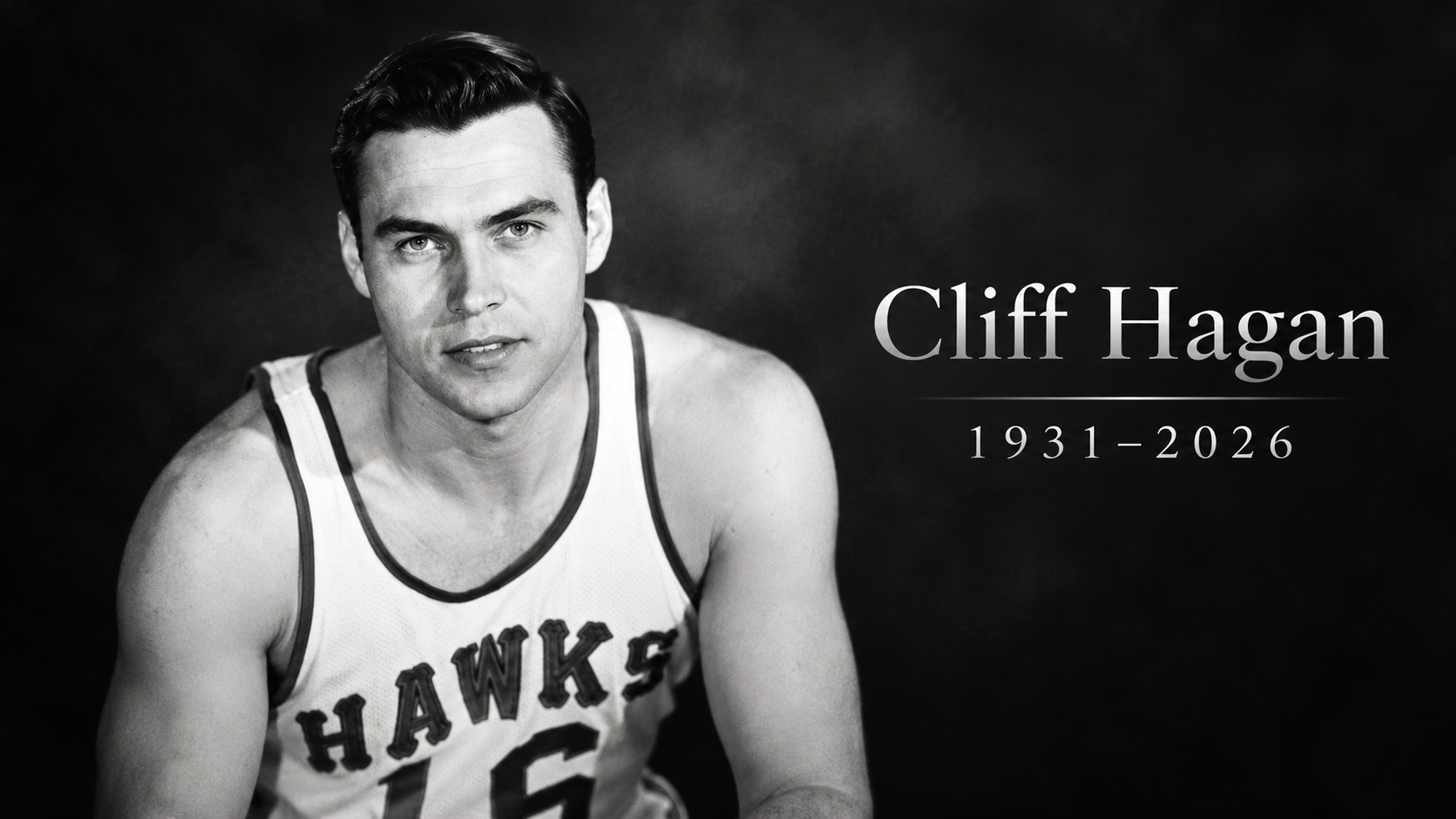
Cliff Hagan, one of the central figures in the history of the Hawks franchise and a member of the Naismith Memorial Basketball Hall of Fame, has died at the age of 94.
Hagan passed away Thursday, according to longtime Kentucky basketball figure Oscar Combs. No cause of death had been publicly announced in the initial reports.
A 6-foot-4 forward from Owensboro, Kentucky, Hagan built a career that connected several important eras of basketball. After starring at the University of Kentucky under Adolph Rupp, he helped the Wildcats win the 1951 NCAA championship and later played on Kentucky’s unbeaten 25-0 team in 1954. He was a two-time consensus First Team All-American before moving on to the professional game.
His NBA career is permanently tied to one of the most famous trades in league history. Boston had drafted Hagan, but the Celtics eventually sent him and Ed Macauley to the St. Louis Hawks in exchange for the draft rights to Bill Russell. Hagan went on to spend 10 NBA seasons with the Hawks, becoming one of the franchise’s defining stars.
Hagan was selected to five NBA All-Star Games and earned two All-NBA Second Team honors. Most importantly, he was a major part of the 1958 St. Louis Hawks championship team, the only NBA title in franchise history.
He was especially effective in the postseason. Hagan averaged 20.4 points and 8.3 rebounds per game in NBA playoff competition, a reflection of how important he was next to fellow Hawks great Bob Pettit during the franchise’s most successful period.
After leaving the NBA, Hagan continued his professional career in the ABA with the Dallas Chaparrals, where he also served as player-coach. Across his NBA and ABA career, he appeared in 839 regular-season games and averaged 17.7 points, 6.6 rebounds and 3.2 assists.
His impact stretched well beyond the professional game. Hagan later returned to Kentucky and served for years in the university’s athletic department, including a long tenure as athletics director. He was inducted into the Naismith Memorial Basketball Hall of Fame in 1978 and remains one of the most important players in both Kentucky and Hawks history.
