
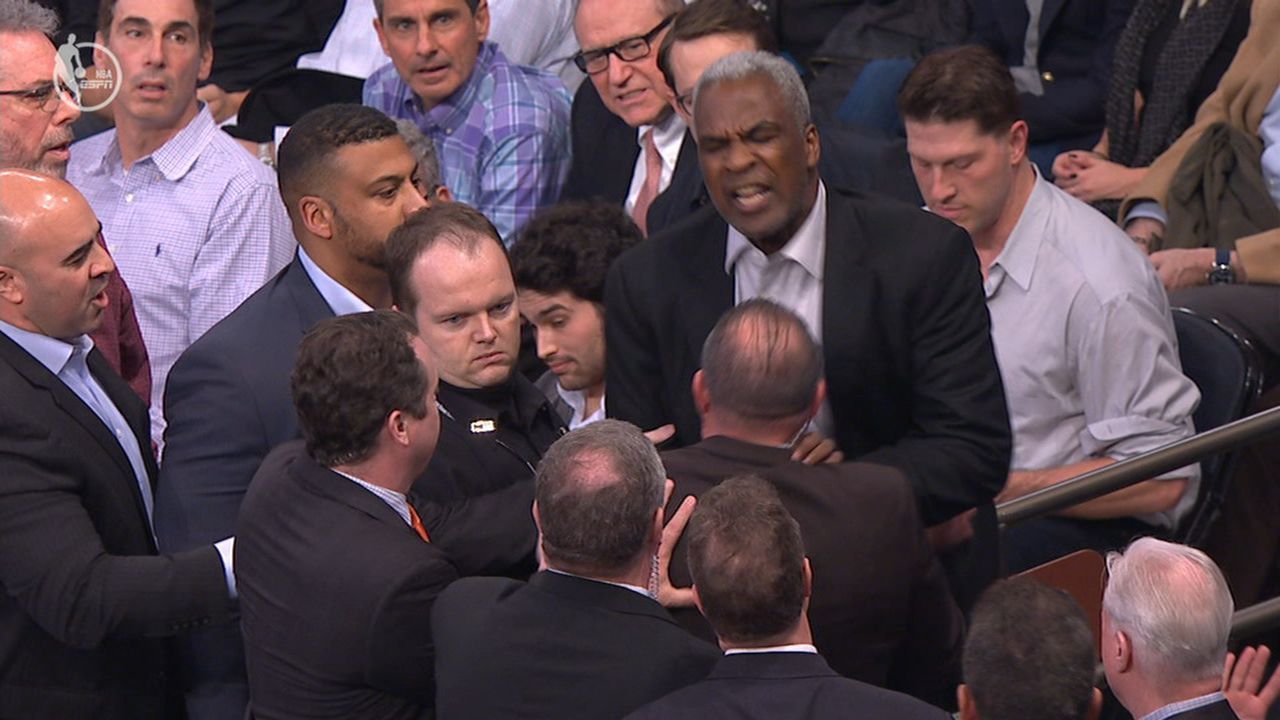
Charles Oakley has never been a man built for soft exits. Not on the court, not in New York, and definitely not when the subject is James Dolan.
So when Oakley says he was supposed to appear on Jalen Brunson and Josh Hart’s “Roommates Show,” only to be canceled the day before, and then later saw Dolan appear on the same platform, it lands exactly where every Oakley-Dolan story lands: somewhere between Knicks nostalgia, civic theater and a family argument that somehow never makes it past Thanksgiving dinner.
Oakley’s version is simple and sharp. He says he was booked. He says he got a call the day before telling him the appearance was canceled. He says Dolan showed up weeks later. Then Oakley added another claim: that he was shooting a commercial near Madison Square Garden, around Cafe 31, with permission, only for the production to be shut down after one day. His conclusion was classic Oakley:
“So he bullying me around the city, too.”
Oakley is not just another former Knick. He was the muscle, the mood and sometimes the heartbeat of the 1990s Knicks. He played ten seasons in New York, made the 1994 All-Star team, defended stars, protected Patrick Ewing, set screens and gave Madison Square Garden a personality that still survives in grainy highlights and old-school arguments. Oakley was never the franchise’s most gifted player, but he may have been its most New York player.
That is why the Dolan feud has always felt bigger than a dispute between an owner and a former employee. It is a fight over memory. Oakley represents the Knicks many fans still romanticize: hard, bruising, loyal, unpolished, impossible to intimidate. Dolan represents the modern Garden power structure, the private owner of a very public emotional institution. When those two collide, it is never just about a podcast seat or an arena seat. It becomes a referendum on who gets to belong.
The defining rupture came in 2017, when Oakley was removed from Madison Square Garden during a Knicks-Clippers game and arrested after an altercation with arena security. Oakley later sued Madison Square Garden and Dolan. Parts of the lawsuit were dismissed, while the legal fight over assault and battery claims continued for years. In 2025, a judge ordered Oakley to pay more than $642,000 in attorney fees after a dispute over text-message preservation, with Oakley’s side disputing the sanction and planning to appeal.
That history is important because it explains why even a podcast cancellation can become combustible. In a normal NBA ecosystem, a former franchise icon being left off a player-hosted podcast might be awkward. In Knicks world, with Oakley and Dolan, it becomes evidence in a much larger emotional case.
The “Roommates Show” itself has become part of the Knicks’ modern mythology. Hosted by Brunson and Hart, it has offered fans a softer, funnier, more player-driven window into the team’s championship era. Dolan’s appearance on the show was real, and the podcast also released video of Dolan’s April speech to the Knicks before their title run.
That is what makes Oakley’s complaint sting. The Knicks’ present has been celebrated loudly. The owner has been welcomed into the content universe. The players have become media personalities. The franchise is finally fun again. And Oakley, one of the men who helped define an earlier version of Knicks pride, still feels like he is being kept outside the velvet rope.
There is a little comedy in it, because Oakley can make anything sound like a scene from a New York movie. A canceled podcast. A commercial by the Garden. A mysterious shutdown. Dolan lurking in the background like a final boss in expensive glasses. Oakley telling the story with the tone of a man who has been fouled, called for the foul himself, and is now walking directly toward the referee.
But underneath the humor is something sadder. Oakley should be part of Knicks life. He should be able to walk into the Garden and get the ovation that belongs to him. Dolan should not still be the name attached to a decade-long feud with one of the franchise’s most beloved players. The Knicks finally reached the mountaintop again, and somehow one of their great old warriors is still fighting from the sidewalk.
Charles Oakley was never perfect. That was part of the package. He was blunt, intense, stubborn and allergic to nonsense. But that is also why Knicks fans loved him. He played like the Garden was not a building but a family name.
And that is the irony of all this. The Knicks have spent years trying to reconnect with what made the franchise matter. Oakley is part of that answer. Not as a mascot. Not as a nostalgia prop. As living proof of a time when the Knicks had an identity nobody had to explain.
The feud has gone on long enough to become absurd, then exhausting, then absurd again. Oakley keeps talking because he feels wronged. Dolan keeps hovering over the story because his silence or resistance never quite ends it. And Knicks fans are left watching two men argue over a house they both helped make famous in very different ways.
At some point, someone has to be bigger than the beef. But with Charles Oakley and James Dolan, that has always been the problem. Neither man has ever been very interested in backing down.
