
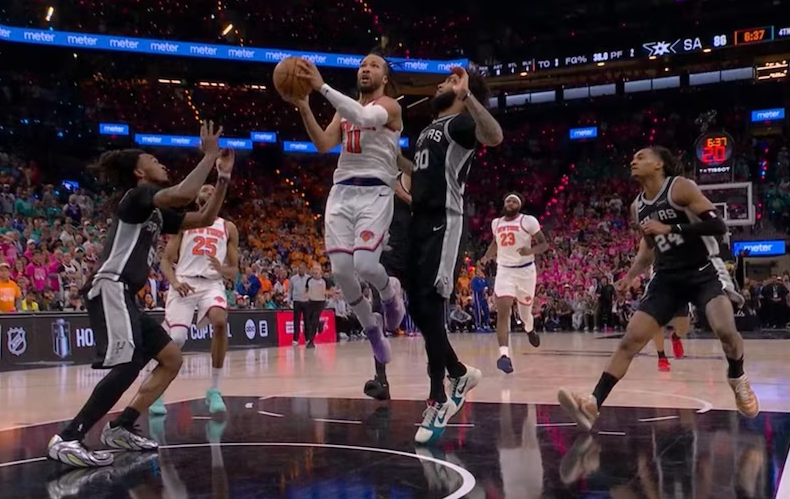
Brian Windhorst pushed back on the easiest word attached to the Knicks’ Game 1 win. New York did not “steal” the opener in San Antonio. It took it.
That distinction matters. A steal implies luck, a loose ball, a strange whistle, a collapse gifted by the opponent. The Knicks’ 105-95 win over the Spurs was something else. They trailed by 14, yes. They were on the road, yes. Victor Wembanyama had the building, the moment and the anticipation of a Finals debut behind him. But New York did not win because it tricked the game. It won because it executed a clear defensive plan and trusted it until San Antonio ran out of answers.
Windhorst’s point was that the Knicks did not throw gimmicks at Wembanyama. No bizarre coverages. No desperate traps every touch. No circus defense built to make a young superstar uncomfortable. They put Karl-Anthony Towns on him and made Wembanyama play through strength, discipline and repeated resistance. Towns, long criticized for defensive lapses earlier in his career, delivered one of the most important defensive games of his life.
Brian Windhorst says the Knicks didn’t steal game one, they took it:
“If you look at the way they played in the 2nd half, they played right to a very well designed game plan. They didn’t do any trick defense are trick coverage on Victor Wembanyama they didn’t do nothing crazy.… pic.twitter.com/9HzYfeeV7j
— NBA Courtside (@NBA__Courtside) June 4, 2026
Wembanyama still finished with 26 points, 12 rebounds and three blocks, but the line was heavier than it looked. He shot just 6-for-21 from the field, 2-for-9 from three and committed six turnovers. The Spurs shot 36% as a team and only 25.6% from deep, numbers that reflected how crowded and uncomfortable the game became after halftime.
That is where Towns’ performance changes the story. His 18 points and 12 rebounds mattered, but his defensive poise mattered more. He absorbed Wembanyama’s first move, stayed down, used his body without turning every possession into a foul, and forced the Spurs’ best player into a series of difficult decisions. Wembanyama could still see over the defense. He just could not consistently get through it.
New York’s fourth quarter completed the argument. The Knicks closed the game on an 11-0 run, with Jalen Brunson finishing with 30 points and Karl-Anthony Towns, OG Anunoby and Josh Hart supplying the structure around him. Hart’s rebounding and activity were crucial, while Anunoby’s two-way presence helped New York turn the final minutes into a possession-by-possession squeeze.
That is not theft. That is control arriving late.
For San Antonio, the problem is now tactical and psychological. If Wembanyama cannot simply play over Towns, the Spurs have to create easier pathways for him in Game 2: deeper catches, quicker decisions, more movement before the entry pass, more help from De’Aaron Fox, Stephon Castle and the supporting cast. If the Knicks can defend him straight up often enough, the series changes.
Game 1 was supposed to introduce Wembanyama to the Finals. Instead, it reintroduced Towns as a defender capable of surviving the biggest assignment on the sport’s biggest stage.
The Knicks did not steal anything.
They walked into San Antonio, followed the plan and took the first game.
