
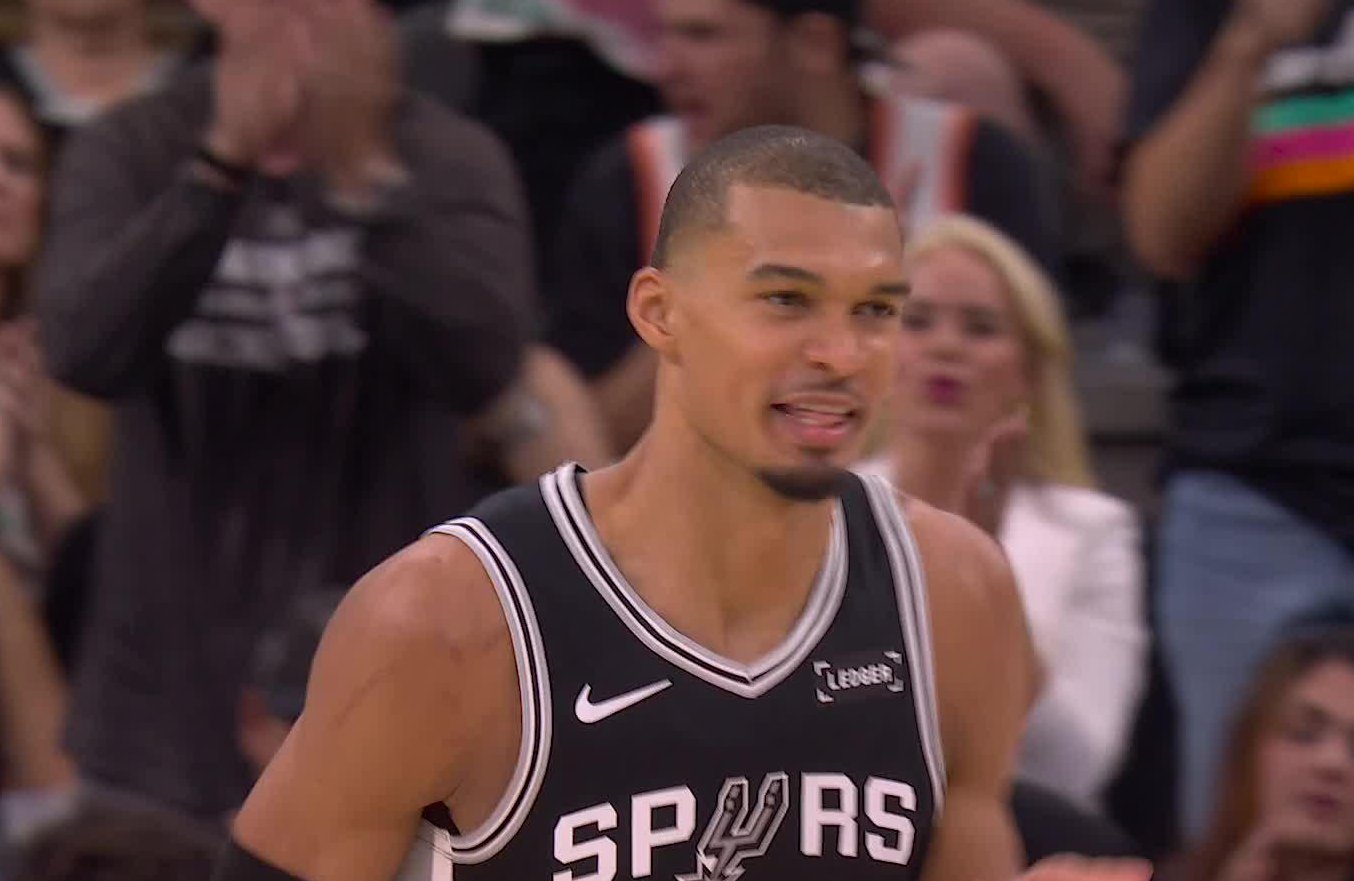
Nick Wright does not think Victor Wembanyama was scared by the NBA Finals. His concern is worse than that.
After the Spurs’ 105-95 Game 1 loss to the Knicks, Wright argued that Wembanyama looked exhausted, not overwhelmed. The difference matters. A young star can adjust to pressure. Fatigue is harder to hide, especially when a 7-foot-4 franchise player is asked to carry a defense, anchor the glass, create offense, survive double teams and do it all deep into the longest basketball season of his life.
“Victor Wembanyama has been running on a quarter tank since the double overtime game,” Wright said, pointing back to the 49-minute monster performance earlier in the playoffs.
Nick Wright says he don’t think Wemby was spooked by the moment, it’s something more concerning he’s exhausted:
“Victor Wembanyama has been running on a quarter tank since the double overtime game. And that was 7 games ago. What that and this is the tax of and I’ve been banging… https://t.co/yrb9hXHTkD pic.twitter.com/a6GOH5PWTf
— NBA Courtside (@NBA__Courtside) June 4, 2026
His argument was simple: that night may have taken more from Wembanyama than the Spurs could afford. Before this postseason, Wright noted, Wembanyama had rarely played above 40 minutes and had never been stretched like that. Since then, the concern is not just the box score. It is the way his shots have looked.
Game 1 gave the theory oxygen. Wembanyama finished with 26 points, 12 rebounds and three blocks in his Finals debut, but shot only 6-for-21 from the field, 2-for-9 from three and committed six turnovers. The Spurs led by 14 in the second half before the Knicks closed the game on an 11-0 run to steal home-court advantage.
The numbers were not empty, but they were heavy. Wembanyama still got to the line, still affected shots, still produced the kind of stat line most players would happily take in a Finals debut. But the usual violence of his game was missing. The easy lift. The clean rhythm. The sense that every possession could become impossible for the opponent. Against New York, too many possessions looked like work.
That is where Wright’s point becomes serious. This may not be about Wembanyama shrinking. It may be about the bill arriving. The Spurs’ run through the West demanded everything from him, from the double-overtime war to the Game 7 win in Oklahoma City. For a player this young, this tall and this central to everything San Antonio does, the physical tax is not theoretical.
Wembanyama did not hide afterward. He blamed himself, said he was bad, but also insisted he was “not worried in the slightest.” That confidence matters. So does the reality that the Knicks now have proof they can survive his presence if his legs are not fully under him.
Game 2 becomes a test of recovery as much as adjustment. Can the Spurs get Wembanyama easier catches? Can they cut down his workload? Can De’Aaron Fox, Stephon Castle, Dylan Harper and Julian Champagnie give him enough offensive relief? Can San Antonio make the game simpler for him before the Knicks make it harder?
Wright’s warning is not that Wembanyama is failing the moment.
It is that the moment may be arriving while his body is still paying for the last one.
