
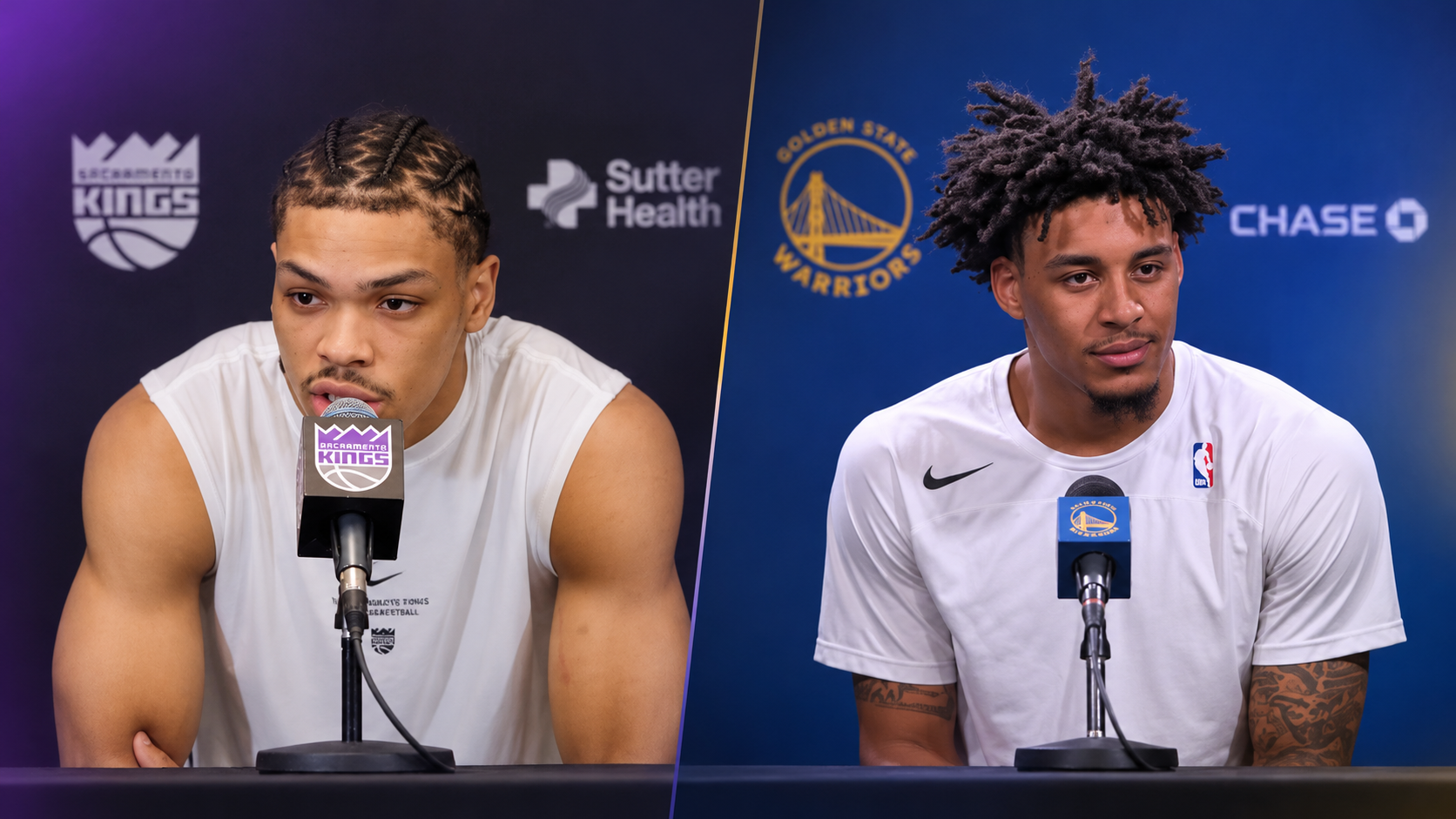
Part I – Before the Game | Golden State Warriors vs. Sacramento Kings | November 25, 2026
There was a time when a matchup between the Golden State Warriors and Sacramento Kings meant Stephen Curry against De’Aaron Fox, established stars competing in one of Northern California’s most entertaining basketball rivalries. On Wednesday night at Chase Center, however, the most intriguing storyline belongs to two players whose NBA careers have barely begun.
Darius Acuff Jr. and Yaxel Lendeborg have emerged as two of the defining figures of an exceptionally talented 2026 rookie class. They are the league’s two highest-scoring first-year players, but their similarities largely end there.
One is a newly turned 20-year-old point guard who has been handed the keys to a struggling franchise. The other is a 24-year-old forward whose unconventional journey through college basketball prepared him to become an immediate contributor for an organization still trying to maximize the final years of its championship dynasty.
Different positions, different responsibilities and vastly different paths to the NBA. Yet both have exceeded expectations and are already demonstrating the kind of talent that could shape their respective franchises for years to come.
For Acuff, the transition to professional basketball has been nothing short of extraordinary.
Selected seventh overall by Sacramento after a sensational freshman season at Arkansas, the Detroit native has immediately become the Kings’ primary offensive weapon. Through his first 17 games, Acuff is averaging 24.6 points, 7.2 assists and 3.4 rebounds, leading all rookies in both scoring and playmaking.
His production is especially remarkable considering his age. Acuff celebrated his 20th birthday on November 16, having averaged 25.5 points across his first 13 NBA appearances, the highest scoring average ever recorded by a teenager over that many games.
He has already registered five 30-point performances and four games with at least ten assists, displaying a combination of individual shot creation and playmaking instincts rarely seen from a player so early in his career.
His offensive confidence was evident well before he arrived in Sacramento. At Arkansas, Acuff averaged 23.5 points and 6.4 assists while becoming the first freshman to win the Bob Cousy Award, presented to the nation’s best collegiate point guard. He also earned SEC Player of the Year honors and consensus First-Team All-American recognition.
The Kings clearly recognized his potential when they selected him in June. What they perhaps did not anticipate was how quickly he would become the centerpiece of their entire offense.
Sacramento enters Wednesday’s contest with a dismal 2-15 record. The organization has struggled to establish a consistent identity, and Acuff has frequently been forced to create offense against defenses that know precisely where the ball is going.
That responsibility has produced remarkable numbers, but also exposed the limitations of a young player still learning how to navigate the NBA.
Acuff is shooting just 40.3 percent from the field and 32.1 percent from three-point range, reflecting both his enormous offensive workload and the difficulty of consistently generating efficient opportunities without sufficient support.
He currently ranks among the NBA’s highest-volume shooters, attempting more than 22 field goals per game. His ability to create space, operate in the pick-and-roll and attack defenders with a remarkably mature offensive repertoire has been impressive. His decision-making, shot selection and defensive consistency remain works in progress.
Nevertheless, Sacramento has found something increasingly valuable: a player around whom it can build an entirely new basketball identity.
On Saturday, Acuff offered a glimpse of that potential when he recorded 21 points, eight assists and six rebounds in a dramatic 97-96 victory over the Boston Celtics. The win ended Sacramento’s lengthy home losing streak and finally allowed the rookie to participate in the franchise’s famous purple-beam celebration.
It was one of the few genuinely joyful moments in an otherwise miserable opening month for the Kings.
Across Northern California, Yaxel Lendeborg has been creating an entirely different kind of excitement.
When Golden State selected the former Michigan standout with the 11th overall pick, the decision reflected the organization’s desire to acquire a mature, versatile player capable of contributing immediately.
Lendeborg’s journey to the NBA had been anything but conventional. Unlike Acuff, who had been considered an elite prospect since high school, Lendeborg spent three seasons at Arizona Western College before transferring to UAB, where he established himself as one of the nation’s best rebounders and most versatile defenders.
His collegiate career culminated at Michigan, where he helped lead the Wolverines to the 2026 NCAA championship while earning Big Ten Player of the Year and consensus First-Team All-American honors.
By the time Golden State drafted him, Lendeborg was already 23 years old. His age was considered a disadvantage by some draft evaluators, but for the Warriors, it represented an opportunity.
General manager Mike Dunleavy Jr. believed the forward’s combination of physical maturity, defensive versatility, passing ability and offensive skill would allow him to contribute immediately alongside Curry and Draymond Green.
Few could have anticipated just how quickly that prediction would be validated. Through his first 17 NBA games, Lendeborg is averaging 19.2 points, 7.4 rebounds and 3.6 assists while shooting 45.2 percent from the field and 36.7 percent from beyond the arc.
Standing 6-foot-9 and possessing an unusually diverse skill set, he can attack mismatches, handle the ball in transition, facilitate offense and defend multiple positions. At his best, Lendeborg looks remarkably comfortable within Golden State’s movement-oriented offensive system. He makes intelligent reads, moves effectively without the ball and possesses the confidence to take advantage of the opportunities created by his teammates.
His 38-point explosion against Memphis earlier this season, featuring nine three-pointers, provided a spectacular demonstration of his offensive ceiling. Yet his impressive start has also created an unexpected challenge.
With Curry sidelined by an oblique injury, Jimmy Butler recovering from ACL surgery and Golden State struggling to maintain offensive consistency, Lendeborg has suddenly been asked to assume responsibilities that go well beyond those typically assigned to a rookie.
Before Curry’s injury, Lendeborg benefited from the extraordinary attention defenses devoted to the greatest shooter in NBA history. Now, with Golden State missing its offensive centerpiece, opponents can devote considerably more resources to containing the young forward.
The adjustment has not been seamless. Over his last five appearances, Lendeborg has averaged 13.4 points while shooting just 30.8 percent from the field and 18.2 percent from three-point range. It is the first significant offensive slump of his professional career and a reminder that even unusually experienced rookies must adapt to the NBA’s relentless scouting and defensive adjustments.
Nevertheless, his overall impact remains impressive, more so for a player whose draft position initially suggested that several prospects possessed considerably greater long-term potential. Interestingly, the two rookies have already provided a preview of what their first regular-season meeting could offer.
During an October 10 preseason matchup at Chase Center, Lendeborg recorded 23 points, ten rebounds and six assists in a 111-106 Warriors victory. Acuff countered with 25 points and eight assists, demonstrating the scoring and playmaking abilities that have since become the foundation of Sacramento’s offense.
Wednesday’s meeting, however, carries considerably greater significance. Golden State enters the contest at 9-8, having recently ended a five-game losing streak with a hard-fought 88-87 victory over Boston. The Warriors have won seven consecutive home games and remain in contention for advancement in the NBA Cup.
Sacramento, meanwhile, has already been eliminated from the competition and is primarily searching for stability after one of the worst starts in franchise history.
For Acuff, the challenge will be translating his spectacular individual production into more efficient basketball and, ultimately, victories. For Lendeborg, it will be adapting to the increased defensive attention that comes with becoming one of his team’s most important offensive options.
There is one additional complication: Lendeborg is listed as questionable for Wednesday’s contest because of illness, leaving his participation uncertain. Should he be cleared to play, the matchup would bring together two of the most fascinating individual development stories of the season.
The NBA’s latest Rookie Ladder, released Wednesday, places Acuff first after another productive week. Lendeborg, who occupied the top position only a week earlier, has slipped to fourth following his recent shooting struggles. Cameron Boozer and AJ Dybantsa currently separate the two.
It is an early reminder that the Rookie of the Year race remains extraordinarily competitive, with several highly regarded prospects already making significant contributions. But Wednesday’s meeting between Golden State and Sacramento represents something considerably more interesting than an individual awards race.
The Kings are asking Acuff to help build their future. The Warriors are asking Lendeborg to help preserve their present.
One is learning how to lead a team that desperately needs a new direction. The other is learning how to shoulder responsibility for a franchise accustomed to competing for championships.
Neither has completed even a quarter of his first NBA season.
And yet both have already become indispensable to the way their organizations envision success.
The final result at Chase Center will determine which team leaves with another victory. But the more compelling question is what the evening might reveal about two young players whose NBA journeys have only just begun.
For Darius Acuff Jr. and Yaxel Lendeborg, the future is arriving considerably faster than anyone expected.
Part II – After the Game | Golden State Warriors 129, Sacramento Kings 110 | November 25, 2026
The final score suggested a comfortable victory, and for much of Wednesday evening, that was precisely what the Golden State Warriors enjoyed. But beneath their 129-110 triumph over the Sacramento Kings at Chase Center, another fascinating storyline unfolded. Two of the NBA’s most exciting rookies shared the floor for the first time in a regular-season game, providing another glimpse into just how different their respective journeys have become.
For Darius Acuff Jr., the evening was another demonstration of both his extraordinary potential and the enormous responsibility he already carries. For Yaxel Lendeborg, it was a reminder that contributing to winning basketball does not always require spectacular scoring numbers.
And ultimately, the difference between their circumstances was almost as striking as the result itself.
Acuff finished with 22 points, nine assists and four rebounds in 37 minutes, while Lendeborg contributed 15 points, eight rebounds, two assists, three steals and a block in 31 minutes. On paper, neither performance quite matched the remarkable standards both players have established during the opening month of their NBA careers.
But their impact told a considerably more interesting story.
Golden State entered the contest desperate to rediscover its offensive rhythm following a difficult stretch without Stephen Curry. The Warriors immediately overwhelmed Sacramento, shooting 11-of-14 from the field to open the game and building a commanding 44-19 advantage after the first quarter.
For Acuff, the opening half was challenging. The rookie guard scored just four points before halftime, struggling to establish his rhythm against Golden State’s defensive pressure. Sacramento’s offensive possessions frequently became disjointed, and the Kings’ inability to generate consistent stops forced their young point guard to operate from behind almost immediately.
Yet Acuff’s response after halftime demonstrated why Sacramento has already entrusted him with such an important role.
Rather than retreating into passivity, he became increasingly aggressive, attacking the defense, looking for scoring opportunities and attempting to accelerate the Kings’ offense.
Sacramento eventually produced a 25-10 third-quarter run that reduced a previously enormous deficit to just four points at 82-78. Acuff scored eight points during that stretch, repeatedly helping the Kings regain the offensive momentum they had lacked throughout the opening half.
The comeback ultimately proved insufficient. Golden State responded with timely perimeter shooting and regained control before the beginning of the fourth quarter.
Acuff’s final shooting numbers, nine makes on 24 attempts, including just three of 12 from beyond the arc, illustrated the challenges he continues to face as a high-volume offensive creator. He also committed five turnovers, another indication of the difficult decisions he must make while learning how to manage an NBA offense.
Nevertheless, his nine assists demonstrated that his value extends beyond scoring. His ability to pressure defenses, recognize passing opportunities and generate offense for others remains exceptional for a player who celebrated his 20th birthday just nine days earlier.
Even opposing head coach Steve Kerr acknowledged his enormous potential.
Following the game, Kerr described Acuff as a modern point guard, praising his shooting range, ability to create off the dribble and understanding of how to attack the paint.
“You can build an offense around him,” Kerr said.
It was a meaningful assessment from a coach who has spent more than a decade working with Stephen Curry.
For Lendeborg, meanwhile, Wednesday presented an entirely different challenge. The Warriors rookie had entered the game questionable because of illness, having missed Tuesday’s practice. Although he was eventually cleared to play, his opening minutes suggested that he was far from his best.
He airballed an early three-pointer, committed a traveling violation and was called for an offensive foul within the first four minutes. It was hardly the kind of beginning expected from a player who has already delivered several spectacular performances this season.
Yet Lendeborg found ways to influence the game without relying on his shooting. He recorded three steals in the first quarter alone, helping Golden State establish its early defensive advantage. By halftime, he had already contributed 11 points, displaying the versatility that made him such an attractive prospect for the Warriors.
Rather than forcing difficult perimeter attempts, Lendeborg increasingly operated closer to the basket, taking advantage of cutting opportunities, attacking openings and using his physicality to create advantageous situations.
He finished six-of-11 from the field, although he missed all three of his three-point attempts and committed four turnovers.
The performance was far from flawless, but it demonstrated something perhaps more important than another explosive scoring night. Lendeborg can contribute even when his offensive rhythm deserts him.
Kerr revealed afterward that the 24-year-old had been dealing with illness for several days and praised his willingness to compete despite the circumstances.
That resilience is valuable for a Warriors organization currently navigating a difficult transitional period. With Curry sidelined, Golden State cannot rely on its greatest player to resolve every offensive problem. Young players must assume greater responsibility while simultaneously learning how to operate within a demanding system.
Lendeborg is being asked to do precisely that. The contrast between the rookies was also reflected in how their respective teams approached the evening.
Sacramento relied heavily on Acuff to create offense, particularly during its second-half comeback. Golden State, meanwhile, distributed its offensive responsibilities across the entire roster.
De’Anthony Melton scored 24 points, all on eight three-pointers, while Gui Santos added 22 points off the bench. Draymond Green orchestrated the attack with 11 assists, helping the Warriors finish with 37 assists on 49 made field goals.
Golden State also received 61 points from its reserves, compared with just 19 from Sacramento’s bench. That difference in supporting production helps explain why evaluating Acuff and Lendeborg exclusively through individual statistics would be misleading.
Acuff is carrying an extraordinary offensive workload for a struggling team that desperately needs him to develop into its franchise centerpiece. Lendeborg, despite Golden State’s own injury problems, still benefits from experienced teammates who understand how to organize an offense, distribute responsibilities and create opportunities within a collective system.
Neither situation guarantees success. Acuff’s freedom to experiment could accelerate his development, but the constant pressure to generate offense risks reinforcing inefficient habits. Lendeborg’s opportunities to contribute to meaningful victories could help him mature more quickly, although his responsibilities will inevitably change once Curry and the Warriors’ other injured players return.
Their first regular-season meeting offered no definitive answer as to which rookie possesses the brighter future.
Acuff scored more points and created more assists. Lendeborg was more efficient, contributed defensively and helped his team secure the victory.
Both displayed strengths that explain why they have already become central figures in their organizations.
But perhaps the most revealing aspect of Wednesday’s matchup was the difference between their immediate objectives.
Sacramento fell to 2-16 with the defeat, and Acuff’s development remains one of the few genuinely encouraging aspects of a disappointing season. Every opportunity to attack an experienced defense, recognize a difficult coverage or respond to adversity represents another lesson in his development.
Golden State improved to 10-8, keeping its NBA Cup ambitions alive. For Lendeborg, the challenge is learning how to turn his individual versatility into consistent contributions for a team that still expects to compete for meaningful victories.
One rookie is learning how to become the foundation of a franchise. The other is discovering how to become an essential part of an established basketball culture.
On Wednesday night, their contrasting circumstances were impossible to ignore.
The Warriors won the game. Acuff continued accumulating the experiences that could eventually make him one of basketball’s premier offensive guards. Lendeborg demonstrated that his value is not necessarily dependent on how many points he scores.
And as their first professional seasons continue to unfold, the most fascinating aspect of their rivalry may not be which player ultimately wins Rookie of the Year. It may be how two remarkably different development paths eventually lead them toward the same destination: becoming the kind of player capable of changing a franchise’s future.
