
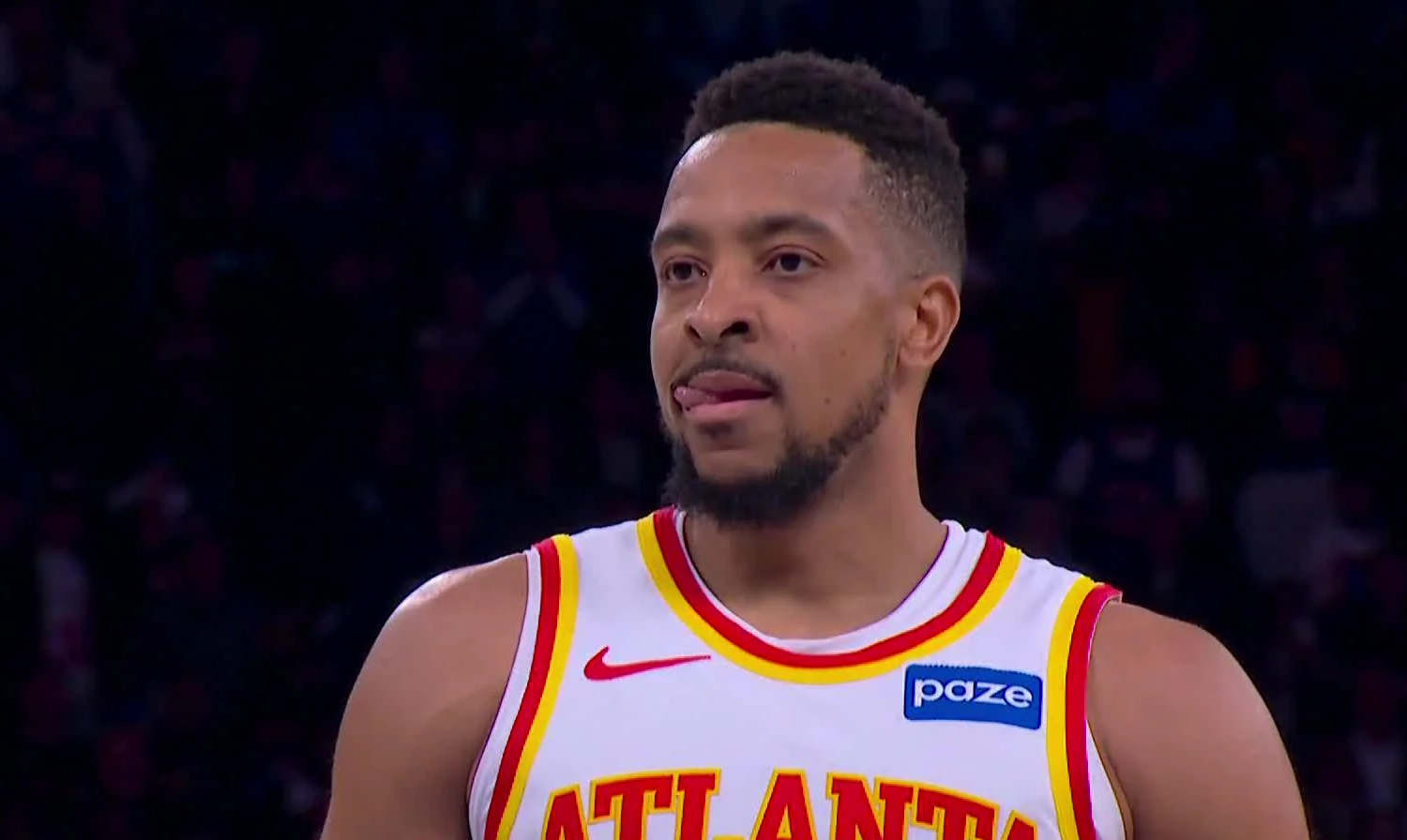
In a league where established veterans often struggle to accept diminished roles, CJ McCollum is offering a refreshing example of what leadership should look like.
The 35-year-old Atlanta Hawks guard recently revealed why he voluntarily approached head coach Quin Snyder about moving to the bench, allowing 19-year-old rookie Kingston Flemings to take over as the team’s starting point guard.
The change was implemented on November 4 against the Washington Wizards, with Flemings scoring 14 points in his first career start to help Atlanta to a 120-105 victory. Remarkably, it was McCollum himself who initiated the lineup adjustment.
McCollum explained that Atlanta’s starting unit had struggled with its offensive rhythm and ball movement, identifying Flemings’ explosiveness and ability to penetrate opposing defenses as qualities that could inject new energy into the lineup.
However, his reasoning went well beyond immediate tactical considerations.
“For us as a franchise and for us as an organization, I’m 35 and he’s 19, so I see the vision of where they’re going,” McCollum explained. “I think for us to be successful, he has to develop. He has to get better.”
Selected eighth overall in the 2026 NBA Draft, Flemings is currently averaging 7.8 points, 4.1 assists and 2.5 rebounds per game. With the departure of Trae Young last season, Atlanta has an opportunity to develop another long-term solution at point guard.
Meanwhile, McCollum has demonstrated that coming off the bench does not necessarily diminish his impact. The veteran scored 21 points in just 24 minutes against the Los Angeles Lakers on Monday before contributing 20 points, five rebounds and five assists against Chicago on Friday.]
“I think that I’m mature enough to be able to handle different roles, different minutes, be utilized on the ball and off the ball,” McCollum added.
CJ McCollum explains why he gave up his starting spot to 19 year old Kingston Fleming, saying the team’s long term success depends on developing its younger players
“As a starting unit I think we were a little sluggish. I think we were lackluster. From a ball movement standpoint, I think we were stagnant and we have a lot of guys that can create and make plays. And I think for Kingston, he’s a guy who gets downhill. He’s got tremendous speed”
“He’s learning and growing. And I think it gives him a chance to develop. For us as a franchise and for us as an organization, I’m 35 and he’s 19, so I see the vision of where they’re going. I think for us to be successful, he has to develop. He has to get better. We got to be able to have a deep team who’s able to contribute off the bench”
“I think for me, the way I play, I can get to it off the bench. I can get to it as a starter. I think that I’m mature enough to be able to handle different roles, different minutes, be utilized on the ball and off the ball. And I think for us to be successful long term, they have to be able to see the growth and development in some of our younger players as well”
— dank (@cptdankkk) November 14, 2026
For a player who spent much of his career as a prolific scorer and offensive centerpiece, voluntarily surrendering a starting position speaks volumes about his understanding of the bigger picture.
Veteran leadership is frequently discussed in the NBA, but its value can be difficult to quantify. Sometimes, it means teaching a young player how to navigate the league. Sometimes, it means holding teammates accountable. And sometimes, as McCollum has demonstrated, it means giving someone else the opportunity you spent years earning yourself.
