
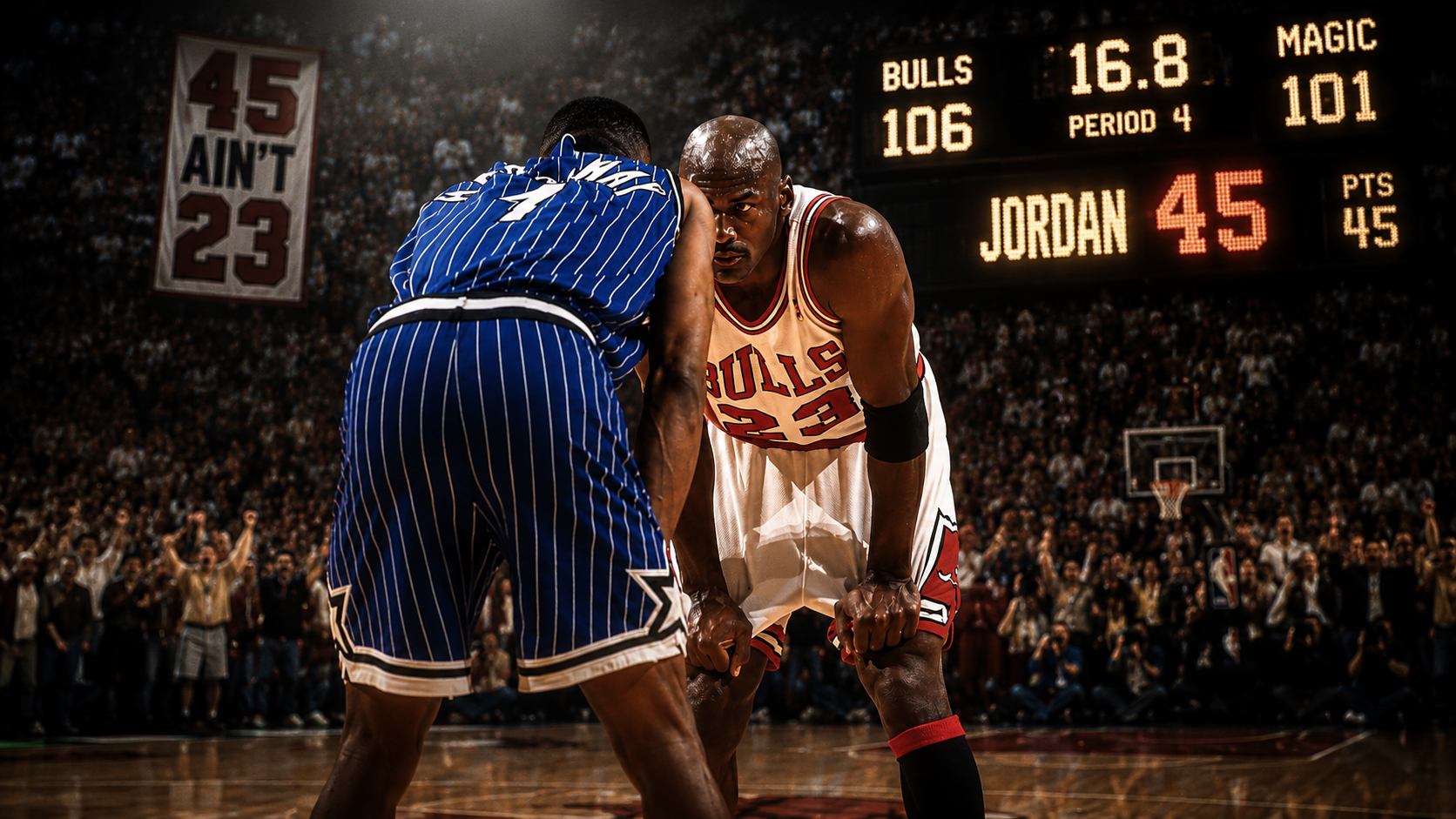
There are Michael Jordan stories that sound exaggerated until you remember the subject is Michael Jordan. Then they start sounding not only believable, but almost routine.
This one belongs in that special category. Game 4 of the 1996 Eastern Conference Finals. Chicago Bulls at Orlando Magic. A year after the Magic had ended Jordan’s comeback season, a year after Nick Anderson had poked the bear with the famous “45 isn’t 23” line, Jordan stood at the free-throw line with the series already in his hands and history already leaning in his direction.
The Bulls were about to sweep Shaquille O’Neal, Penny Hardaway and the team that had embarrassed them the year before. Jordan had already made his point on the court. Chicago was better. Jordan was back. The 72-win Bulls were not just a great team; they were basketball vengeance dressed in red and black.
But Jordan, as the story goes, wanted one more message.
Nick Anderson and Dennis Scott have since recalled that Jordan intentionally missed late free throws so his point total would stay at 45. Then, according to that version of the story, he pointed to the scoreboard. Forty-five points. Not the jersey number. The punishment.
That is what makes the story so perfect, even if it lives partly in the world of memory and mythology. The box score confirms the poetry: Jordan finished with 45 points in a 106–101 Bulls win. Chicago completed the sweep. Orlando, the same franchise that had ended the Bulls’ 1995 playoff run, was gone. And the number 45, once used as a punchline, had been turned into a receipt.
The background is essential. In 1995, Jordan returned from baseball wearing No. 45. He was still brilliant, but he was not fully himself yet. His timing was off. His body was still catching up. The Magic were young, explosive and fearless. After Anderson stripped Jordan late in Game 1 of the 1995 Eastern Conference Semifinals, Orlando won the game, and Anderson’s “45 isn’t 23” comment became one of the most dangerous sentences in NBA history.
Jordan switched back to No. 23 during that series, but Orlando still beat Chicago in six games. For almost anyone else, that would have been a painful playoff loss. For Jordan, it became offseason fuel.
Then came 1995–96.
The Bulls added Dennis Rodman. Scottie Pippen was still at his peak. Phil Jackson had the machine humming again. Jordan won MVP. Chicago went 72–10, then an NBA record. Every night felt like a correction. Every opponent became part of the tour. But Orlando was different. Orlando had actually beaten them. Orlando had spoken. Orlando had touched the crown.
So when the rematch arrived in the 1996 Eastern Conference Finals, the Bulls did not just beat the Magic. They squeezed them. Chicago won the first three games, and by Game 4, Orlando was fighting to stay alive at home. Shaq and Penny were still dangerous, but the balance of power had changed. The young challengers from Florida were now standing in front of a fully restored dynasty.
Jordan’s 45 points in the closeout game were not just scoring. They were storytelling. He controlled the game like a man settling a private account in public. Every jumper carried context. Every drive felt personal. The Magic had seen No. 45 in 1995 and thought they had found a crack. One year later, No. 23 gave them 45 anyway.
That is the part that makes the alleged free-throw miss so delicious. Most stars chase round numbers. Jordan chased meaning. Fifty would have looked better in a headline. Forty-seven or forty-eight would have added to the total. But 45 was the number with teeth. Forty-five was the callback. Forty-five was the inside joke only everyone understood.
And that was Jordan at his most ruthless. He did not just want to win games. He wanted to own the memory of them. He wanted opponents to remember the exact sentence, the exact mistake, the exact moment they gave him something to keep.
The Magic were not some ordinary victim, either. This was Shaq before Los Angeles. Penny before the injuries took away part of his magic. Horace Grant facing his old team. Nick Anderson living with the most famous quote of his career. Orlando was talented enough to believe it had interrupted the Bulls’ dynasty. Chicago’s sweep in 1996 told a colder truth: it had only delayed it.
After eliminating Orlando, the Bulls went on to beat the Seattle SuperSonics in the NBA Finals and complete one of the greatest seasons in basketball history. Jordan finished the job with another championship and another Finals MVP. The second three-peat had begun.
But tucked inside that season is this little masterpiece of basketball pettiness. A superstar remembers a quote. A team builds a revenge tour. A scoreboard becomes a message board. A missed free throw becomes a flex.
That is why Jordan stories last. Not just because he scored. Not just because he won. But because he turned basketball into theater without ever letting the theater get in the way of the result.
Against Orlando in 1996, Michael Jordan did not need 45 points to prove he was back. He scored 45 anyway. And if the Magic players’ memory is right, he left it there on purpose.
