
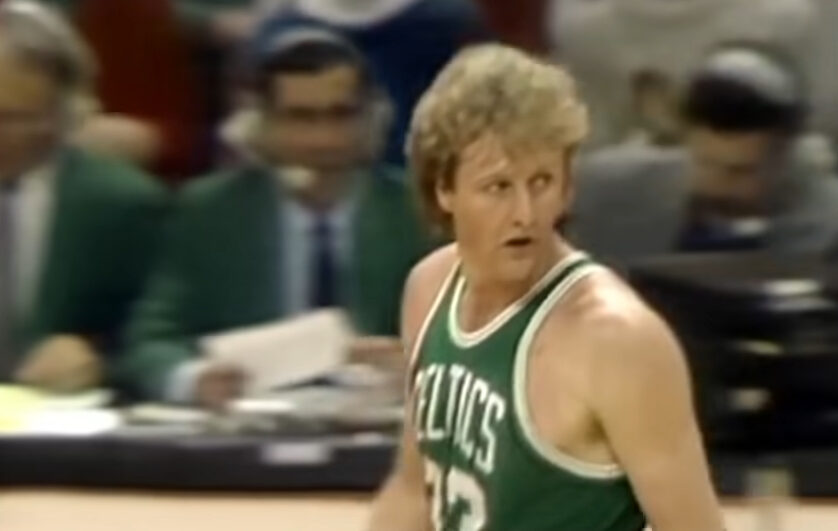
On May 28, 1986, Larry Bird did not merely win another MVP. He joined a private basketball monarchy.
The Boston Celtics forward captured his third consecutive Maurice Podoloff Trophy, becoming only the third player in NBA history at the time to win three straight Most Valuable Player awards, joining Bill Russell, who did it from 1961 to 1963, and Wilt Chamberlain, who followed from 1966 to 1968. For Bird, in only his seventh NBA season, it was not just recognition. It was confirmation that the league’s center of gravity had moved through Boston again.
By 1986, Bird had become the sport’s most complete problem. He could shoot over smaller defenders, pass before the defense knew the cut existed, rebound in traffic, talk opponents into mistakes, and win possessions with a coldness that made the spectacular look routine. That season, he averaged 25.8 points, 9.8 rebounds, 6.8 assists and 2.0 steals per game, numbers that captured only part of his control over the floor.
The award also belonged to one of the greatest teams ever assembled. The 1985-86 Celtics had Bird, Kevin McHale, Robert Parish, Dennis Johnson, Danny Ainge and Bill Walton, all operating inside a machine built on passing, spacing, intelligence and cruelty. Boston finished 67-15, dominated at home, and eventually beat the Houston Rockets in six games to win the championship. Bird completed that Finals with a Game 6 triple-double and his second Finals MVP.
What made Bird’s third MVP feel so enormous was the company. Russell represented the winning empire. Chamberlain represented the statistical supernova. Bird became the bridge between genius and team basketball, a forward who made everyone around him sharper while still carrying the league’s most ruthless competitive edge.
Three straight MVPs is not just a streak. It is a statement that, for a sustained stretch, the entire league belonged to one man. In 1986, that man was Larry Bird.
