
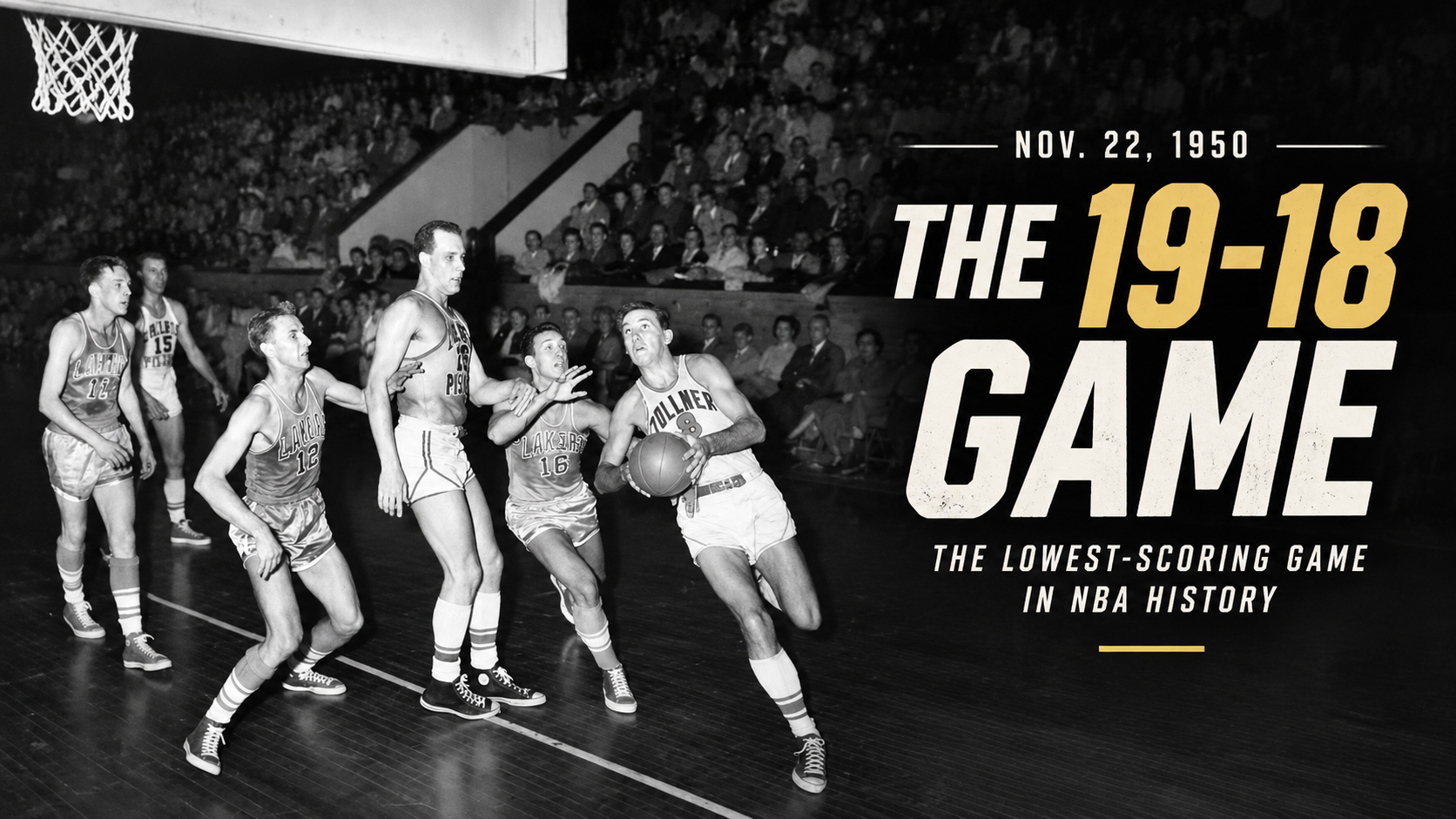
On November 22, 1950, the Fort Wayne Pistons and Minneapolis Lakers played a basketball game so extraordinary, and so painfully slow, that it would eventually help change the sport forever.
In front of 7,021 spectators at the Minneapolis Auditorium, the Pistons defeated the defending NBA champions 19-18, combining for just 37 points in what remains the lowest-scoring game in league history, 76 years later.
The remarkable result was no accident. It was the product of a deliberate strategy designed to neutralize the most dominant player in basketball.
At the time, Minneapolis was led by George Mikan, the NBA’s original superstar, whose combination of size, strength and scoring ability had made the Lakers nearly unstoppable. Fort Wayne head coach Murray Mendenhall understood that attempting to beat Mikan in a conventional basketball game would be an enormous challenge.
So he decided not to play one.
With no shot clock in existence, Mendenhall instructed his players to hold possession for as long as possible, passing the ball around without attempting to score. Under the rules of the era, teams were under no obligation to shoot within a particular period, allowing Fort Wayne to effectively freeze the game.
The strategy was brutally effective, if hardly entertaining.
Fort Wayne led 8-7 after the opening quarter, but the Lakers recovered to take a 13-11 halftime advantage. The third quarter produced just nine combined points, and by the beginning of the fourth, Minneapolis held a narrow 17-16 lead.
What followed was almost unimaginable by modern standards. The two teams combined for just four points in the entire final quarter, with the Pistons outscoring the Lakers 3-1.
With six seconds remaining, Fort Wayne’s Larry Foust converted the decisive basket to secure the historic 19-18 victory.
Mikan finished with 15 points, accounting for an astonishing 83.3 percent of Minneapolis’ entire offensive production. Only three other Lakers points were scored, while Fort Wayne’s leading scorer, John Oldham, managed just five.
Even more remarkably, the teams combined to make only eight field goals across 48 minutes of basketball.
For the frustrated spectators, the evening represented everything that was wrong with professional basketball’s existing rules. Without any mechanism forcing teams to attack, games could deteriorate into prolonged exercises in time-wasting rather than competitive entertainment.
The consequences extended far beyond this single contest.
Although the NBA did not immediately change its rules, the infamous game became one of the clearest examples of why basketball desperately needed a shot clock.
Four years later, Syracuse Nationals owner Danny Biasone and general manager Leo Ferris helped introduce the revolutionary 24-second rule, which made its NBA debut during the 1954-55 season.
The impact was transformative. Teams could no longer protect narrow leads by simply holding the ball indefinitely. Every possession now demanded offensive action, accelerating the pace of play and helping professional basketball develop into the dynamic spectacle it is today.
Ironically, the Pistons’ victory was strategically brilliant. Mendenhall had identified the most effective way to contain the league’s greatest offensive weapon and executed his plan successfully.
But in doing so, he had also exposed a fundamental flaw in the sport itself.
More than seven decades later, the 19-18 score remains one of basketball’s most bizarre records, a statistical anomaly virtually impossible to replicate under modern rules.
The Fort Wayne Pistons won a basketball game that night. In the process, they helped demonstrate why basketball needed to change.
