
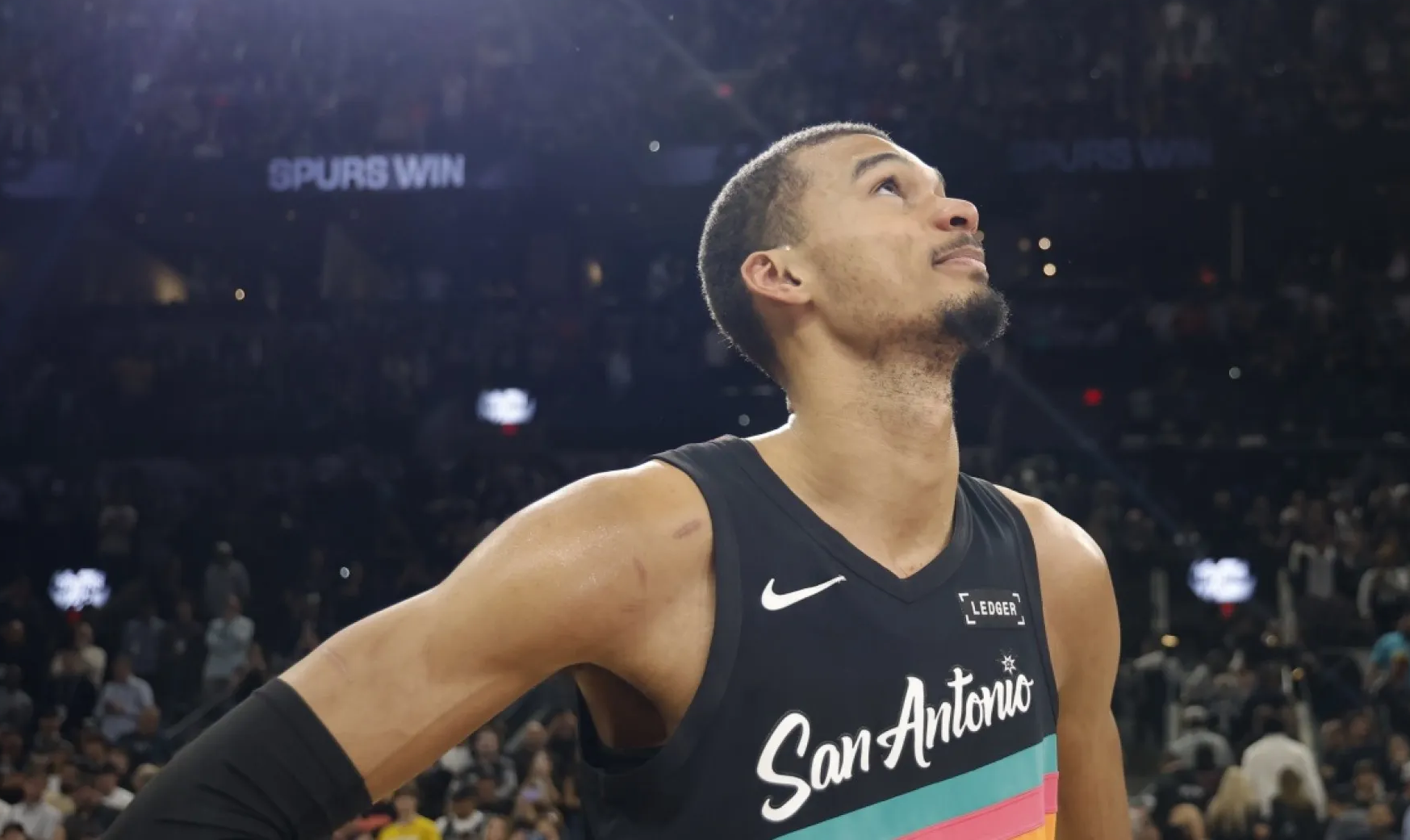
Victor Wembanyama winning Defensive Player of the Year does not feel like the end of an argument. It feels like the start of a much darker one for the rest of the league. The San Antonio Spurs star was announced Monday as the 2025-26 Kia NBA Defensive Player of the Year, becoming both the youngest winner in the award’s history and the first unanimous selection ever. He received all 100 first-place votes after a season in which he led the league in blocks for the third straight year and anchored one of the NBA’s best defenses on a 62-win Spurs team.
That is the factual part. The more unsettling part for everyone else is what it suggests. This award does not read like a career summit. It reads like an opening chapter. Wembanyama is only 22, already distorting shots, possessions and game plans on a league-wide scale, and now owns a trophy that historically marks arrival. In his case, it may mark something more severe: the moment his dominance became official before it has fully matured. The Spurs did not just watch him win DPOY; they watched him do it while averaging 25.0 points, 11.5 rebounds and 3.1 blocks, numbers that make the usual “defense-only” label feel far too small.
That is why this feels less like a celebration than a warning label for the rest of the NBA. Wembanyama does not defend in a normal superstar way, where a great player cleans up mistakes or shuts down one matchup. He warps the geometry of the floor. He changes what opponents even attempt. He split his defensive matchup time across guards, forwards and centers while holding all three groups under 43 percent shooting. That versatility is what turns ordinary rim protection into something more ominous. He is not merely occupying the paint. He is stretching fear across the entire offensive map.
And if that sounds dramatic, good. It should. Because Wembanyama is not trending toward being a nuisance. He is trending toward becoming the organizing terror of the league’s next era. The phrase “reign of terror” is usually reserved for scorers who pile up points in visible ways, but his version may be worse. He can break a game without touching the ball, break your spacing by standing near it, and break your confidence by erasing the shot you thought was open. If he keeps scaling like this, the NBA will spend the next several years adjusting itself around him, drafting for him, scheming for him, and measuring contenders by whether they have any answer for him at all. That is how a league becomes captive to a single force.
The timing only sharpens the point. Wembanyama won the award on the eve of a Spurs playoff run that already looks like the beginning of something larger, not a happy overachievement. San Antonio finished with the second-best record in the league and the third-best defensive rating, while Wembanyama himself had already opened the postseason with a 35-point debut against Portland. That is not a rebuilding curiosity anymore. That is the sound of a franchise and a superstar moving from promise into threat.
So yes, Wembanyama won Defensive Player of the Year. But that is not the story people will remember if this unfolds the way it now seems capable of unfolding. The real story may be that this was the season the NBA formally met its next great disruptor and, with full unanimity, admitted what was coming. The trophy is the headline. The fear underneath it is the future.
