
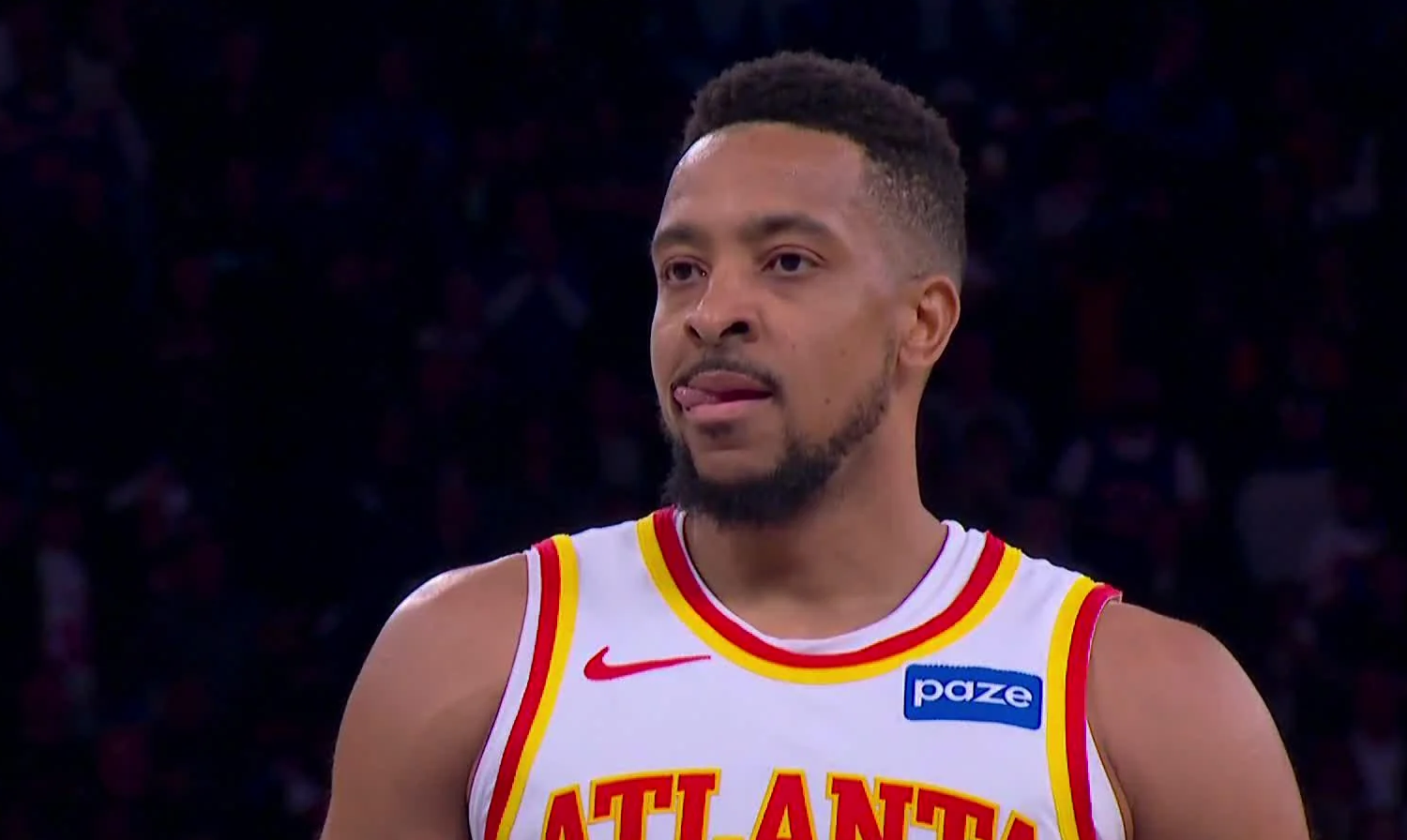
CJ McCollum did not arrive at Madison Square Garden asking for the role. The building assigned it to him. By the end of Game 2, with the Atlanta Hawks stealing a 107-106 win from the New York Knicks and knotting the series at 1-1, McCollum had become exactly what New York crowds always create in spring: the cold-blooded visitor who ruins the night and walks out with the noise still chasing him. McCollum scored a game-high 32 points and delivered the go-ahead baseline fadeaway with 33.5 seconds remaining, the shot that ultimately gave Atlanta the lead for good.
That made him the game’s defining figure, but not because he dominated from start to finish in some theatrical, one-man avalanche. What made McCollum’s performance feel so sharp was its timing. The Hawks trailed by eight with less than five minutes to play and by 14 in the third quarter, yet closed on a 15-6 run as the Knicks’ offense tightened and the game shifted under pressure. McCollum scored six points in the final two-plus minutes, turning a tense New York finish into something much harsher: a home collapse and a series suddenly alive again.
That is how playoff villains are usually made. Not through personality first, but through interruption. The Garden had already begun to imagine a 2-0 lead. Instead, McCollum kept appearing in the exact places New York did not want him, first as a scorer, then as the veteran hand in the middle of Atlanta’s late composure. The Knicks shot just 22.7% in the fourth quarter, while the Hawks hit 72.2% and in that gap McCollum found his stage.
There is an irony in all of this. McCollum is not naturally cast as a cartoon antagonist. He is one of the league’s more thoughtful veterans, more likely to sound reflective than performative. He pushed back on the label afterward, saying, “I ain’t no villain,” even as the crowd treated him like the latest man to trespass against the city’s postseason hopes.
But playoff basketball rarely cares how a player sees himself. It cares what he does to the room. On Monday night, McCollum was the one who took over the ending, silenced the arena just enough, and left the Knicks with a loss that felt far heavier than one game in April usually should. He may not want to be the villain. In Game 2, he played the part too well to avoid it.
