
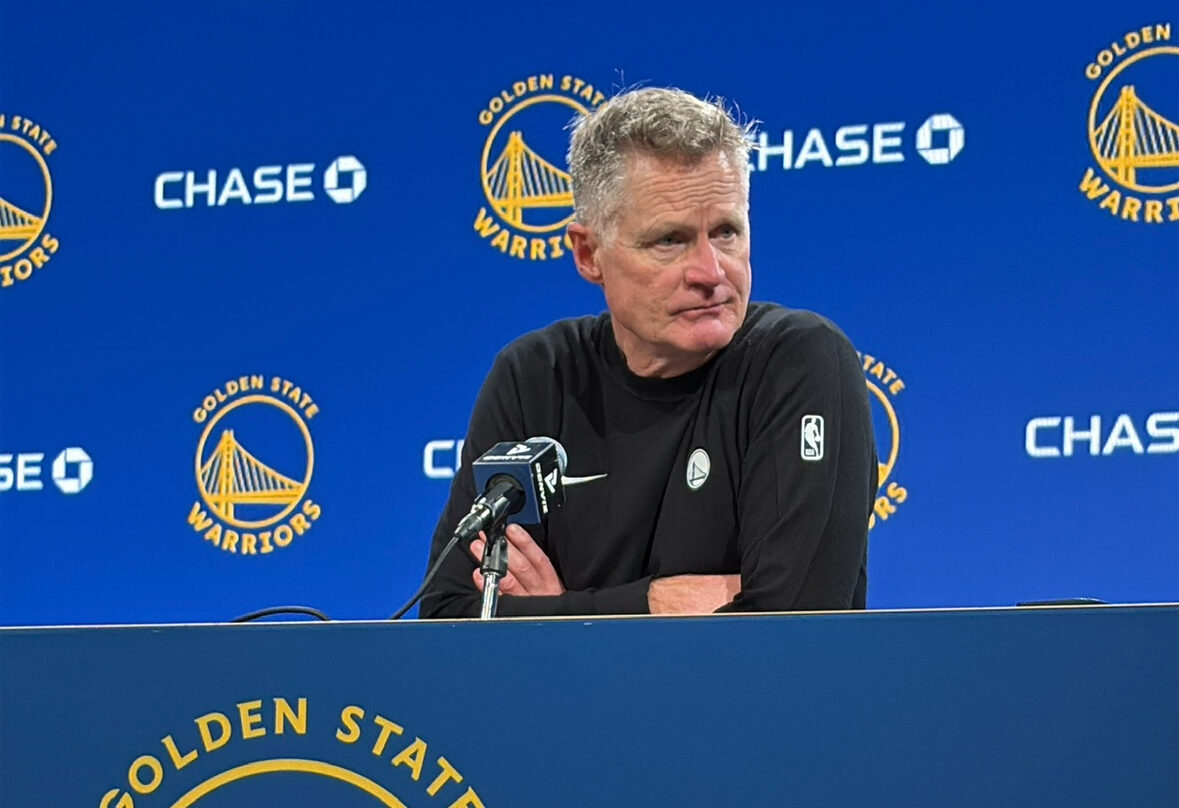
The most unsettling thing about the Warriors right now isn’t just the roster math or the narrowing timeline of the Stephen Curry era. It’s the possibility that the man who coached the franchise into a dynasty may be nearing the end of his run on the sideline.
In a new report for The Ringer, Logan Murdock wrote that Steve Kerr’s “future is still up in the air” and emphasized a detail that has begun to shape the mood inside the organization: Kerr is in the final year of his contract, and as of today he had not signed a new deal. More strikingly, Murdock reported that multiple assistant coaches have been operating under the premise that Kerr will not return next season, with some already surveying the league for jobs for next year, according to team sources.
“This is the final year of his contract, and as of Wednesday, he has yet to sign a new deal. Though Kerr has publicly been mum about his future, multiple assistant coaches have been operating under the premise that he will not return next season, according to team sources, with some surveying the league to secure jobs next season.”
Contractually, the timing checks out. The Warriors announced a contract extension for Kerr in February 2024, a two-year, $35 million deal that runs through the 2025-26 season, meaning this season is the end of the current agreement.
That’s the formal backdrop. The emotional one is messier. Kerr has publicly avoided turning his future into a weekly storyline, and earlier in the season he struck a notably calm tone about coaching on an expiring deal, saying he was “very comfortable” entering the year without an extension and that he’d reassess at season’s end.
What changes the temperature is the idea that, behind the scenes, staffers are already acting as if a transition is coming. Coaches don’t “survey the league” because they’re bored; they do it because the coaching industry is a short-notice business, and assistant jobs dry up quickly when the carousel starts spinning. When multiple assistants prepare for life after Kerr, it suggests less a routine negotiation and more a shared assumption that the ground could shift beneath them.
The report also arrives at a volatile moment for the franchise. Murdock’s piece is framed around the shockwaves from Jimmy Butler’s season-ending injury and the broader sense of instability that comes when a team is forced to confront uncomfortable “what now?” questions at midseason. Whether or not the injury directly affects Kerr’s thinking, it adds context: the Warriors aren’t simply trying to patch a rotation. They’re staring at existential decisions, about the roster, the timeline, and potentially the leadership structure that has defined them for more than a decade.
If Kerr truly is nearing the end, it would close one of the most consequential coaching tenures in modern NBA history. Kerr took over in 2014 and became the face of a system that didn’t just win championships, but changed the league’s geometry; pace, spacing, and decision-making turned into an ideology. The Warriors’ four titles under Kerr are not just trophies; they’re a blueprint that half the NBA has been chasing ever since.
Of course, “uncertain” does not mean “gone.” Contracts get extended quietly all the time, and front offices often prefer to handle these conversations away from microphones. But the telling part of Murdock’s report is not that Kerr hasn’t signed yet, it’s that people who would know the rhythm of the building are behaving as if he won’t.
