
The NBA’s international games are built to sell the league as a global product. New crowds, new cameras, a marquee arena, a Sunday afternoon that feels halfway like a festival. But when the Memphis Grizzlies arrived in London, the storyline waiting for Ja Morant wasn’t about the spectacle at The O2. It was about ownership of his own future.
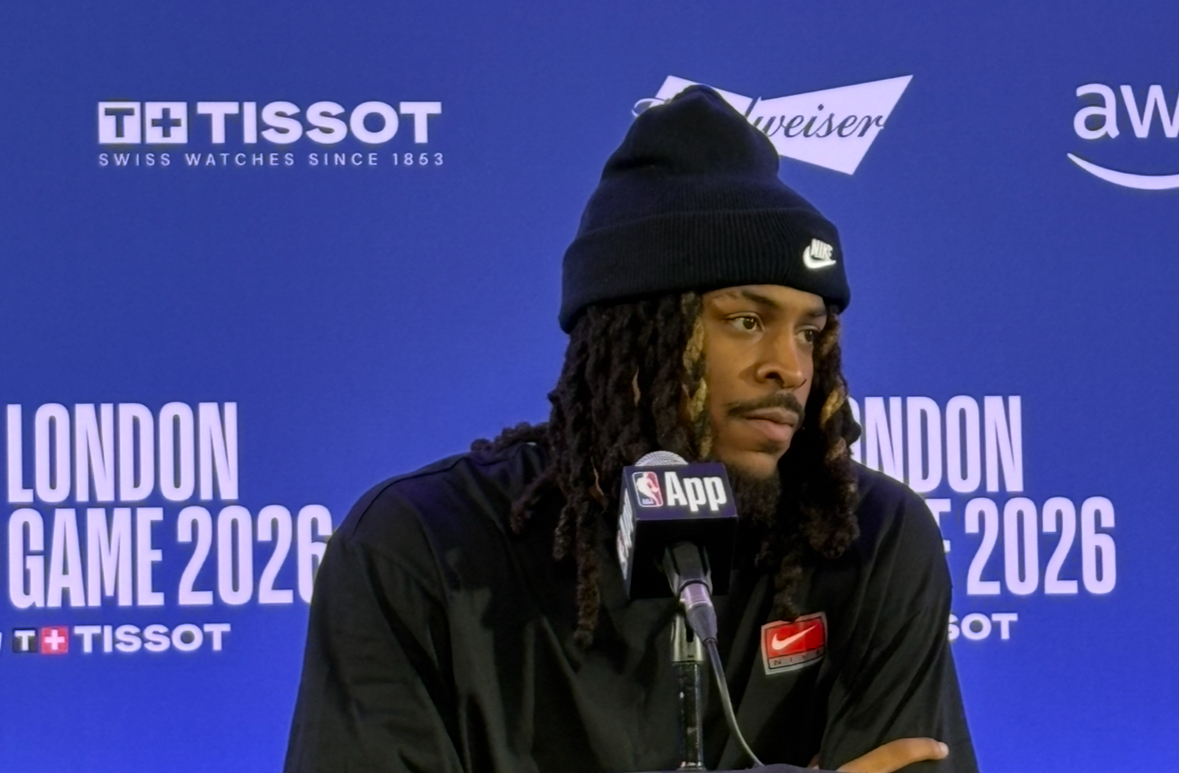
Morant’s answer, delivered after Memphis’ 126–109 win over the Orlando Magic, cut through weeks of noise with the simplest kind of personal evidence: ink.
“Everybody in here who knows me, knows I’m a very loyal guy,” Morant said. “I got a logo on my back, and that should tell you where I want to be.”
Ja Morant’s answer when asked by @TheSteinLine on where he wants things to go from here
“Anybody who in here knows me knows I’m a very loyal guy. I have a logo on my back (Grizzlies tattoo) so that should say exactly what I want” pic.twitter.com/YAkAsJ4mVf
— James Plowright (@British_Buzz) January 18, 2026
It landed because it wasn’t phrased like spin. It sounded like a player who knows exactly what the question is really asking, and refuses to let it become a referendum on anyone else’s timetable.
Morant’s statement came on a day when he did more than talk. He returned from a right calf contusion that had sidelined him for six games and immediately played like someone eager to reclaim the season’s steering wheel, posting 24 points and a season-high 13 assists. Memphis, which had just split its Europe trip with Orlando by losing in Berlin and then flipping the rematch in London, looked far more in control with Morant back dictating pace and pressure points.
That combination, dominant return, decisive win, and an on-record declaration, gave the quote extra weight. It wasn’t loyalty offered in the abstract. It was loyalty framed as something he wants to keep living out on the floor.
The tattoo detail matters because it speaks the language players actually trust. Contracts can be negotiated. Public quotes can be clipped. But a team logo embedded in your skin is a different sort of statement, one Morant pointed to as shorthand for where he sees himself long-term. In the modern NBA, where roster timelines and cap math constantly tug at star-player relationships, that kind of symbolism reads almost old-fashioned, an appeal to identity rather than leverage.
Still, the context is complicated, and Morant didn’t pretend otherwise. Trade speculation has swirled around him and that any team considering a deal would be inheriting significant long-term money: Morant is under a five-year, $197 million contract through 2027–28, with eligibility for a major extension in the summer. In other words, this isn’t the easy kind of “will he or won’t he” chatter. The mechanics alone would reshape any franchise that tried.
Then there’s the season itself. Morant has been limited to 19 of the team’s 41 games so far, with reduced minutes and numbers compared to his peak seasons, a reality that turns every return into both a basketball boost and a new round of questions about durability. London, in that sense, worked as a reset. It reminded everyone what Memphis looks like when the engine is actually running.
And it set up the tension that makes Morant’s quote so compelling: loyalty in the NBA is never a one-way street. Fans want it to mean permanence. Front offices want it to mean stability. Players want it to mean respect and clarity. Morant, by pointing to a Grizzlies logo on his back, wasn’t issuing a demand. He was staking a preference, planting a flag in a conversation that too often gets conducted as if the player is the last person consulted.
That’s why the line hit. It didn’t sound like a man trying to win a negotiation. It sounded like a star trying to reclaim authorship.
London gave him the stage. He used it to win a game, then used it to say, as plainly as possible, that he still sees Memphis as home.
