
It started the way so many modern sports stories do: a hand-written sign, a courtside seat, a kid brave enough to believe a star might actually stop and listen.
In early January 2025, after a Timberwolves game in Detroit, Anthony Edwards met a 6-year-old fan named Luca who was battling leukemia. Luca handed Edwards an orange wristband that read “Love Like Luca.” In the moment, Edwards didn’t treat it like a photo-op or a quick autograph stop. He made a vow, caught on video, that he would wear the wristband “for the rest of my career,” specifically on his left arm.
That kind of promise is easy to make and hard to keep, not because it’s physically difficult, but because the NBA moves too fast for sentiment to survive the grind. Players change shoes at halftime. They swap accessories, tape jobs, undershirts. Teams travel. Routines reset. The league is a conveyor belt, and most “special moments” get filed away the minute the next game arrives.
Edwards didn’t file this one away.
In the days after meeting Luca, Edwards immediately followed through, wearing the wristband in the next game and continuing to reference the pledge. The story grew because it wasn’t just about a symbol, it was about consistency. Luca’s family spoke publicly about how much it meant to see a superstar actually do what he said he would do.
And now, more than a year later, the wristband is still there.
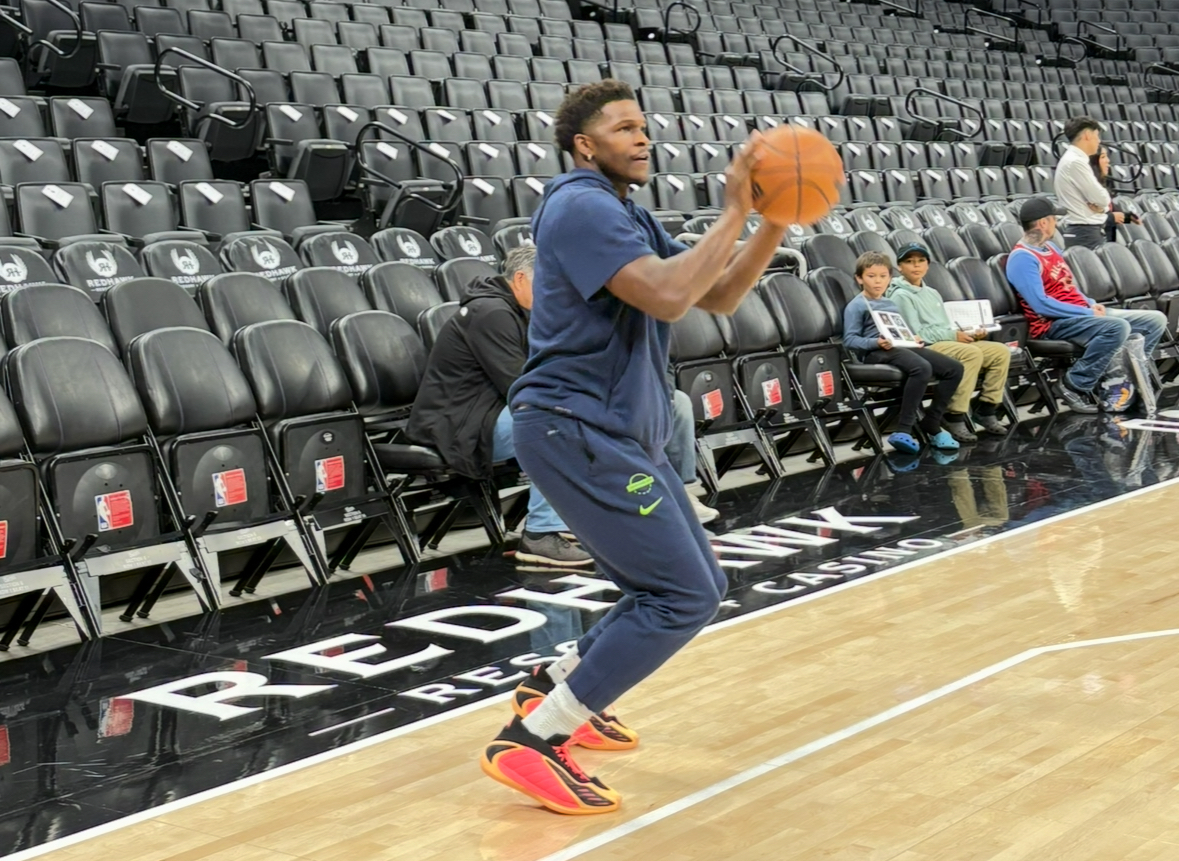
Recent social posts from January 2026 have pointed out that Edwards continues to wear the orange band, while Edwards himself has discussed the wristband and its meaning in circulating clips, reconnecting it directly to the moment with Luca in Detroit. The proof isn’t a press release or a charity campaign announcement. It’s simpler than that: the band keeps showing up, game after game, a small bright loop of color that has outlasted the news cycle that first amplified it.
This is the part that’s easy to underestimate if you only look at it as a “nice gesture.” In pro sports, permanence is rare. A wristband that stays on becomes a form of public accountability. It’s a quiet contract renewed every time Edwards steps onto the floor. The orange band doesn’t score, doesn’t defend, doesn’t change a scouting report. But it does something athletes and franchises spend millions trying to manufacture: it creates meaning that feels real.
It also reveals something about Edwards’ particular stardom. His public persona, confident, funny, sometimes chaotic, always competitive, can make empathy feel like an off-brand surprise. But the Luca story has never required Edwards to shift into a different version of himself. It fits because it’s direct. It’s uncomplicated. A kid asked; Edwards answered; and then, crucially, he kept answering every night by not taking the band off.
A lot changes in a year in the NBA. Rotations, injuries, standings, narratives, noise.
The orange band didn’t.
