
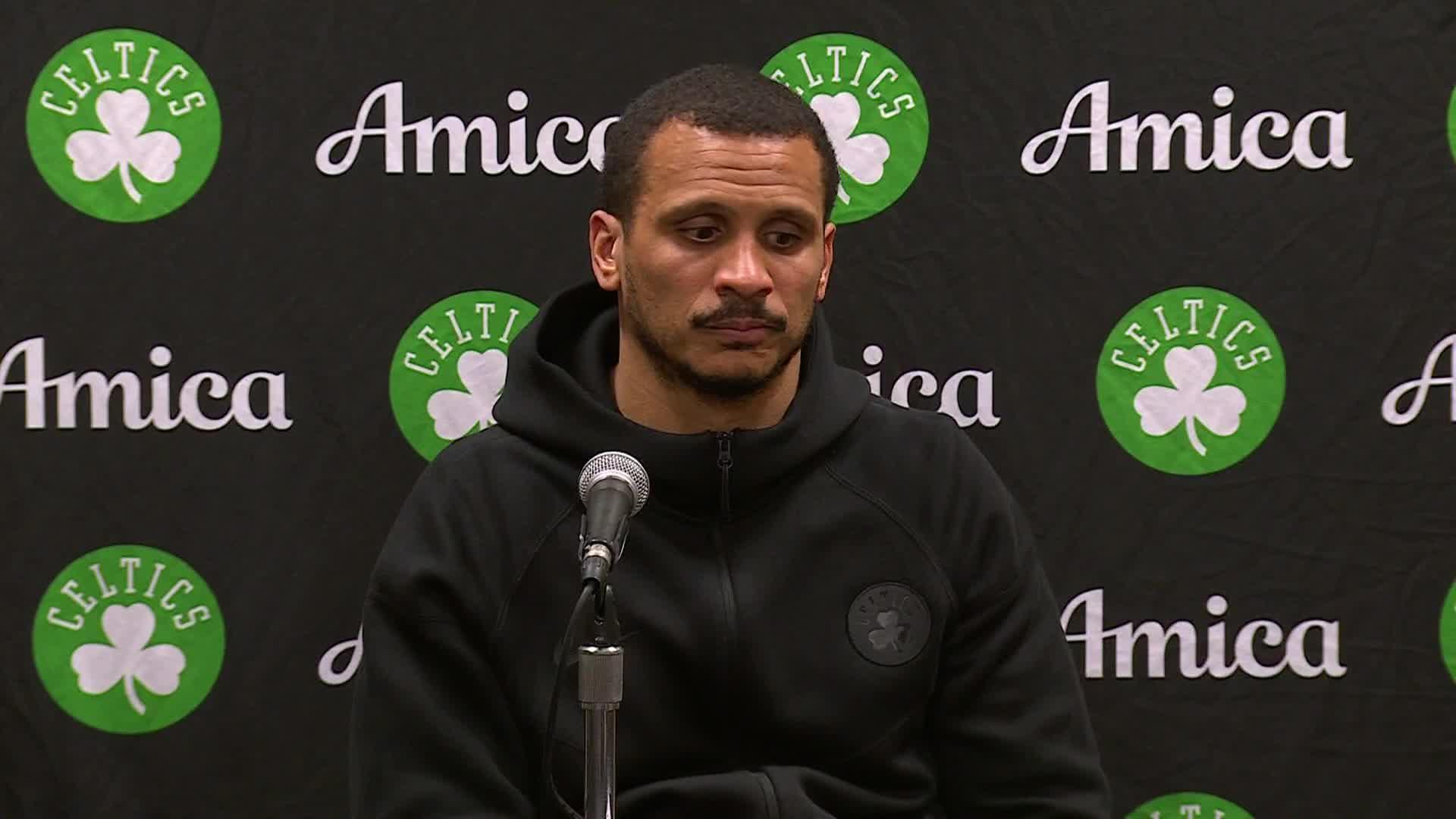
Joe Mazzulla didn’t walk into the postgame media room in Indianapolis to explain a loss. He walked in to file a complaint.
After Boston’s 98–96 defeat to the Indiana Pacers on Monday night, the Celtics coach was asked six separate questions. He answered every single one the same way: “Illegal screen.” Over and over, no elaboration, no detour, no second topic. Forty seconds of press conference, one phrase, and a message so blunt it practically came in all caps.
joe mazzulla answering every question “illegal screen” pic.twitter.com/SCnuXLXW3B
— JGFC (@JGFC__) January 13, 2026
The play he was pointing to was the one that decided the game. With the score tight in the final seconds, Pacers forward Pascal Siakam set a screen near the top of the arc that caused Derrick White to lose his balance. Siakam then got the ball back from Andrew Nembhard, pump-faked, stepped inside the foul line, and banked in a high-arching leaner with 6.1 seconds left, the shot that held up as the winner.
PASCAL SIAKAM GAME WINNER!
The Pacers clutch up against the Celtics to hand them their first loss without Jaylen Brown
Watch the #NBA LIVE on ESPN via #Disney+ pic.twitter.com/eUwMFE0Q5g
— ESPN Australia & NZ (@ESPNAusNZ) January 13, 2026
What, exactly, makes a screen illegal? The NBA’s own video rulebook examples boil it down to a few recurring sins: the screener moves into the defender’s path, doesn’t give the defender room to avoid contact, or shifts/pivots into contact instead of being set. The gray area, the part that drives coaches insane, is that these plays are often judged not by the existence of contact, but by whether the screener was stationary, whether the defender had space, and how the contact was initiated.
That’s why Mazzulla’s two-word protest resonated beyond Boston. The modern NBA is built on screens. Offense is geometry, and screens are the compass. Teams hunt mismatches, force switches, spring shooters, open driving lanes, and the line between a legal screen and an “everybody does it” moving screen can feel, at times, like an unspoken agreement between players and whistle.
But Mazzulla’s press conference wasn’t just about one moment. It landed inside a broader Celtics frustration arc. Earlier the same day, Jaylen Brown was fined $35,000 by the league for criticizing officiating after Boston’s loss to the Spurs. In that context, Mazzulla’s repetition read less like a meme and more like strategy: say enough to make the point, not enough to earn a fine.
And that’s what made it weirdly brilliant as theater. Coaches usually try to appear in control after a close loss. Mazzulla chose something else: a controlled burn. The repetition wasn’t accidental. It was a self-imposed shot clock. No quotes to parse. No “we have to be better.” No schematic autopsy. Just a single officiating verdict, stamped six times, like he was trying to make it official by force of repetition.
