
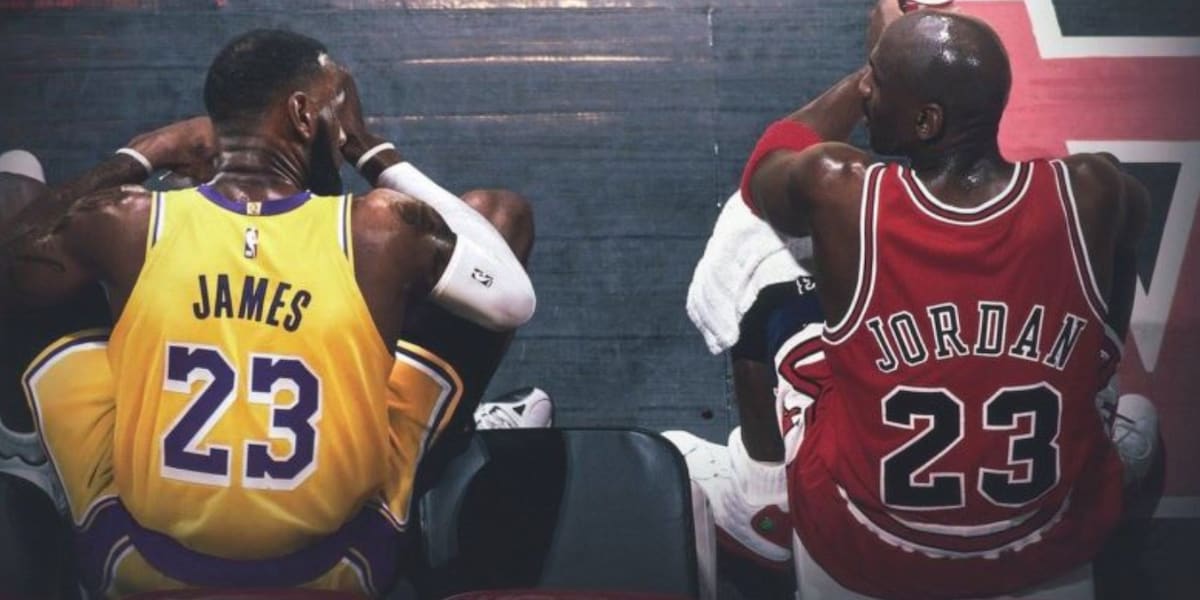
Isiah Thomas knows exactly where the NBA’s most exhausting argument lives: in the space between what people feel and what the numbers actually say.
That’s why his latest comments landed like a shove. On FanDuel’s “Run It Back,” the Hall of Fame guard questioned how Michael Jordan can remain the default “greatest of all time” answer in a league that now includes Stephen Curry and Kevin Durant, and in a sport where LeBron James has built a résumé so large it sometimes feels like its own category.
Thomas’ central point was blunt. In his framing, other sports tend to crown their icons with record books in hand, while basketball, in his view, keeps circling back to a player whose cultural impact, shoes, warmups, mythology, can overshadow statistical leadership.
“LeBron James is sitting there. He’s holding every single basketball record. You treat him like he ain’t nothing. And you’re looking at a Kevin Durant and Steph Curry. But then when you say who is the greatest, you talk about the guy that gave you some shoes and gave you some warmups…
… When you talk about track, tennis, football, baseball, arguably the best players or athletes in those sports, they all hold records. We talk about Jordan. He leads in no statistical basketball category. When you look at Kareem and LeBron, they lead in several statistical categories.”
Isiah doesn’t understand how people call MJ the GOAT when players like KD and Steph exist, and LeBron holds almost every major record.
“When you say who’s the greatest, y’all talk about the guy who gave yall some shoes and warmups”
(h/t @HeatCulture13)
— NBACentral (@TheDunkCentral) January 8, 2026
It’s a familiar theme in modern debate: rings and aura versus accumulation and longevity, peak dominance versus total production.
But Thomas’ argument also overreaches in ways that the numbers immediately correct, and that’s where the conversation gets interesting. He said Jordan “leads in no statistical basketball category,” a line that doesn’t survive even the quickest check. Jordan is the NBA’s all-time leader in career points per game at 30.12, and he also owns the highest career playoff scoring average at 33.45 points per game.
Those aren’t obscure metrics. They’re the sport’s most primal measurement, how much you score, per night, for an entire career, both in the regular season and when the stakes are highest.
This means the debate isn’t as clean as he presented it. Jordan does lead categories. LeBron leads categories. Kareem led categories. And the reason fans still argue is because each of those “categories” is a different definition of greatness.
If Thomas wants to make the statistical case for LeBron, he has stronger ammunition than the sweeping claim that James “holds every single basketball record.” He doesn’t. But he holds an extraordinary number of the ones that matter most in the modern era, starting with the biggest one: all-time regular-season points. He also owns massive postseason mountains, including most playoff points, games, and minutes, and he has pushed the combined scoring frontier to a place no one else has reached.
Even the league’s own record coverage has emphasized how LeBron’s longevity has effectively turned availability into dominance: a career built not only on brilliance, but on staying elite long enough to rewrite the volume pages of the book.
And that’s the crux. Thomas is arguing for a sports-world logic: in track, tennis, baseball, football, “best” often aligns with clear statistical leadership.
Basketball complicates that because the sport’s most famous icons do not all win their cases the same way.
Jordan’s case has always been about a ruthless peak: six titles, six Finals MVPs, scoring titles, the aura of inevitability, and, yes, a cultural footprint that turned him into something bigger than the league itself. But the numbers bolster him too, particularly in scoring rate and playoff scoring rate.
LeBron’s case is the opposite shape: unprecedented longevity at a superstar level, cross-era adaptability, and record-book dominance that grows heavier each season he keeps playing like an All-NBA guy in year 20-plus.
Durant and Curry, the two names Thomas invokes as modern-era giants, represent another truth: the league has evolved. Curry bent geometry and made three-point volume the sport’s organizing principle. Durant is one of the cleanest high-volume scorers the game has seen. Their impact is undeniable, even if neither has the same combination of peak myth and cumulative record ownership that fuels Jordan-versus-LeBron arguments every day of the week.
So what is Thomas really doing here?
He’s calling out what he sees as selective reasoning. If people want to use rings and dominance, Jordan is an obvious answer. If they want to use longevity and total production, LeBron has a historic case. If they want to use transformational impact, Curry belongs in the conversation. Thomas isn’t wrong to say the debate often begins with a conclusion, “it’s Jordan”, and then works backward into justification.
But the record book won’t let the discussion be reduced to “Jordan had shoes” either. Jordan leads in major statistical categories, and LeBron doesn’t own every single record. The truth is messier, and that’s why it persists.
