
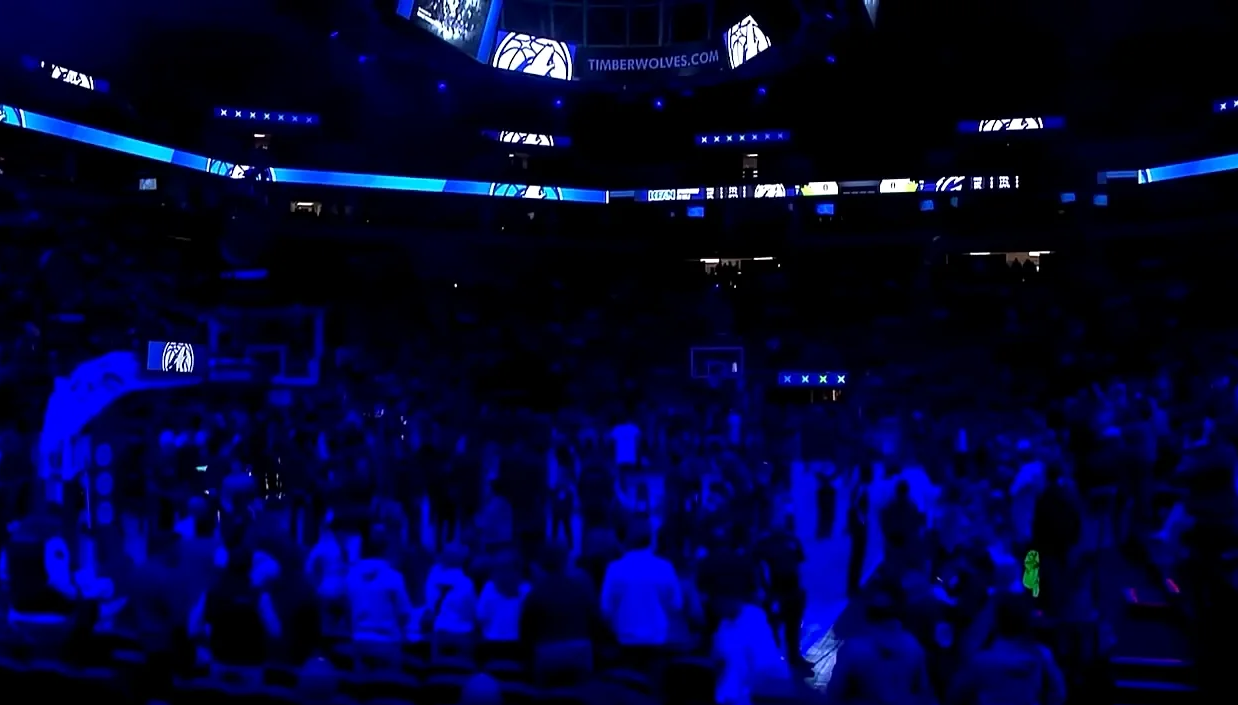
The silence inside Target Center landed heavier than most. Not because an arena full of fans suddenly forgot how to be loud, but because everyone understood why the Timberwolves asked them to stop.
Before Thursday night’s game against the Cleveland Cavaliers, the Minnesota Timberwolves held a pregame moment of silence for Renee Nicole Good, the 37-year-old Minneapolis resident and mother of three who was fatally shot while in her car by a U.S. Immigration and Customs Enforcement officer on Wednesday, Jan. 7, 2026, a few miles from the Wolves’ downtown home arena.
The Minnesota Timberwolves held a moment of silence for Renee Nicole Good. 🙏 pic.twitter.com/dwBLNwWub5
— OpenCourt-Basketball (@OpenCourtFB) January 9, 2026
Sports franchises do moments of silence all the time. What made this one different was the immediacy, and the civic wound underneath it. Good’s death has triggered grief and anger across the Twin Cities, with protests unfolding amid reports of a surge in immigration enforcement activity in the area.
The Wolves, a team that shares its city with the people living this story in real time, chose to acknowledge that the arena is not sealed off from Minneapolis, it sits inside it.
Coach Chris Finch offered condolences before the game, keeping the message simple and human: a team expressing sympathy for the people affected by a tragedy that hit home.
In the stands, the quiet was followed by a burst of emotion, an audible reminder that, for many fans, this wasn’t “news,” it was their neighborhood.
The facts at the center of the story are already stark. The fatal encounter happened during an ICE operation and involved a brief confrontation on a Minneapolis street.
The Department of Homeland Security has offered its own characterization of events, while eyewitnesses and city leaders have publicly disputed aspects of that narrative, and incident is being investigated at the federal level.
Good’s family has described her as compassionate and nonviolent, a mother devoted to her children, and a writer and poet who had built a life that did not resemble the kind of threat implied by official rhetoric.
That dissonance; between an agency’s justification and a community’s lived understanding of who was lost, is why this moment of silence carried political weight even without a single slogan. When a woman dies in an encounter with state power, the question is never only what happened in those seconds. It’s what kind of country creates the conditions for those seconds to happen at all, and what kind of accountability follows.
It’s hard to see this as anything but a warning flare. Immigration enforcement is supposed to operate under law and restraint, not as a roaming force that leaves communities feeling hunted, and certainly not as something so aggressive that a civilian ends up dead on a public street. When raids and crackdowns become normalized, the collateral damage stops being a hypothetical. It becomes a name, a family, and a moment of silence in a basketball arena.
Opposing “ICE raids in general” isn’t about being soft on the idea of borders. It’s about refusing to accept a politics that treats fear as a governing tool, where intimidation is a feature, not a bug, and where migrants and their neighbors are expected to live under constant threat of sudden disruption. When enforcement becomes spectacle, when rhetoric escalates toward dehumanization, you move closer to something Americans are supposed to reject on instinct: state power that feels unaccountable, punitive, and politically performative.
People can argue policy all day, but a democracy is judged by how it wields force, especially against the vulnerable, and especially in moments when it claims it had no choice.
The Timberwolves didn’t try to solve that argument in 30 seconds of silence. They didn’t have to. What they did was smaller, and in its own way, more important: they recognized Renee Nicole Good as a person worth grieving in public, and they recognized their city as something bigger than entertainment. In a time when cruelty is too often sold as toughness, a shared pause, an arena choosing empathy, can feel like a form of civic resistance.
For Good’s family, nothing about Thursday night changes what happened on Jan. 7. But in Minneapolis, where grief and anger are now braided together, the Wolves’ moment of silence made a statement that sports sometimes forget it can make: we see you, we mourn with you, and we won’t pretend this is normal.
