
The Minnesota Timberwolves didn’t just beat the Oklahoma City Thunder on Friday night, they beat the league’s most stable team while playing through chaos of their own creation.
Minnesota won 112–107 at Target Center, closing the game on an 8–0 run in the final minute to hand Oklahoma City only its third loss in 28 games this season.
The ending was pure late-game theater: Anthony Edwards buried a step-back three with 38.5 seconds left to take the lead, then turned around and made the defining defensive plays, a block on Shai Gilgeous-Alexander’s layup attempt and, in the final seconds, a steal that sealed it.
Edwards returned from a three-game absence and delivered 26 points and 12 rebounds, while Julius Randle added 19 points and eight rebounds despite a rough shooting night. Naz Reid and Donte DiVincenzo chipped in 15 apiece, and the Wolves got the kind of interior muscle they didn’t always have in this matchup last spring, with Rudy Gobert’s work on the glass repeatedly extending possessions.
Oklahoma City still looked like Oklahoma City for long stretches – Gilgeous-Alexander scored 35 with seven assists – but the Thunder couldn’t hold a late lead after going up 107–104 with just over a minute to play.
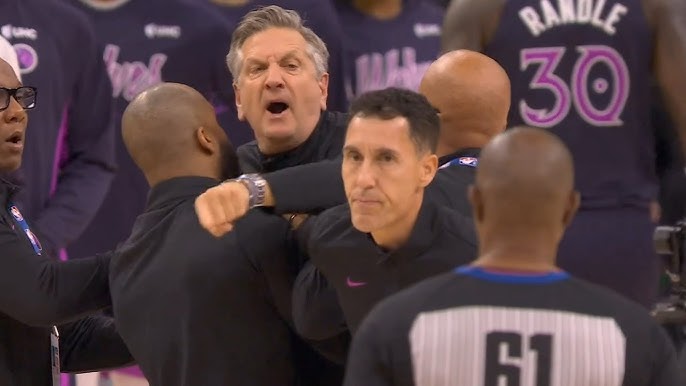
The game’s other defining storyline happened almost immediately, and it set the tone for everything that followed. Timberwolves coach Chris Finch was ejected midway through the first quarter after vehemently complaining about the officiating.
Finch erupted after a non-call on a Julius Randle drive, chased referee John Butler up the floor, drew a technical, then charged at the rest of the crew during the stoppage, earning a second technical and an ejection. Finch even had to be restrained by assistants as he came onto the court arguing that Luguentz Dort should have been whistled for a foul.
Timberwolves head coach Chris Finch disgusted with this no call against Julius Randle. OKC has played this way on D all year. The whole NBA knows it, and is sick of it. pic.twitter.com/8LtTej3tF6
— Chris Harrison (@charrison90) December 20, 2025
From there, the night became a strange test of Minnesota’s emotional control: the crowd was juiced, the matchup carried playoff residue, and the Wolves were essentially playing a marquee game without their head coach for nearly the entire night. Finch’s top assistant, Micah Nori, stepped in and, notably, framed the matchup with unusual calm.
“I think the one thing about this ball club, meaning, OKC, obviously, very good basketball team, but we’re comfortable playing them,” Nori said. “We match up well with them, and they don’t do anything that we didn’t see in the Western Conference finals.”
Edwards, in his own way, tried to downplay the emotional charge afterward; even as the game clearly meant something to a team that still carries the scar tissue of last season’s playoff exit.
“I mean, it was one game,” he said, noting that Oklahoma City was on the second night of a back-to-back.
But his other comments told the real truth about what Minnesota was chasing in this matchup: a higher ceiling when their identity is fully engaged.
“It takes us to another level,” Edwards said of Gobert’s impact. “I tell him all the time, ‘When you come play like that, I don’t think nobody can beat us.’”
That’s why this win matters beyond a single December result. Oklahoma City didn’t fold, it executed well enough to lead late, and Gilgeous-Alexander did what stars do. Minnesota simply finished better, and it did so while navigating the kind of early-game volatility that usually breaks teams. Finch’s ejection could have become an excuse. Instead, it became a backdrop to one of the Wolves’ most complete competitive performances of the season.
