
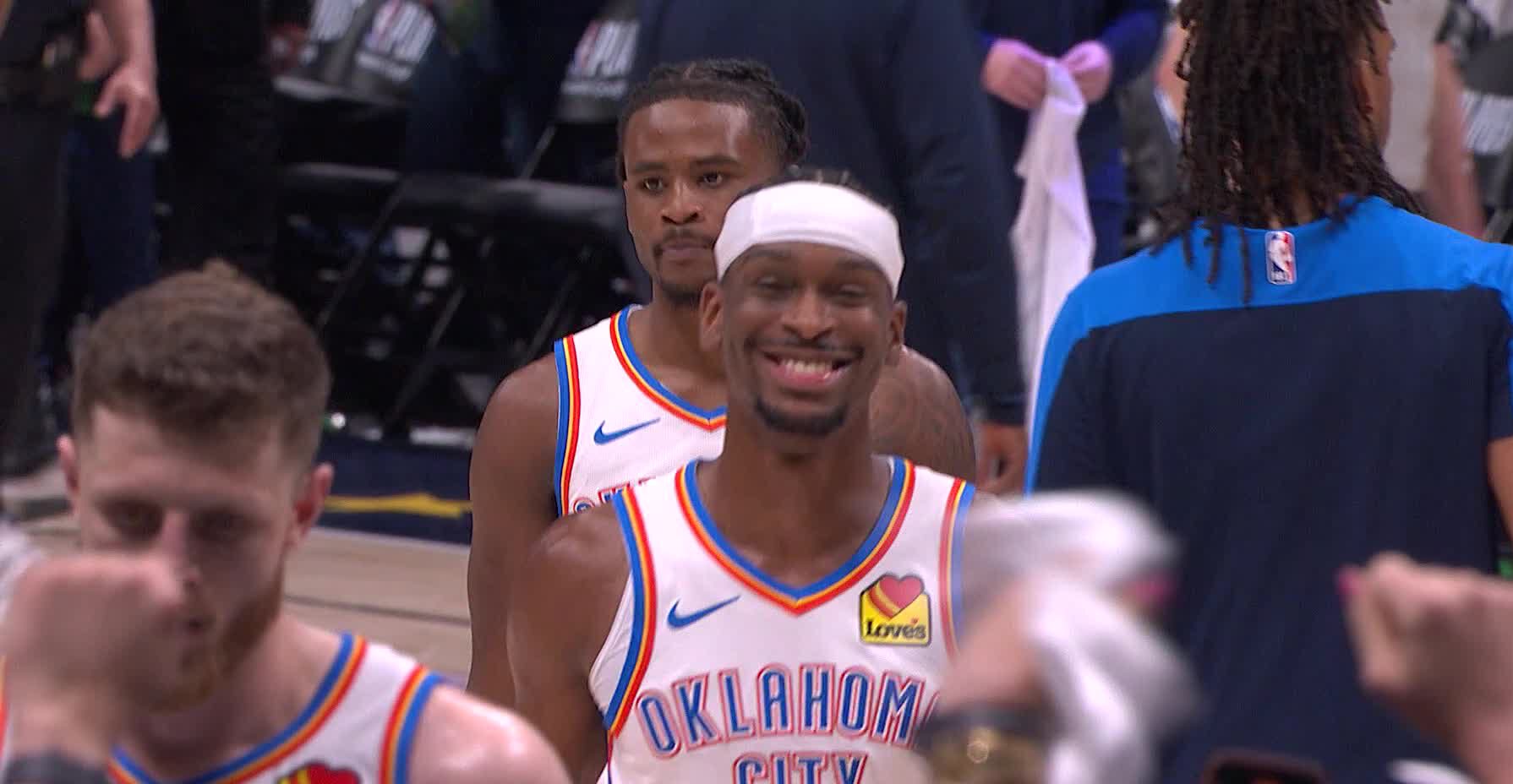
By any normal standard, the defending champion Oklahoma City Thunder are off to a dream start. By theirs, it already feels routine.
On a Wednesday night in November, the Los Angeles Lakers rolled into Oklahoma City looking for a measuring stick. They left with a 121–92 loss and a pretty clear message: the Thunder are not just good, they’re comfortably good. Shai Gilgeous-Alexander dropped 30, Oklahoma City moved to 12–1, and once again, its franchise player spent the fourth quarter sitting in warmups, watching his team cruise.
That was his seventh game this season in which he essentially got the fourth off while still averaging north of 30 points per night. In a league where stars routinely push past 36 minutes just to keep their teams afloat, Gilgeous-Alexander is putting up MVP numbers on a time-share schedule. And somehow, he still leads the NBA in crunch-time scoring. Welcome to the strangest, scariest power flex in basketball.
Last season, Gilgeous-Alexander authored one of the great modern campaigns: league-leading 32.7 points per game, 6.4 assists, 5.0 rebounds, the scoring title, regular-season MVP and Finals MVP, and the first championship of Oklahoma City’s era. The Thunder went 68–14 and posted a ludicrous +12.9 point differential, the best in NBA history.
You don’t follow that act easily. Unless you’re Shai.
Through mid-November, Gilgeous-Alexander is again near the top of the scoring charts at about 32.8 points per game on over 50% shooting from the field, efficiency numbers that used to be reserved for bigs camping near the rim, not guards beating traps 30 feet from the basket.
The Thunder, meanwhile, are 12–1 with the best record in the league and the best start in franchise history. There’s no championship hangover, no young-team regression, no sense that last year was a fluke. If anything, they look more comfortable. More inevitable.
And that’s where the fourth-quarter trend becomes so revealing.
To understand how absurd this is, you have to hold two facts in your head at once:
- Gilgeous-Alexander is playing fewer fourth quarters than he’s finishing. In a 13-game sample, he has already sat out roughly half of the fourth quarters entirely, usually because the Thunder are up by so much that keeping him on the floor would border on malpractice from a load-management perspective.
- He still leads the league in clutch points.By the NBA’s definition – last five minutes of a game with the score within five – Shai tops the league with 46 clutch points, outpacing everyone from Tyrese Maxey to Cade Cunningham and Victor Wembanyama.
That’s the contradiction that gets at just how good both he and OKC really are. When the Thunder do find themselves in close games, Gilgeous-Alexander doesn’t just show up; he owns the closing stretch so ruthlessly that he’s still out in front of the league’s best closers while logging fewer fourth-quarter minutes overall than just about any superstar of his caliber.
We saw it immediately this year. On opening night, he dropped 35 points in a double-overtime win over Houston, including the game-winning free throws. Two nights later, he hung a career-high 55 on the Pacers in another double-overtime thriller, carving up the same team (without the same players) he’d just beaten in the Finals.
The natural historical comparison is Stephen Curry’s 2015–16 masterpiece, when the Warriors went 73–9 and Curry averaged 30.1 points per game while sitting entire fourth quarters in blowouts so often it became a running joke.
That wasn’t myth. In that season, Curry played in 79 games and, according to detailed tracking done later, did not appear in the fourth quarter of 20 of them. For a 30-point scorer, that’s unprecedented territory.
Gilgeous-Alexander is now flirting with that same bizarre statistical niche. With around half his fourth quarters already wiped out through 13 games and his scoring average sitting above Curry’s 2016 mark, he’s on an early pace that would comfortably pass 20 fourth-quarter DNPs if this level of dominance and health holds. That’s not an official NBA “record,” but historically, you’re in extremely rare company the moment your season starts to resemble that Curry year.
The difference? Curry’s Warriors were a long-established juggernaut making history. Shai’s Thunder are doing this while still technically in their ascent, fresh off their first title with this group, still ahead of the age curve, and still adding pieces.
That’s the part that should worry the rest of the league.
If you want the single most terrifying Thunder stat, it’s not SGA’s scoring average or their record. It’s this: They’ve done all of this without Jalen Williams.
Williams, the All-NBA wing who blossomed into OKC’s clear No. 2 last season, has yet to play this year after offseason wrist surgery and a follow-up procedure to remove a screw. He’s still rehabbing and is expected back sometime in the coming weeks, but as of now, he’s a DNP across the entire 12–1 start.
In his place, the Thunder are leaning into the depth that Sam Presti has been hoarding. Chet Holmgren has taken another step as an all-court unicorn, toggling between rim protection and spacing the floor. Isaiah Hartenstein gives them the kind of bruising, playmaking 5 off the bench that good teams usually have to overpay for. Alex Caruso adds yet another elite perimeter defender and connective passer to a roster that already suffocates opponents at the point of attack. Around them, a rotating cast – Aaron Wiggins, Cason Wallace, Isaiah Joe, and Ajay Mitchell – fills in the gaps, shoots when open, defends like possession-by-possession matters in November, and seems weirdly unbothered by the pressure of being the hunted.
This is where those fourth-quarter sits become more than just a quirky stat. They’re proof of concept. You don’t rest your MVP for entire final frames unless the rest of the machine is so sound that the risk of collapse is essentially zero.
The Thunder are blowing teams off the floor not because Gilgeous-Alexander is going nuclear in short bursts, but because they come in waves. When Shai heads to the bench, the lineups don’t fall apart. The defense doesn’t crack. The offense doesn’t stall.
That’s the hallmark of an actual dynasty candidate, not just a hot start. As frightening as the present looks, the future is where the Thunder go from “title favorites” to “existential problem.”
Oklahoma City already has a championship core and a clean cap sheet. On top of that, they’re sitting on one of the league’s most ridiculous draft pick stockpiles. In 2026, they’re in position to control up to four first-round picks, thanks to a tangle of obligations involving Houston, Utah and Philadelphia. Crucially, the Thunder will get two of the most favorable 2026 firsts from their own, Houston’s (with protections) and the Clippers’ pick, with Washington taking the least favorable of the three.
The Clippers have stumbled out of the gate again, hovering in the lottery range early, a development that has not gone unnoticed in Oklahoma City, where that pick is already being circled as a potential top-10 asset.
Sam Presti has been here before. He once drafted Kevin Durant, Russell Westbrook and James Harden in a span of three years, then watched the economics of contention pull that team apart. This time around, he’s building something with more ballast, more cost-controlled talent, more optionality, more ways to survive the cap spikes and luxury-tax crunches that tear contenders down.
The current Thunder aren’t just a great team. They’re a great team with options.
If the right star shakes loose, OKC can stack first-rounders like poker chips and shove in the middle. If they stand pat, they’ve got a pipeline of young players and picks to cycle in as contracts escalate. Either way, there’s no obvious “this is where it all collapses” moment looming on the horizon.
So… Just How Good Are They? You could say “best team in the league right now” and be done with it, but that undersells what’s happening.
The Thunder just finished a 68-win, historically dominant, title-winning season. They entered this one as defending champions, started 8–0 for the first time in franchise history, and have pushed that to 12–1, all while their second-best player hasn’t logged a single minute.
