
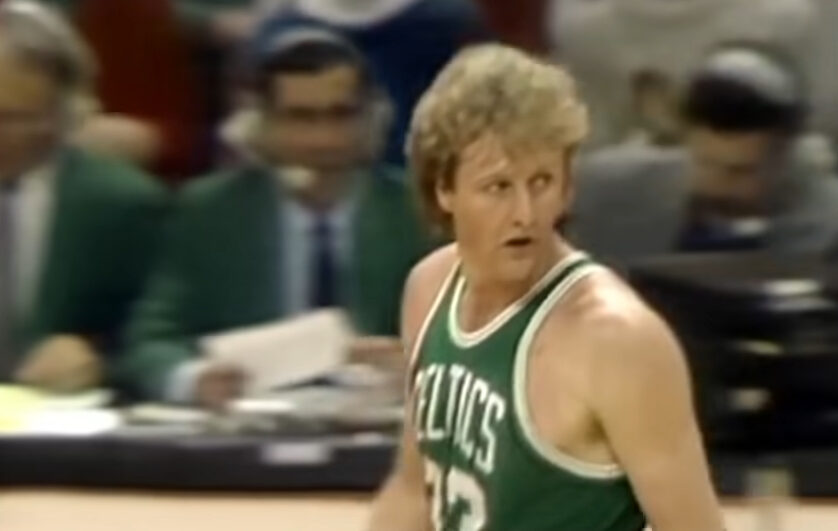
On August 18, 1992, Larry Bird officially announced his retirement from the NBA, bringing an end to one of the most influential careers in basketball history.
Bird stepped away at 35 years old after 13 seasons with the Boston Celtics, with chronic back problems ultimately making it impossible for him to continue. During his retirement press conference, Bird acknowledged how physically difficult his final years had become, particularly the daily battle with his back.
By that point, his résumé was already secure among the game’s greatest.
Bird retired after 897 regular-season games with 21,791 points, 8,974 rebounds and 5,695 assists, averaging 24.3 points, 10.0 rebounds and 6.3 assists for his career. He shot 49.6% from the field and 88.6% from the free-throw line.
The numbers only tell part of the story. Bird won three NBA championships with Boston in 1981, 1984 and 1986, captured two Finals MVP awards and became one of only a handful of players in league history to win three consecutive regular-season MVP awards, doing so from 1984 through 1986. He also earned 12 All-Star selections during a career spent entirely in Celtics green.
His arrival helped transform Boston almost immediately. The Celtics had won just 29 games in the season before Bird debuted in 1979-80. With Bird as a rookie, Boston jumped to 61 victories. Over the following decade, his rivalry with Magic Johnson and the Los Angeles Lakers became one of the defining forces behind the NBA’s explosive growth in popularity during the 1980s.
By the end, though, Bird’s body was struggling to keep up with his mind. He underwent surgery on both heels earlier in his career and later developed severe back problems that repeatedly forced him out of the lineup. He missed 37 games during the 1991-92 regular season and four games during Boston’s seven-game Eastern Conference semifinal series against Cleveland.
Yet even in his final season, Bird was still capable of producing reminders of what made him special. In March 1992, despite playing through significant back pain, he erupted for 49 points in a double-overtime victory over Portland.
Just months later, after helping the United States’ legendary Dream Team win Olympic gold in Barcelona, Bird knew the time had come. The Celtics soon retired his No. 33.
Thirty-four years later, Bird’s retirement still represents the end of one of basketball’s defining eras. He entered the league as a small-town Indiana star with questions about whether his athleticism would translate to the NBA. He left as a champion, an MVP, a Celtics icon and one of the greatest basketball players the sport has ever produced.
