
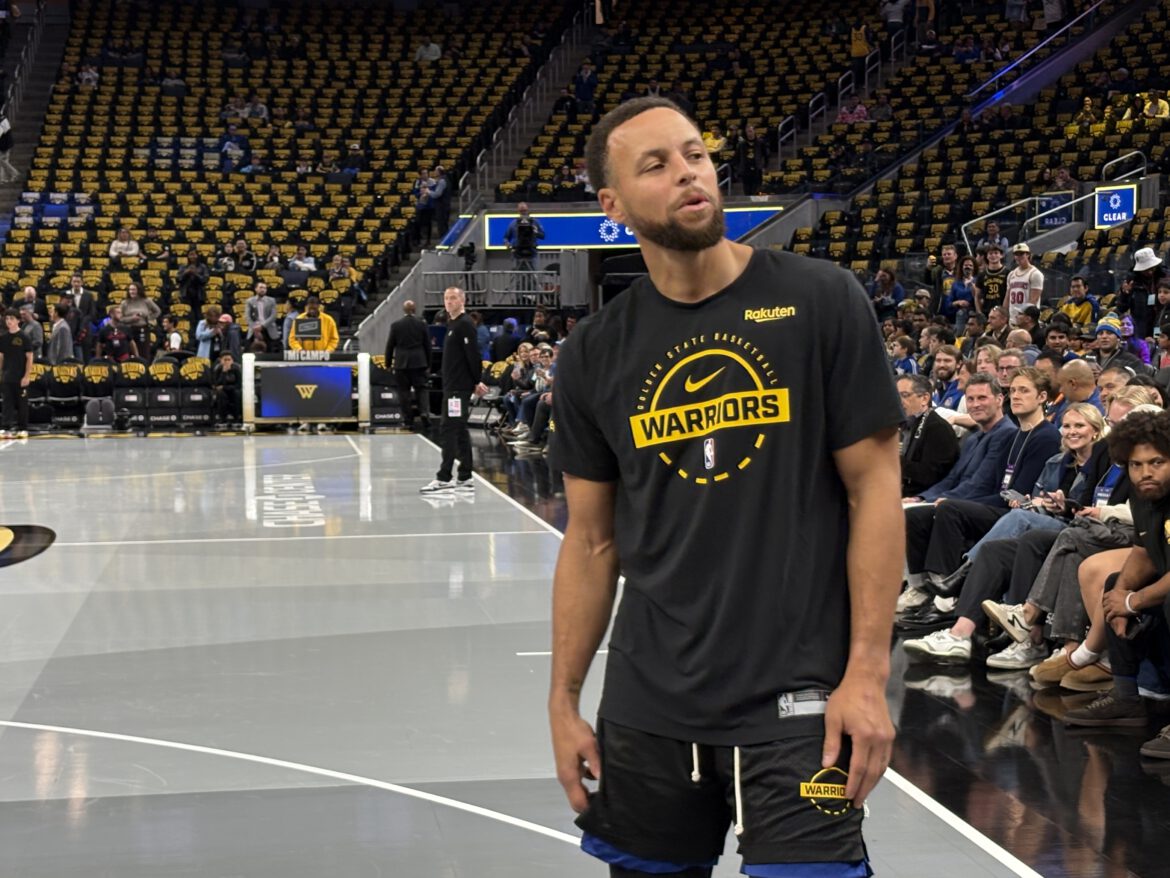
Stephen Curry is not pretending that the Golden State Warriors can simply resume their championship pursuit as if last season’s injuries never happened.
During a recent interview with Nick Friedell of The Athletic, Curry reflected on the losses of Jimmy Butler and Moses Moody, two major injuries that changed Golden State’s season and continue to shape its outlook for 2026-27.
Curry said:
“When Jimmy got hurt and Moses got hurt, the whole calculus of everything changes. How do you get through their absence and still stay at a certain level? And then how that goes into this year. It’s the same deal. So, I’m a realist on that.”
Butler suffered a torn right ACL in January and missed the remainder of the season. At the time of the injury, the Warriors were 25-19, and Butler was averaging 20.0 points, 5.6 rebounds and 4.9 assists. Golden State eventually finished 37-45 and missed the playoffs.
Moody’s season ended in March after he tore the patellar tendon in his left knee. The wing was enjoying the strongest statistical season of his career, averaging 12.1 points, 3.3 rebounds and 1.0 steal in 25.7 minutes per game.
Those injuries created two separate problems for Golden State. Butler’s absence removed a proven scorer, secondary creator and physical defender from the top of the rotation. Losing Moody further weakened the Warriors on the wing, reducing their youth, perimeter defense and lineup flexibility.
The uncertainty extends into the new season because both players are recovering from serious knee injuries. Curry’s comments suggest that Golden State cannot responsibly build its expectations around an immediate return to full strength. The Warriors must find a way to remain competitive while Butler and Moody recover, rather than assuming both will quickly return to their previous form.
Curry’s tone was not an attack on the front office, nor was it a declaration that Golden State cannot contend. It was an acknowledgment that the Warriors’ ceiling depends heavily on health, depth and the organization’s ability to survive the opening portion of the season without overloading its available veterans.
That reality places even more responsibility on Curry, Draymond Green and the rest of the rotation. Golden State will need younger players to develop, healthy veterans to remain available and its front office to provide enough support to prevent the season from becoming another exercise in waiting.
Curry still wants to compete, but he is no longer discussing the Warriors through nostalgia or blind optimism. His conclusion is more measured: Golden State may still have a path back to relevance, but that path begins with accepting how much Butler’s and Moody’s injuries have changed the equation.
