
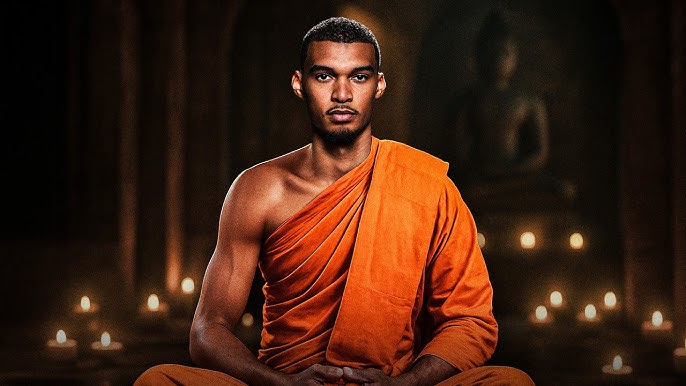
Victor Wembanyama has already stretched the imagination of modern basketball. At 7’4″, with guard skills, uncommon timing, and a defensive reach that seems to alter geometry, he has forced the sport to reconsider what a franchise player can look like. But even for a talent that unusual, there comes a point where the next step is no longer simply about adding skill. Sometimes it is about finding another kind of control.
That is what makes Wembanyama’s June 2025 retreat to Shaolin Temple so compelling. The trip, kept quiet at the time, was not framed as a publicity exercise or a curiosity. It was described instead as a deliberate search for something that conventional training could not fully provide: greater coordination, greater balance, and a deeper command of the mind under strain.
According to Shaolin master Yan’an, who oversaw the work, the premise was clear from the beginning.
“Basketball is not a game simply about physical confrontation.”
At the highest level of the NBA, the difference is often not found in weight-room numbers or shooting drills alone. It lives in the less tangible spaces: poise when momentum turns, emotional stability late in games, concentration through pain, clarity in exhaustion.
Yan’an said Wembanyama and his camp were not chasing kung fu techniques for direct use on the court, but something broader.
“For this reason, Wembanyama and his coaches saw in kung fu a kind of foundation that could help address these challenges – not specific techniques, but a philosophical system centered on focus and balance.”
For an athlete whose gifts are already historic, that is a telling idea. The project was not about building a new player from scratch. It was about sharpening the internal systems that allow rare talent to function at its highest level.
Even the first moments of the retreat suggested seriousness rather than spectacle. Yan’an recalled Wembanyama asking,
“Do I have to shave my head to become a true kung fu practitioner?”
When the answer came back yes, he reportedly did it immediately.
“Without hesitation, he sat down on the stone steps beside a statue and let me shave off his wavy brown hair with a razor.”
Whether one views that as symbolism, discipline, or simple curiosity, it left an impression on his teacher.
“That convinced me that his intentions were completely sincere — this wasn’t just a publicity stunt, as some had speculated.”
There were practical complications from the start. A monastery is not built for an NBA giant. The monks’ beds were too short, so three single beds had to be pushed together. Standard training clothes did not fit. The diet was another issue. Temple rules forbid meat and strong-smelling foods such as garlic and onions, while the nutritional needs of an elite professional athlete are far different from those of a monk. Wembanyama’s team reportedly solved that by arranging off-site meat-based meals, carefully respecting the monastery’s boundaries and customs.
But the most interesting part of the story is not the novelty of logistics. It is the structure of the work itself. On his first evening there, Yan’an said Wembanyama laid out three specific goals:
“to improve his physical coordination and control in complex conditions; to explore physical conditioning modalities beyond traditional training methods; and to enhance his mental focus and inner stability.”
That sounds less like a celebrity retreat than an athlete treating self-improvement as a research project.
The physical training was built around versatility rather than specialization. Yan’an described uphill jumps, downhill frog leaps, balancing drills, and movement on uneven terrain. For a player of Wembanyama’s dimensions, that matters. Height is a gift, but it also magnifies every instability. High centers of gravity are harder to control. Joints absorb more stress. Balance is constantly under negotiation. If basketball already makes Wembanyama a problem for defenders, this kind of training appears aimed at helping him remain efficient and composed while the game tries to knock him off axis.
That idea came through in Yan’an’s explanation of the program.
“At 2.24 meters tall, Wembanyama’s greatest challenge is gravity.”
It is a striking way to frame the matter. Most players battle opponents. Wembanyama, in some sense, must also battle physics. Yan’an also said the work emphasized force generation and maintaining a stable center under pressure. In basketball terms, that translates cleanly: absorbing contact, recovering balance, shooting or reacting while leaning, resisting the chaos created by double teams and collisions.
The retreat was not only physical. The more revealing element may have been the meditation. Wembanyama reportedly struggled with it at first and asked,
“Why do we just sit here?” Yan’an’s explanation was simple and profound: “meditation is a way of actively settling the mind.”
In his telling, the goal was to strip away noise, obligation, and identity until the athlete confronts the present moment without distraction. For a player who exists under constant observation and expectation, that may be as valuable as any drill.
One episode stands above the rest. On the sixth day, after Wembanyama asked whether there was a way to “train my awareness,” Yan’an organized a nighttime hike to Bodhidharma Cave in the mountains behind the temple. The group moved through darkness, without relying on lights, using moonlight, touch, hearing, balance, and concentration to navigate steep ground. Yan’an admitted his own concern.
“I felt slightly apprehensive — after all, he’s an NBA superstar; what if he slipped and got injured?” Yet he also offered the philosophy behind the risk: “But if one aspires to achieve the extraordinary, one must be willing to take on what others will not.”
That line could serve as a summary of Wembanyama’s entire career arc. Greatness rarely comes from comfort. In Yan’an’s account, the darkness stripped away dependence on sight and forced a more complete awareness. Once they reached the cave, Wembanyama sat to meditate, and the master saw not a global basketball phenomenon but, as he described it, “a man quietly seeking inner peace.”
There is a temptation to romanticize stories like this, to present them as mystical shortcuts or turning points that explain everything that follows. That would be careless. Shaolin training did not replace the years of elite coaching, strength work, skill development, film study, and medical oversight that shape an NBA star. But that is not what makes this worth writing about. Its value lies in the way it reveals Wembanyama’s seriousness. Plenty of gifted players chase refinement. Fewer seem willing to step outside the familiar structures of professional sport and submit themselves to a demanding environment with different rules, different rhythms, and no guarantee of immediate payoff.
Yan’an offered an analogy that captures the distinction:
“Wembanyama’s previous program was like swimming in a pool – professional, efficient, standardized. Shaolin training is like swimming in the sea – exposed to wind, waves, hidden currents, and uncertainty.”
That comparison is elegant because it does not dismiss basketball training. It simply argues that another form of preparation can develop other dimensions of resilience.
In the end, the most powerful image is not Wembanyama as phenom, marketer, or future face of the league. It is the image Yan’an himself returned to: the player meditating in darkness near Bodhidharma Cave, far from arenas and cameras, pursuing steadiness in a world built on motion. For a star of his scale, maybe that is the next frontier. Not becoming bigger. Not becoming flashier. Becoming more centered.
And in a league that tests the body relentlessly while attacking the mind from every direction, that may be the most advanced training of all.
