
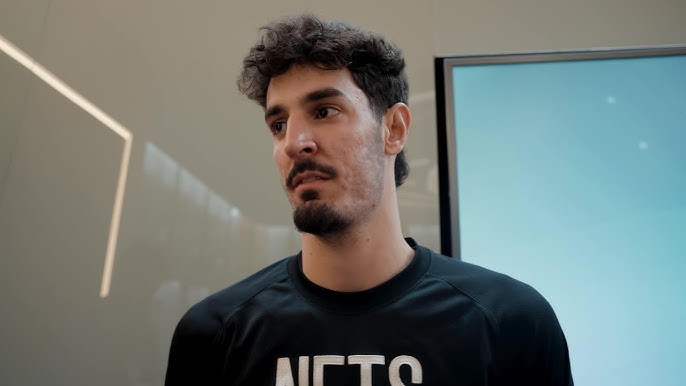
Ben Saraf’s development has never really been about flash. It has been about translation.
When the Brooklyn Nets selected the 6-foot-6 guard with the No. 26 pick in the 2025 draft, they were not drafting a finished product. They were drafting a profile: size, feel, passing, paint touch, poise, and enough professional experience in Europe to believe that the adjustment curve might be shorter than it is for most 19-year-olds.
Before Brooklyn ever put him in an NBA uniform, Saraf had already played real professional basketball in Israel and then in Germany with ratiopharm Ulm, where he averaged 12.3 points, 4.3 assists and 2.6 rebounds in his final season while shooting 46 percent from the field. He had also been named MVP of the 2024 FIBA U18 EuroBasket, another marker that he was not arriving as an unknown project.
What Brooklyn was buying, more than anything, was his ability to organize offense without looking overwhelmed by it. His draft profile described passing as Saraf’s best skill, highlighted his downhill game and mid-range comfort, and projected him as a floor general whose size could eventually allow him to play multiple positions. Even early in training camp, he looked unusually poised and physical for a teenager, not necessarily “NBA-ready” in the polished sense, but clearly not out of place either.
That matters when you go back to his Ulm season, because Germany was the proving ground for this version of Saraf. Ulm is not a place where young guards get to fake professionalism. The reads have to be quick, the body has to hold up, and the game punishes indecision. Saraf’s three-point numbers there were shaky, particularly in EuroCup play, where he averaged 12.8 points and 4.6 assists but shot just 22.2 percent from deep. Yet even then, the appeal was obvious: he could get into the paint, manipulate angles, and make the next pass. He was already playing a grown-up game, even if parts of the jumper and the efficiency still needed sanding down.
That is why his recent stretch with Brooklyn feels meaningful. Not definitive, but meaningful. Over his last eight NBA appearances, Saraf averaged 12.3 points and 4.5 assists, and those numbers are less important than the shape of them. There has been a 22-point night against Sacramento, a 14-point, seven-assist effort against Golden State, and multiple games in which he has looked increasingly comfortable touching the paint and making simple, composed reads once he gets there.
That progression was exactly what Jordi Fernández pointed to before Wednesday’s game against the Warriors. Asked by my colleague, Abby Cordova, how he had seen Saraf evolve with more playing time, the Nets coach said:
“Yeah, very happy with Ben as well. His ability to touch the paint. It’s elite. And defensively, he can chest drives. He’s big, physical, he can make plays for his teammates, he’s getting to play off two feet in the paint and making the simple play. So, once again, that comes with reps and adjustment and work and watching film and working at it. It’s been great working with him. We’ve seen the evolution of, like, the first few games and then playing in Long Island and now here with more minutes. And I’ve been very pleased with him.”
Jordi Fernández on how he has seen Ben Saraf evolve with more playing time. pic.twitter.com/5TECGrisSO
— OpenCourt-Basketball (@OpenCourtFB) March 27, 2026
That quote gets to the core of where Saraf is right now. He is not being praised for hot shooting or microwave scoring. He is being praised for the traits that survive translation: getting into the lane, using his body, staying balanced, making uncomplicated decisions and holding up physically on defense. Fernández’s phrase about playing “off two feet in the paint” is especially revealing. It is coach language for control. It means Saraf is not just crashing into the lane and hoping for a bailout; he is arriving there with purpose.
And that is where the Long Island Nets portion of the story matters. For many young guards, the G League is a holding tank. For Saraf, it appears to have been part of the calibration. Fernández explicitly mentioned the path from “the first few games” to “playing in Long Island” to now earning more NBA minutes. That is the developmental arc Brooklyn wanted: reps, film, adjustment, more reps, then a clearer sense of what translates. The organization did not need Saraf to dominate immediately. It needed him to absorb. Right now, he looks like he is doing exactly that.
So has he proven the Nets right? To a point, yes. He has validated the logic of the pick. Brooklyn drafted a big, creative guard with professional experience, trusting that his pace, paint touch and feel would hold up better than the box-score skeptics feared. Those qualities are showing. His ability to get downhill has been real. His passing has been real. His size has helped him survive. And the game does not seem too fast for him, which is no small thing for a teenager making this leap.
But it would be too early to call the case closed. The same questions that followed him from Ulm still hover around the edges. The jumper remains the swing skill. The efficiency comes and goes. There are nights when his aggression is there before the results are. There are others when the reads are right but the finishing still needs more NBA strength and craft. That is not failure. That is rookie guard life.
What Brooklyn has right now is not an answer, but a promising early outline. Saraf has not proven the Nets wildly right, and he certainly has not proven them wrong. He has done something more useful than either of those extremes: he has begun to look like himself at this level. For a young guard, that is a serious development.
