
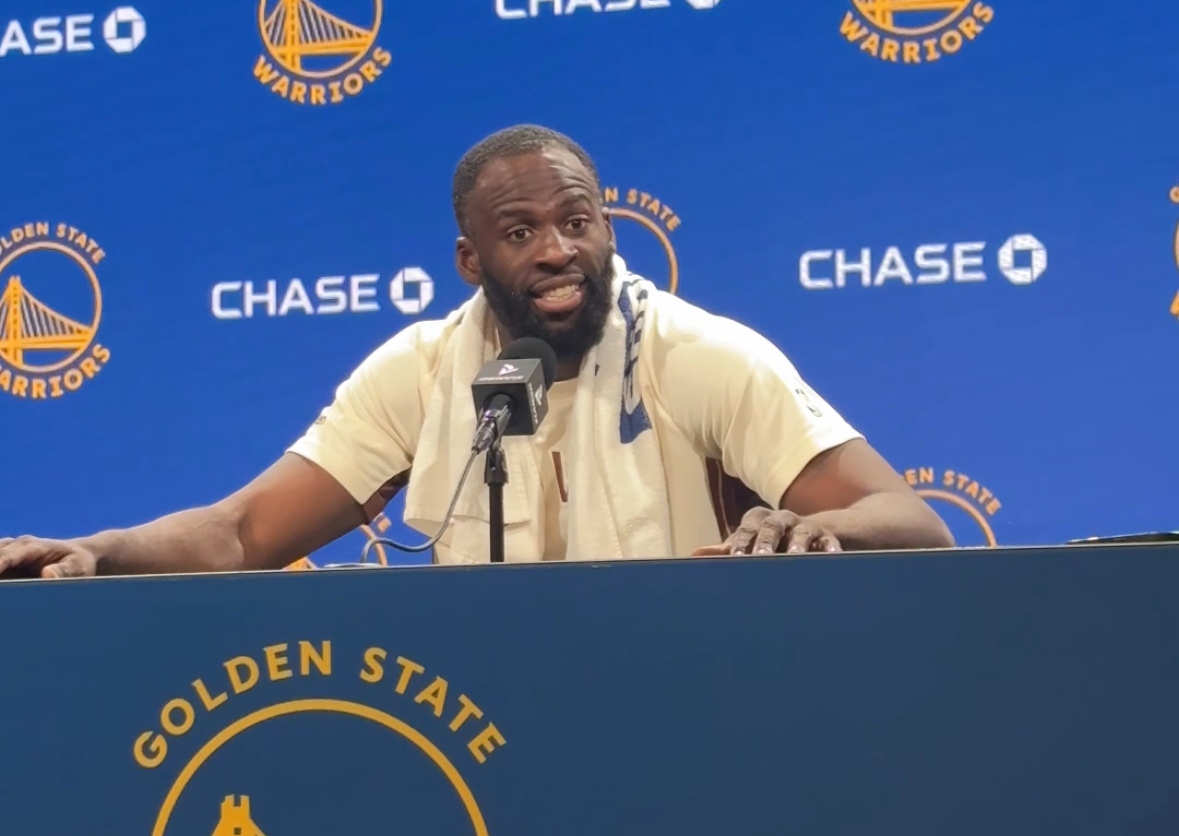
After the Golden State Warriors’ 109-106 win over the Brooklyn Nets on Wednesday, Draymond Green delivered one of the most revealing responses yet to Victor Wembanyama’s recent public MVP case.
Green said he both “hated” and “absolutely loved” what the Spurs star had done, not because he disagreed with it, but because he believed Wembanyama should never have needed to say it in the first place. Golden State’s win was secured by Gui Santos’ career-high 31 points and Green’s two late free throws, a result that clinched a play-in spot for the Warriors.
Wembanyama had argued this week that “defense is 50% of the game” and said he believes he is the league’s most impactful defensive player, framing that as a central reason he belongs in the MVP race. Green’s reaction showed both admiration and frustration.
“I hated it, and I absolutely loved it,” Green said. “And the reason I hate it is because until Wemby said defense is 50% of the game, it was like, oh, man, no one realized that? Right? Like, no one realized that 50% of the game we play is on that end of the floor?”
That was the heart of Green’s point. He was not criticizing Wembanyama for speaking up. He was criticizing the broader basketball culture for needing the reminder at all. Green went even further, saying,
“The fact that he has to come out and remind people, ‘Hey, y’all, see what I do over there?’ It’s like an indictment on the game of basketball.”
Sieh dir diesen Beitrag auf Instagram an
In Green’s view, a player with Wembanyama’s size, mobility and rim protection should not need a media campaign for people to recognize what is happening on defense every night.
At the same time, Green made clear that he respected the approach.
“And yet, and still, I love what he said. Like, I love the way he was approaching it.”
Green, who has made public award cases for himself in the past, argued that the reality of NBA voting is simple: if a player does not speak for himself, many voters and commentators will not fully see the case.
That is why Green’s answer landed as something more than routine postgame commentary. It became a defense of defense itself. He pointed to the contradiction in how the league discusses two-way basketball: players such as Luka Dončić are often criticized when their defensive standards slip, Green said, yet an elite defender like Wembanyama still has to fight for proper appreciation. In that sense, Green was not just endorsing one player’s MVP argument. He was questioning the values behind the debate.
For Green, the issue was never whether Wembanyama had a valid argument. It was why the argument still feels necessary. His final point was blunt and memorable:
“If you don’t come out and speak for yourself, it don’t work.”
That was part praise, part warning, and part indictment of a league conversation that still too often treats defense as secondary, even when one of the sport’s most extraordinary talents is making it impossible to ignore.
