
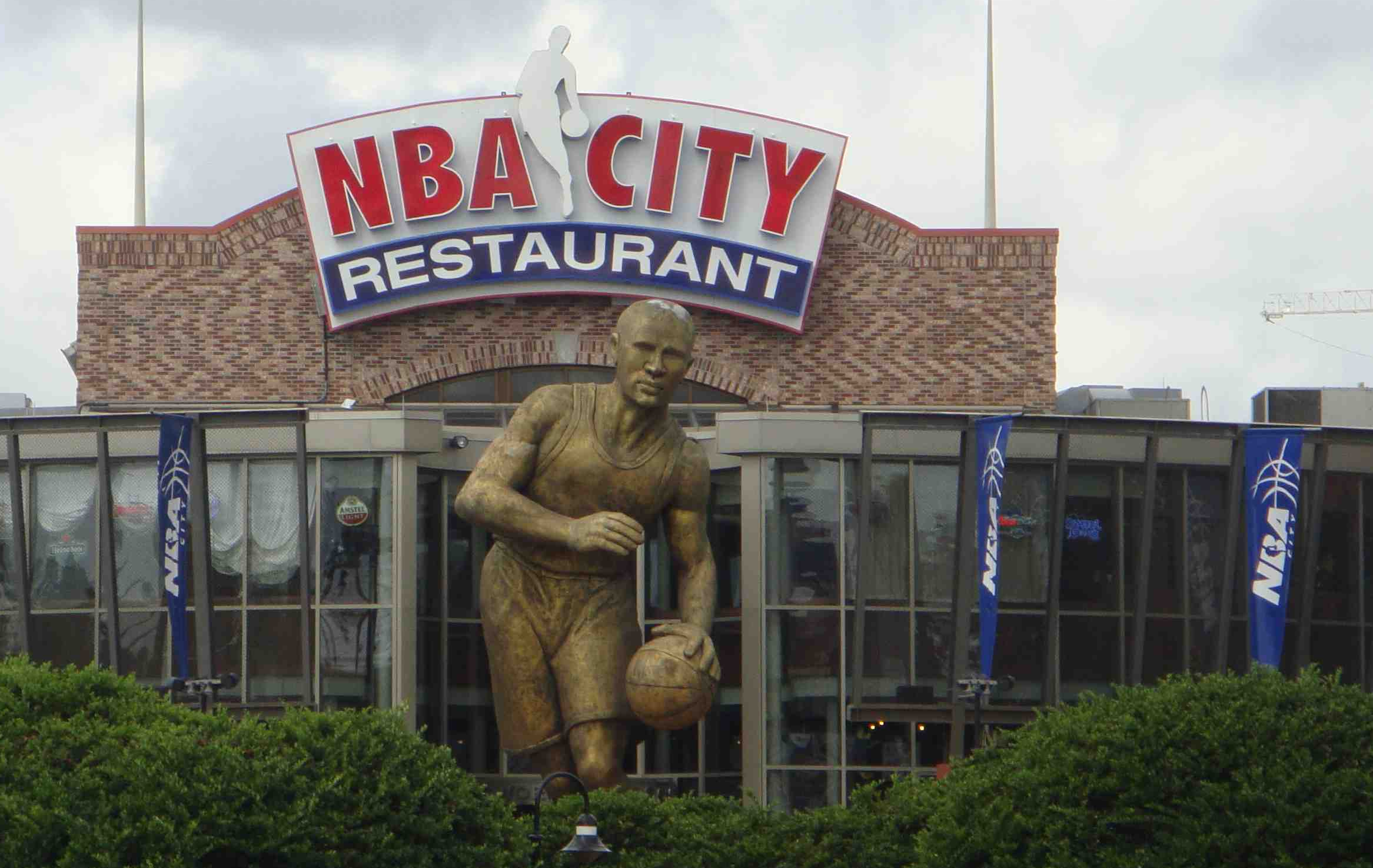
27 years ago today, on February 25, 1999, the NBA took a very late-’90s swing at expanding its brand beyond arenas and television. The league and Hard Rock Cafe International broke ground on a new concept, unveiling the name and logo for NBA City, billed as the first-ever NBA restaurant. The flagship was slated for the CityWalk entertainment district at what was then Universal Studios Escape in Orlando.
The idea fit the moment. The NBA was pushing hard into lifestyle territory, turning fandom into something you could wear, collect, and, in this case, eat inside. NBA City was designed as a basketball-themed restaurant and retail experience: part sports bar, part branded attraction, built to keep fans inside the NBA ecosystem even when there wasn’t a game on the floor. In Orlando, it opened as a large footprint venue in the heart of a tourist corridor where themed dining was currency and big brands competed for attention.
But if NBA City’s debut was a clean tip, the business plan quickly got messy.
Not long after launch, the original dream of turning NBA City into a multi-city chain hit turbulence. In May 2000, Sports Business Journal reported that Rank Group, then tied to Hard Rock’s role in the themed-restaurant project, pulled back from the partnership for future development, a shift framed as NBA City going from “high hopes” to essentially a lone flagship in Orlando. The vision of NBA City as a global restaurant rollout didn’t materialize the way the concept was initially sold.
By August 2000, there was another key change: Hard Rock Cafe International, which had owned and operated NBA City since its 1999 launch, relinquished development rights and ownership of the Orlando restaurant in a transaction that reflected how the project was being restructured and narrowed. In other words, the “first-ever NBA restaurant” remained real, but the broader expansion plan was already being rewritten.
What followed was a long, quieter second act in Orlando. NBA City stayed open in CityWalk for years as the surrounding entertainment district evolved, renovated, and swapped concepts in and out. The NBA City space became part of the nostalgia quilt for a specific era of sports culture, when leagues were experimenting with destination dining and branded “experiences” well before that word became corporate oxygen.
The end came in 2015. Universal Orlando announced it would not renew the lease and that NBA City would close in late August as CityWalk prepared for a new concept in that location. The restaurant ultimately shut down in August 2015, ending a run that stretched from its 1999 opening through more than a decade of changes in both the NBA and the theme-park entertainment business.
After NBA City, the space didn’t stay dark for long. Universal replaced it with The Toothsome Chocolate Emporium & Savory Feast Kitchen, a new in-house concept that was announced as the successor to the closed NBA City venue as CityWalk continued its broader dining refresh.
So what happened to NBA City since that optimistic groundbreaking in 1999? In practical terms, it became a one-location flagship that outlived the expansion dream, then eventually gave way to a new generation of themed dining. In cultural terms, it’s a snapshot of how the NBA has always chased the next frontier of fandom, sometimes successfully, sometimes experimentally, always with the same underlying belief: basketball isn’t just something you watch. It’s something you live in.
And for a stretch of time in Orlando, you could literally walk into it.
