
There’s a specific kind of disbelief that hits a player only after the points, the highlights, and the contract talk. Not the “I can’t believe I made it” feeling that comes on draft night, but the quieter, stranger version that shows up later, when you’re on the road, in a city that doesn’t belong to you, and you see your own name on someone else’s back.
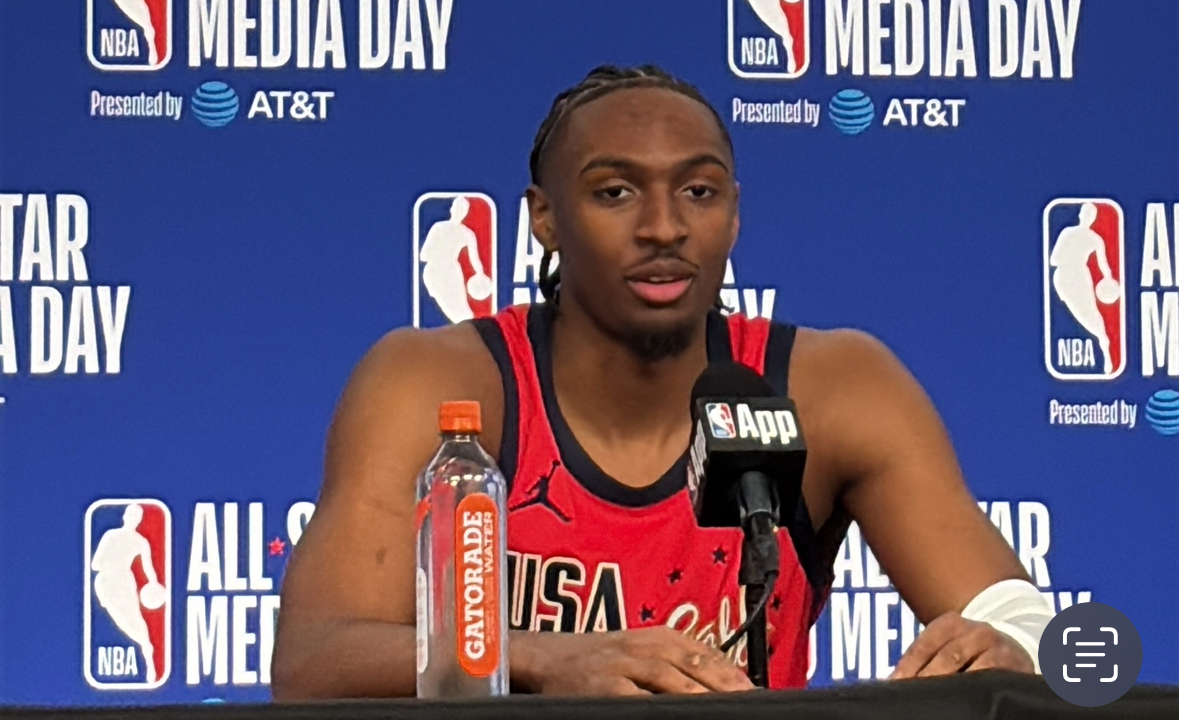
That’s the space Tyrese Maxey was describing at All-Star Media Day, as he reflected on what it’s been like to grow from a young guard fighting for minutes into one of the Philadelphia 76ers’ most beloved faces. He didn’t frame it as entitlement, or even as a milestone he’d set out to chase. He framed it like gratitude that still surprises him in real time; support “across the world,” and especially in Philadelphia, where fans tend to adopt players the way families do: loudly, fiercely, and for keeps.
Tyrese Maxey Still Has Moments Where It Doesn’t Feel Real pic.twitter.com/4qCMrLOp4T
— OpenCourt-Basketball (@OpenCourtFB) February 15, 2026
What Maxey pointed to was the shift from being recognized to being represented. He recalled being told a few years into his career that his jersey sales were high, and how that fact didn’t fully land until he started seeing Maxey jerseys away from Philly, outside the familiar comfort zones of Pennsylvania, or Texas, where he’s from. That’s when it became personal enough that he called his mom, almost as if he needed to say it out loud to make it real: people were wearing his jersey in places that had no reason to care, except that they chose to.
The numbers back up why that moment would hit the way it did. Maxey has already cracked the NBA’s midseason best-selling jersey lists, an objective marker that his popularity isn’t just local noise. In January 2026, The Philadelphia Inquirer reported that Maxey ranked in the league’s top 10 for best-selling jerseys based on the first half of the season. Earlier in his rise, he similarly landed in the top 10 during the 2023–24 season, an appearance that was widely read as a sign he’d leapt from “promising” to “nationally visible.”
But Maxey’s comments weren’t really about ranking. They were about responsibility, the feeling that comes with being a fan favorite in a market that cares as much as Philadelphia does. He talked about “putting on” for the organization and for his family, the way a player does when he understands that the jersey isn’t just merchandise; it’s identity. For some fans, pulling on a Maxey No. 0 is a way to signal optimism about where the team is headed. For others, it’s simpler: they like how he plays, and they like how he carries himself doing it.
Maxey’s NBA story makes that connection even more understandable. He entered the league without the immediate coronation that comes with being a top-three pick, then built his profile through steady improvement and big moments rather than branding. He was drafted 21st overall in 2020 and has played his entire NBA career with the 76ers. Over time, his on-court growth has been paired with something rarer and harder to manufacture: genuine warmth that doesn’t feel performative, even as the spotlight gets hotter.
That’s why the “surreal” part matters. Maxey wasn’t campaigning for credit. He was reacting to a reality he’s still processing, one where fans in other arenas, in other cities, are showing up in his name. In a league where superstardom can look calculated from a distance, Maxey’s version sounded almost disarmingly human: thankful, a little stunned, and still amazed that strangers are choosing to carry a piece of his journey with them.
