
There are certain matchups that don’t need scouting reports, only a deep breath. Kevin Johnson says he found out he was getting one of those matchups the way you learn bad news in a movie: half-asleep, mid-flight, trying to pretend it didn’t happen.
Johnson recently told the story on the Club 520 Podcast, recalling the Phoenix Suns’ trip from Phoenix to Chicago during the 1993 NBA Finals, with Phoenix down 0–2. He fell asleep on the plane, he said, and Suns head coach Paul Westphal woke him to deliver a message meant to sound like motivation: Game 3 was going to be “his game.” Johnson remembers feeling the moment click into place, until Westphal added the part that changed the temperature of the cabin. Johnson, a point guard who’d had a rough start to the series by his own telling, was going to be assigned to Michael Jordan.
The humor in the story comes from how quickly Johnson’s brain tried to protect him. He says he went back to sleep, the plane landed, and he woke up convinced he’d had a nightmare. Then he saw Westphal again while deplaning and tried to laugh it off, surely that couldn’t be real. Westphal’s response, as Johnson tells it, was simple: it was real.
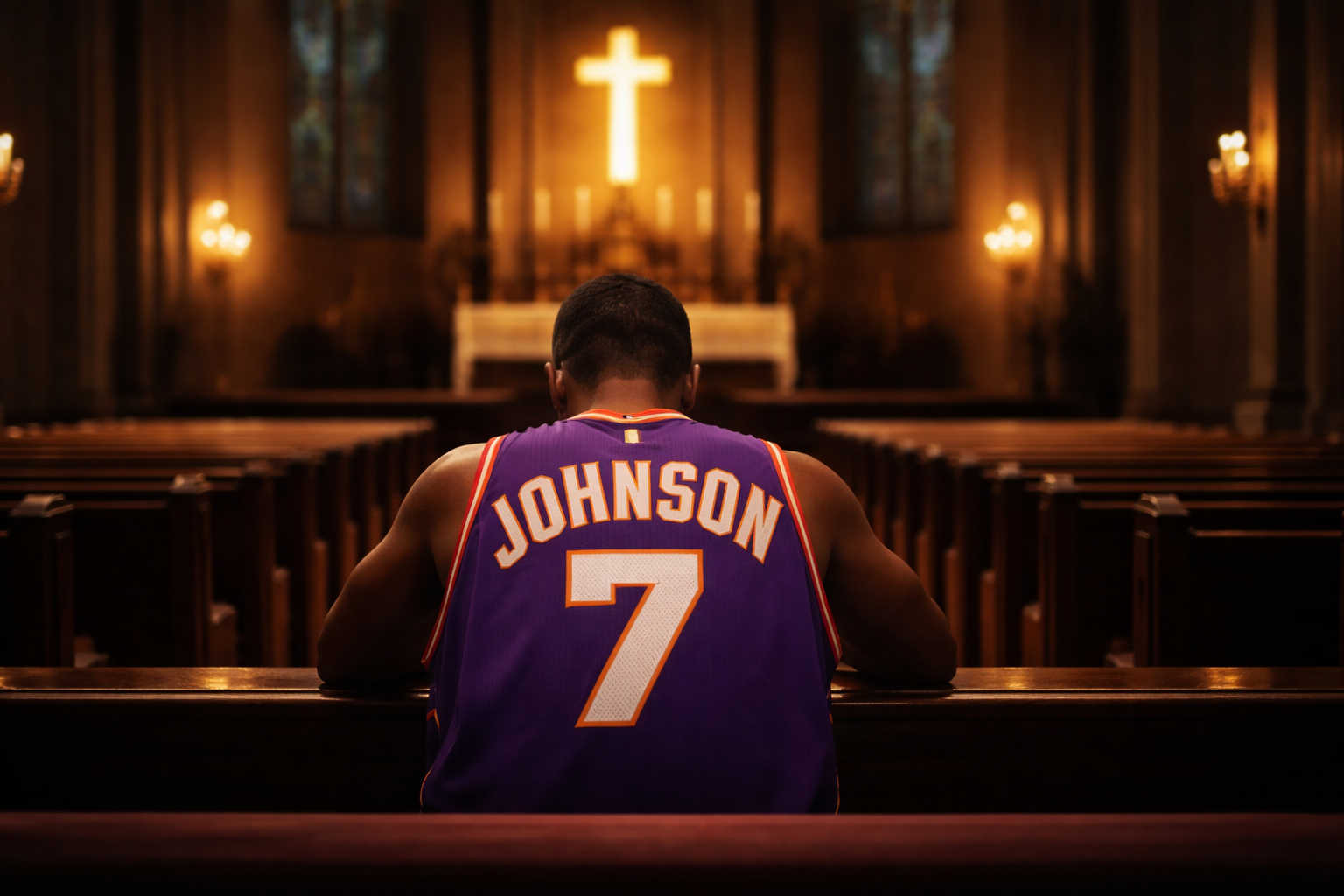
So Johnson did the only thing that made sense to him in that moment. He rode the team bus into downtown Chicago, got off at the hotel, handed his bags to the equipment manager, and walked straight into a church across the street. He sat in the front row and delivered what he presented as a completely honest prayer, except it wasn’t a prayer so much as a protest:
“Jesus, I don’t believe in you no more,” Johnson joked, because there was “no way” a loving deity would assign him to guard Michael Jordan.
Kevin Johnson telling a story about guarding Michael Jordan in the finals
“So we fly in from Phoenix to Chicago. I fall asleep on the plane and then the head coach wakes me up, right? He says, Hey, I just want to let you know, game three is going to be your game. Said, Cool.… pic.twitter.com/8wBHSjZRHa
— NBA Courtside (@NBA__Courtside) February 9, 2026
It’s a funny story because it’s an old basketball truth told with perfect timing: the fear of Jordan wasn’t limited to the opponents on the floor. It lived in the logistics. In the travel. In the way a series can turn a simple decision, who starts the possession on whom, into something that feels like a personal crisis.
The context makes it land even harder. That Suns team had won 62 games and was built around Charles Barkley, with Johnson as the engine, a blur-fast point guard who lived in the paint despite giving up size to almost everyone there. Chicago, meanwhile, was the league’s final boss in real time, and Jordan was at the center of the storm. When a coach starts reaching for new defensive looks in the Finals, it’s usually because the standard plan hasn’t been enough. Johnson frames it that way, too, noting that Phoenix’s top perimeter defender, Dan Majerle, had been working the assignment, and now the job was being pushed onto a player who’d already had two difficult games.
That’s what separates the anecdote from just being a punchline. It’s a reminder of how Finals basketball actually works: the desperation is often quiet, and it shows up first in matchups. A series doesn’t only test your best actions; it tests your roster imagination. Coaches don’t change primary assignments because it’s fun. They do it because they’re searching for oxygen.
Johnson’s telling also captures something else that gets lost in mythology: even elite NBA players experience dread. Not “I’m nervous,” but “I need to sit down somewhere and renegotiate reality.” That’s the real Jordan aura, the way the assignment could make a veteran point guard, in the middle of the NBA Finals, wander into a church and start bargaining with the universe.
