
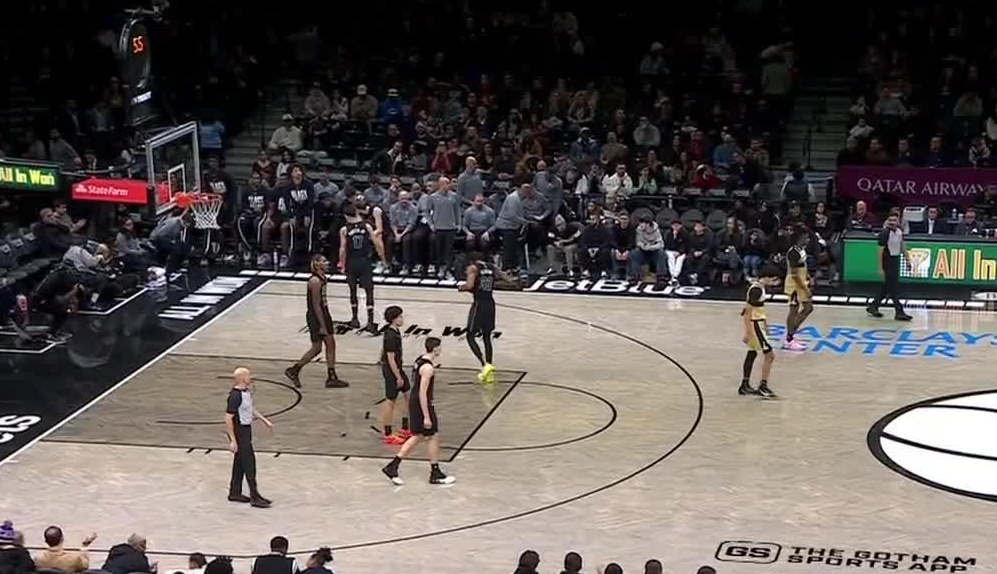
By Saturday afternoon in Brooklyn, the tank wasn’t subtle anymore. It was procedural.
The Nets beat the Wizards 127–113, but the score almost undersold how lopsided the day felt. Brooklyn hung 80 points in the first half – its biggest first-half output in more than three years – sparked by a 46-point first quarter and an avalanche stretch that turned the game into a formality before the arena had fully settled.
Washington, meanwhile, arrived at the edge of the league’s minimums. The Wizards dressed only eight players, and the starting lineup looked like a preseason experiment: Justin Champagnie, Tristan Vukčević, Jamir Watkins, Will Riley, and Bub Carrington. The absences were real and documented: Alex Sarr, Kyshawn George, and Bilal Coulibaly were all ruled out with injuries, and Washington’s post-deadline roster churn left newly acquired pieces unavailable. That combination created the kind of night fans read about more often than they see: a franchise knowingly operating at the margin of competitiveness, with the game’s “who’s active?” math becoming a storyline on its own.
What made it feel even stranger was the opponent. Brooklyn’s offense has had some historically bleak moments recently. The Nets scored just 66 points in a January 21 loss to the Knicks, and 77 points in a February 1 blowout loss to the Pistons. Two results that landed in the “how is that possible?” folder. And yet against Washington’s short-handed group, Brooklyn looked like a team playing against a scrimmage lineup: efficient shooting, constant paint pressure, and seven players in double figures, with Michael Porter Jr. leading the way.
To Washington’s credit, the players on the floor competed. Rookie Will Riley scored a career-high 27 points, with Champagnie adding 21, and Sharife Cooper and Vukčević chipping in 14 apiece. But the broader point, why this was the roster available in the first place, hung over everything.
This is where the modern tank has evolved. It isn’t only about resting stars. It’s also about availability management: injuries that may be legitimate but are handled conservatively; newly traded players held out longer than fans expect; and, increasingly, “minute ceilings” that function like load management without the public-facing bluntness of a DNP-Rest. Fans notice the pattern because it changes the texture of the second half of the season. A game can be technically legal, officially sanctioned, and still feel like it was never intended to be a real contest.
In Washington’s case, the contrast is amplified by the names attached to the rebuild. Anthony Davis, acquired from Dallas, has not debuted for the Wizards, and he is not expected to play the rest of the regular season due to injury. Trae Young, also acquired earlier, has remained sidelined with a right knee MCL sprain and a bruised quad. When marquee talent exists in theory but not in practice, the league winds up with nights like Brooklyn: an NBA game that, functionally, resembles a developmental showcase wearing regular-season clothing.
Adam Silver and the league office aren’t blind to the issue. The NBA already introduced a Player Participation Policy aimed at curbing star-sitting in marquee games and national TV windows. The problem is that the incentives pushing teams toward the bottom – draft position, development priorities, injury risk management – are structural. If a franchise believes the best path forward is to prioritize long-term health and lottery odds, it will search for the cleanest way to do that inside the rules. When “rest” becomes unpopular, the strategy migrates toward “minutes,” “maintenance,” and roster timing.
The danger isn’t that teams rebuild. Rebuilding is part of pro sports. The danger is the creeping normalization of nights where the competitive premise is compromised before tip-off, where the product asks fans to pay full price for something closer to a roster audit. Saturday’s Wizards weren’t throwing a game on the floor; they were simply operating within a system that makes these outcomes rational.
If the league wants to address the next iteration of tanking, it probably won’t be solved by one memo or one fine. It will take tightening loopholes and rethinking incentives: clearer standards for injury reporting and return-to-play timelines, stronger guardrails around post-trade player availability, and reforms that make late-season wins matter more for teams outside the playoff chase.
