
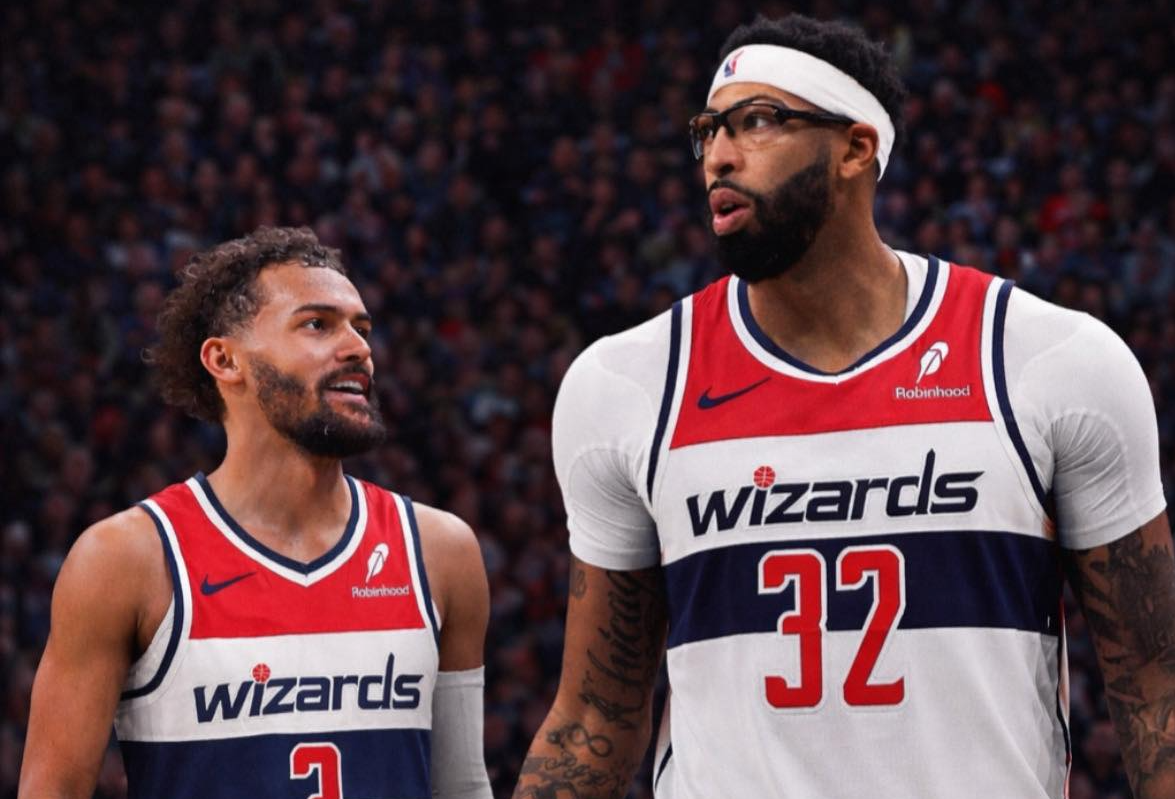
When the smoke clears, and, for Washington, when the injuries finally do too, the Wizards’ outlook for next season suddenly looks nothing like the rebuild they were selling a month ago.
The franchise has effectively bet its short-term credibility on a star pairing that would’ve sounded like a 2K fantasy draft not long ago: Trae Young as the offensive engine, Anthony Davis as the two-way anchor. Washington officially announced the Young acquisition on January 9, 2026, after completing a deal with Atlanta. Then, yesterday, on February 4, the Wizards struck again, landing Davis from Dallas in an eight-player blockbuster that also brought in Jaden Hardy, D’Angelo Russell, and Dante Exum, while sending out Khris Middleton, AJ Johnson, Malaki Branham, Marvin Bagley III, plus two first-round and three second-round picks.
The immediate reality is that Washington’s present tense remains messy. The Wizards entered Thursday, at 13–36, still near the bottom of the East. Availability is the first question, not fit: Davis is currently injured, and Young has also been dealing with health issues around the time of his trade. That’s why the real evaluation starts with next season, not this one.
If both are upright in 2026–27, the blueprint is obvious. Young’s superpower is forcing defensive rotations with deep shooting gravity and pick-and-roll manipulation; Davis’ is cleaning up possessions on both ends; rim protection, rebounding, and being a vertical spacer who can also punish switches. Washington doesn’t need that duo to be “pretty.” It needs it to be functional, consistent, and stressful for opponents. The Wizards have been searching for a clear offensive identity; Young gives them one instantly, and Davis gives it structure and a defensive floor that rebuilding teams almost never have.
The second layer is what Washington can build around them. The Wizards have been collecting young talent and minutes, and the Davis trade, while expensive in picks, didn’t wipe out that developmental runway. Alex Sarr is the clearest long-term piece in the frontcourt, and Washington also has recent first-rounder Tre Johnson in the building. In an ideal version of this, Sarr doesn’t get squeezed out; he gets simplified. With Davis absorbing the hardest defensive assignments and backline responsibilities, Sarr can grow without being asked to be the entire ecosystem. On the perimeter, young wings like Bilal Coulibaly become more dangerous when the offense has a true advantage-creator instead of a committee. (That matters because a Young-led team lives and dies by which non-stars can hit open shots and make the “one extra pass” reads.)
But the biggest question for the Wizards’ next season isn’t whether the two stars “fit”, it’s whether Washington has the supporting infrastructure to survive the nights they don’t play. That’s the hidden tax of this approach. A team built around Young and Davis can look like a playoff team one week and a lottery team the next if it doesn’t have enough two-way competence behind them. Washington’s front office has stocked options (Hardy is a real developmental swing, Russell is a veteran playmaker if he remains on the roster, and Exum is another guard/wing connector if retained), but the roster still needs dependable defense on the wing and shooting that holds up when scouting tightens.
That’s why this is such a fascinating pivot: Washington is no longer operating like a team patiently waiting for a superstar to fall into its lap. It’s acting like a team trying to manufacture relevance – and quickly – by pairing a heliocentric guard with an elite big and letting the market sort out the rest. The price was real draft capital, and the risk is real injury history. The upside, if the timing and health cooperate, is that the Wizards can walk into next season with a star-driven ceiling they simply didn’t have at 13–36; and a clear, sellable identity for the first time in years.
