
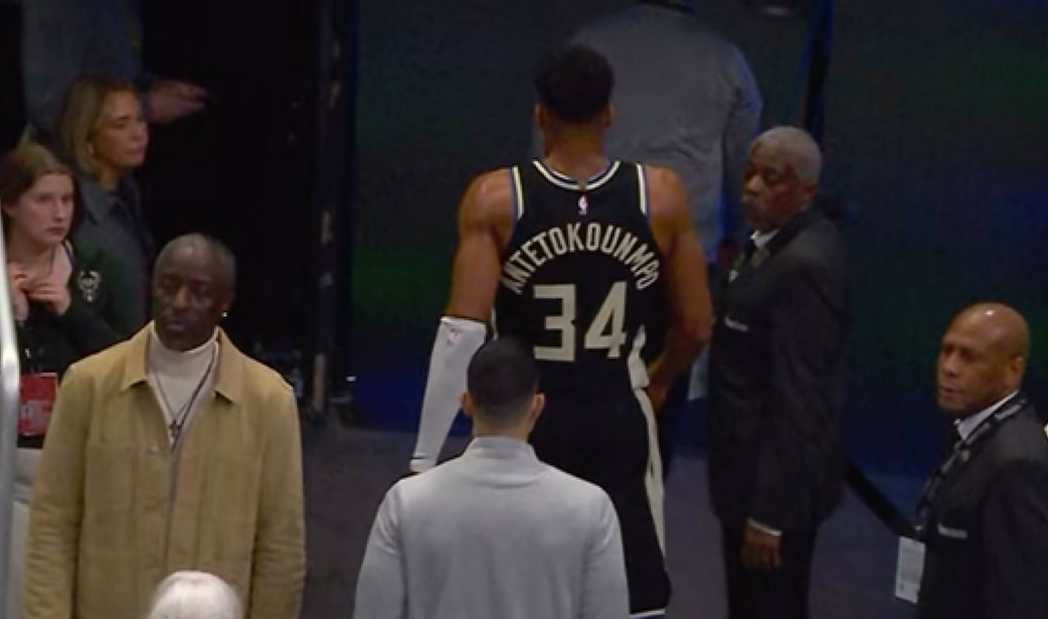
Giannis Antetokounmpo walked off the floor Friday night with a right calf injury, and then, in a way that felt uncomfortably on brand for this season, he filled in the blanks himself.
Postgame, Antetokounmpo told reporters he believes he has a right calf strain and expects to miss four to six weeks, adding that an MRI is scheduled for Saturday. It sounded less like speculation than recognition. Giannis explained that the pain felt familiar, similar to a calf issue he had already dealt with earlier this season, which is why he felt confident enough to attach a timeline before imaging.
The injury occurred late in Milwaukee’s 102–100 loss to the Denver Nuggets, a game the Bucks let slip after briefly regaining control. Antetokounmpo finished with 22 points, 13 rebounds, and seven assists, but numbers weren’t the story. What lingered was the image of him on the bench at the end, quiet, still, and visibly deflated. For a player whose default posture is defiance, it was an unusually heavy look.
Thanasis Antetokounmpo consoling his brother Giannis while he’s injured on the bench ❤️ pic.twitter.com/zkO9TsrJOp
— NBA on Prime (@NBAonPrime) January 24, 2026
Doc Rivers acknowledged afterward that Giannis wanted to return, but the staff held him out, wary of the calf tightening further. Calf strains are notorious for that: they rarely explode, they just keep asking for patience, and they punish teams that don’t give it. Four to six weeks is not catastrophic in isolation, but it’s significant enough to reshape a season, especially one that has already felt brittle.
On its face, this is an injury story. In reality, it instantly became something larger.
Because this fear “have we seen Giannis’ last game as a Buck?” did not materialize out of thin air. It has been forming in layers.
The first layer appeared last summer. Following another early playoff exit, league-wide reporting made it clear that rival executives were monitoring Milwaukee, not because Giannis had asked out – he never has – but because the Bucks’ margin for error was shrinking. The roster was aging, future draft capital had been moved, and the Eastern Conference was getting younger and deeper. The language at the time was cautious, but unmistakable: if Milwaukee stalled again, questions would get louder.
They did. Slowly at first.
This season, the whispers have been louder still. Not because Giannis changed his tone, publicly, he hasn’t, but because time and circumstance have changed the math. Around the league, executives look at Milwaukee and see a franchise walking a narrowing ridge: still competitive, but increasingly dependent on Giannis being superhuman to keep them there. Every uneven stretch, every health concern, every loss that feels heavier than it should gets interpreted through that lens.
Which is why Friday night felt ominous.
A four-to-six-week absence lands right in the part of the season when teams clarify who they are and where they’re headed. It overlaps with trade-deadline conversations. It raises questions not just about wins and losses, but about direction. And injuries, especially recurring soft-tissue ones, have a way of accelerating conversations organizations were already having quietly.
Contractually, nothing has changed. Antetokounmpo is not about to hit free agency, and there is no confirmed indication he has requested a trade or privately pushed for one.
But this is where realism creeps in. Superstars don’t have to ask out for their futures to feel uncertain. Sometimes it’s enough for the environment around them to stop feeling stable. Sometimes it’s enough for the season to start asking the same questions over and over, without offering convincing answers.
What made Giannis’ postgame remarks resonate wasn’t that he diagnosed himself. It was that he sounded like someone who already knew what the injury meant, not just for the next month, but for a season and a situation that had been teetering long before his calf tightened.
Maybe this ends quietly: rehab, return, a late push, familiar noise fading back into the background. That outcome still exists.
But the reason fans are asking the question now, the reason it feels heavier than idle speculation, is because this moment sits on top of a long-running unease. And once that unease is visible on the face of a player who rarely lets doubt show, it’s no longer unreasonable to wonder whether the window is just closing, or already starting to slide shut.
