
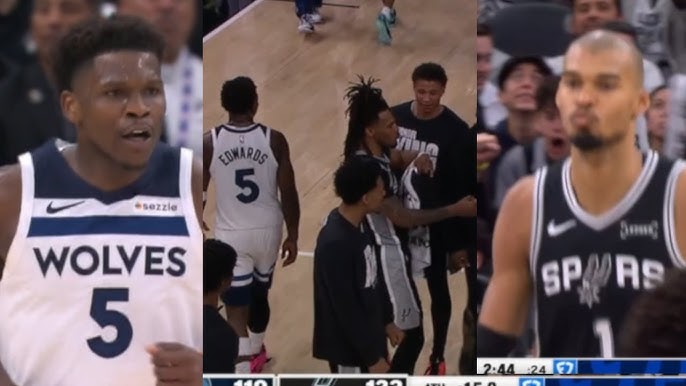
Some regular-season games feel important because they affect the standings. Others feel important because they reveal the league’s future in real time.
San Antonio’s 126–123 win over Minnesota on Saturday was both. It was a thriller that swung wildly, part blowout, part comeback, part late-game chess match, and it featured the kind of superstar duel that doesn’t need marketing help. Anthony Edwards and Victor Wembanyama combined for 94 points (55 and 39), trading haymakers across styles, positions, and eras.
Edwards produced a career night: 55 points, including 39 in the second half and 26 in the fourth quarter, nearly dragging Minnesota over the finish line by himself. Wembanyama answered with a superstar line of his own, 39 points, nine rebounds, two blocks, and then did the thing that turns a big game into a signature one: he decided the final possessions.
This is why Spurs–Wolves immediately entered the “best game of the season” conversation. It wasn’t just the scoring. It was the structure of the chaos.
San Antonio detonated the second quarter so violently it looked like the game had been solved early. The Spurs outscored Minnesota 48–22 in the period and carried a 69–44 halftime lead, with Wembanyama erupting for 20 points in that quarter alone, nearly matching Minnesota’s entire output in the frame. Then the game flipped. Minnesota kept coming, and by late in the fourth the Timberwolves actually pushed in front, with Edwards hitting shot after shot until the arena felt like it was tilting.
From there, it became a late-game classic: ties, lead changes, crunch-time threes, and the physical stress of every possession. Eight ties and 10 lead changes, with Minnesota seizing a lead in the final five minutes before San Antonio survived.
Wembanyama hit a key jumper to nudge San Antonio ahead, then delivered a block that helped set up a Keldon Johnson three in the final seconds. Edwards answered with a corner three. De’Aaron Fox hit pressure free throws. Edwards missed a free throw that would’ve tied it, then San Antonio’s missed free throws opened the door one last time, before Wembanyama grabbed the offensive rebound that effectively sealed it and forced a desperation heave at the horn.
It was messy, but it was honest. That’s what great games are: two teams losing control, then trying to regain it with their best players doing the hardest things at the hardest time.
And hovering over the entire night was the deeper reason it felt like an event: Edwards vs. Wembanyama is starting to look like a rivalry the NBA will be built around.
Not because they talk the loudest. Because their styles collide in a way that creates meaning.
Edwards is the modern perimeter force: explosive, ruthless, a downhill scorer who can also pull-up from deep and turn a fourth quarter into a personal stage. Wembanyama is the league’s ongoing glitch: size that changes shot selection, touch that stretches defenses, and late-game defense that can end possessions before they’re finished. Put them in the same game and the matchups become elastic. Edwards wants to attack the rim; Wembanyama is a moving deterrent sign. Wembanyama wants to shoot over the top and punish switches; Edwards wants to test him, to make the seven-foot-four problem move laterally, to prove the paint still belongs to aggression.
The edge between them is already out in the open. After this latest duel, the San Antonio Express-News reported Edwards basically said the quiet part loud: he’d love to clear the floor and go “check up”, one-on-one, against Wembanyama. That’s not a throwaway quote. That’s a player admitting he’s motivated by a specific opponent in a way that feels personal, competitive, and ongoing.
And it’s not just one game. Six days earlier, Minnesota beat San Antonio 104–103 in Minneapolis in another tight finish, with Edwards again getting the better of the late moment while Wembanyama still poured in 29 in defeat. Two nail-biters in a week, decided late both times, each one defined by those two trading headline-worthy stretches. That’s how rivalries form: repetition plus stakes plus signature moments.
Even the context around the game made it feel like a preview of the league’s next chapter. Minnesota was without Rudy Gobert (hip contusion), forcing them to survive without their defensive anchor while Edwards tried to supply enough offense to cover everything else. San Antonio leaned on Fox’s control (25 points, 12 assists) and still needed Wembanyama’s late-game two-way presence to close the door. It wasn’t just two stars hunting highlights; it was two teams showing what their identities look like under maximum pressure.
That’s why Spurs–Wolves felt like one of the season’s best games. It had the emotional arc fans remember, big lead, furious comeback, breathless finish, but it also had the ingredient that makes a regular-season game echo: the sense that you just watched something that will happen again and again, with higher stakes each time.
Because Edwards isn’t going away. Wembanyama isn’t going away. And if the NBA’s next era is going to be defined by players who can bend games in entirely different ways, then this matchup, force versus geometry, swagger versus inevitability, already has the shape of a long future.
On Saturday night, it was 126–123. It also felt like a trailer.
