
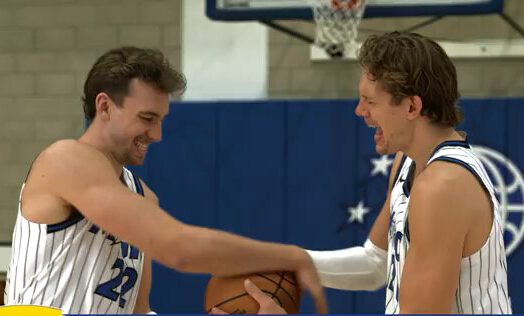
The night the NBA finally arrived in Berlin as a real regular-season stop, the biggest challenge for the city’s favorite sons wasn’t a matchup, a scheme, or the jet lag. It was logistics.
Before the opening tip of the NBA’s first regular-season game played in Germany, the story circulating around the Orlando Magic’s Berlin return was almost absurd in its scale: the Wagner brothers, Franz and Moritz,were said to have had to “take care of” roughly 200 to 250 tickets for friends, family, and familiar faces back home. Dirk Nowitzki even referenced the same idea publicly in NBA-produced content, joking about the sheer number of seats they needed to secure.
That’s the part fans rarely see. The homecoming isn’t only emotional; it’s administrative. It’s group chats, cousins, childhood coaches, former teammates, neighbors, plus the quiet pressure of not letting anyone down on the one night the league comes to your city and the whole country is watching.
And then the game actually happens.
In the middle of that, I asked Franz about his people in the crowd. When you’ve spent days moving 200-plus people into an arena, how many of them do you actually see once the game begins?
Franz said he saw his parents, he knew where they were sitting, and he spotted one of the groups, but not all of them. If he’d “started better,” he joked, maybe he would have noticed more. The important part, he told you, was what he heard afterward: everyone got in, everyone was taken care of, the ticket mission worked. And he admitted he was genuinely happy they pulled it off.
Arbeitsnachweis NBA Berlin (Danke für die Videos @JedenTagNBA) pic.twitter.com/MkJPM1mAUX
— Len Werle (@RealLennyCarlos) January 16, 2026
Then I asked Moritz a version of the same question, and his answer landed in a different register, more revealing about what it costs to play “at home” when home is suddenly looking back at you from every row.
Moe told me it was an “ongoing challenge,” because this kind of opportunity doesn’t come often. Of course you want to enjoy it. Of course you want to look up, take it in, feel it. But then he snapped the night back into the hard reality of professional basketball with one line: on the other side of enjoyment is having to guard Jaren Jackson Jr. In other words: sentiment doesn’t box out. Emotion doesn’t close the gap.
He described it as a balancing act between focus and fun, and he admitted something most athletes won’t: that distraction is part of his personality. That it actually costs him energy to lock in when there are familiar faces everywhere and the atmosphere is pulling at him. But he felt they managed it. And because Orlando won, he said, they could laugh about the mistakes afterward.
Arbeitsnachweis NBA Berlin (Danke für die Videos @JedenTagNBA) pic.twitter.com/MkJPM1mAUX
— Len Werle (@RealLennyCarlos) January 16, 2026
That’s the real anatomy of a homecoming at this level. The arena gives you the illusion of comfort—your language, your city, your people. The game itself gives you no comfort at all.
Berlin added its own layer to that feeling earlier in the day, when the BVG temporarily renamed Richard-Wagner-Platz to honor the brothers, a very Berlin gesture—public transportation as civic affection. But the ticket scramble was the private version of the same thing: the city embracing them, and them trying to embrace everyone back.
Because 200 to 250 tickets isn’t just a number. It’s proof of how many lives touch yours before you ever become an NBA player. It’s the full inventory of a childhood. It’s the reminder that “making it” doesn’t erase your old world—it enlarges it, and then asks you to manage it while a 6-foot-10 All-Star is driving at you in the third quarter.
Orlando’s comeback will live in the standings and the game book: 118–111, a historic Berlin night, Banchero driving the engine, Franz returning in front of his home crowd, and the Magic flipping the game with defense.
But the more human record of the night might be the one you captured afterward: two brothers, both proud and slightly overwhelmed, explaining that the hardest part of playing an NBA game at home is not the noise. It’s the responsibility that comes with it—the obligation to show up for everyone who showed up for you, and then to somehow narrow your world back down to a ball, a matchup, and the next possession.
