
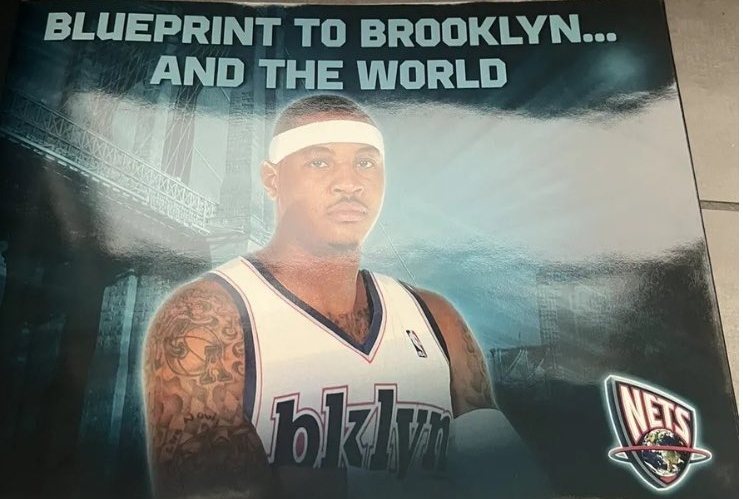
In the early 2010s, NBA free agency didn’t just happen in phone calls and quiet dinners. It happened in boardrooms, branding sessions, and glossy binders that treated superstars less like players and more like venture capital.
That’s why the latest bit of memorabilia making the rounds online feels so unreal: an internal New Jersey Nets recruiting pitchbook, reportedly prepared during the franchise’s push to land Carmelo Anthony as the organization angled toward its move to Brooklyn, surfaced on eBay, and, according to screenshots shared by collectors and fans, sold for $100.
Nets pitchbook to Melo in 2011 has leaked on EBay 🤣 https://t.co/XsPWr1GW0K pic.twitter.com/35V7ZVNNCS
— Mike King (@MikeKing00) October 23, 2023
A hundred bucks is what you pay for a decent pair of sneakers, not a behind-the-scenes artifact from one of the loudest star chases of that era. Yet that price tag is part of what makes this so perfect: the Nets once tried to buy the future with billion-dollar ambition, and years later a piece of that ambition got flipped online like an old PlayStation.
The backdrop is important, because 2010–11 wasn’t just “Melo might get traded.” It was a months-long, league-warping saga; Denver weighing offers, the Knicks pushing for the star who preferred New York, and the Nets trying to hijack the whole thing with what amounted to a new-market sales pitch. ESPN reported in January 2011 that New Jersey was “to the brink” of a deal at one point, before the process kept swerving. Ultimately, on Feb. 22, 2011, the Knicks landed Anthony in the blockbuster that ended the drama.
The pitchbook, as circulated in collector posts and discussion threads, appears to come from that exact moment in time, when the Nets were trying to sell Anthony not only on a roster, but on an identity shift. The franchise was under new ownership, aiming for a new arena, a new borough, and a new relevance. Mikhail Prokhorov’s Nets were marketing a transformation and needed a face to match it. And if you’re trying to convince a superstar to join a team with more concept than credibility, you don’t just promise wins. You promise a movement.
That was the era of the “Blueprint for Greatness” vibe. The Nets leaned hard into the idea of Brooklyn as an inevitability, and the Knicks–Nets rivalry history even notes Prokhorov publicly framed the Carmelo chase as leverage that forced the Knicks to “overpay,” a reminder that recruiting wars are often as much about sabotaging the neighbor as landing the prize.
So yes, the pitchbook is funny. It’s funny because sports marketing from that period had a specific energy: fonts that wanted to be Silicon Valley, slogans that wanted to be Jay-Z, renderings that made the future look cleaner than it ever is. It’s funny because it’s a physical artifact of an era when teams tried to win free agency with PowerPoint swagger.
But it’s also fascinating, because it exposes the mechanics of how franchises think when they’re trying to shift categories. Before the Nets had a modern arena and a stable brand, they were trying to package potential as something tangible enough for a superstar to sign. If you ever wondered what it looks like when an NBA team tries to pitch “you won’t just be a player here, you’ll be the moment,” this is it, printed, bound, and apparently resold for the cost of two lower-bowl tickets and a beer.
And the irony, of course, is that the pitch didn’t work. Anthony didn’t choose the Nets. The Knicks “beat” them to the deal, and the saga ended with Carmelo in Madison Square Garden, not in a glossy vision board about Brooklyn.
Which is where the “what if” gets irresistible.
What if Melo had taken the binder seriously? What if he’d decided that being the first true Brooklyn star was more powerful than being the latest Knicks savior? The Nets did, eventually, get their star traction through other routes, Deron Williams arrived in 2011, and the franchise’s Brooklyn era later swung big again with different superteams. But the alternate timeline is still hilarious to imagine: Carmelo as the centerpiece of a “Brooklyn-before-Brooklyn” launch, with Prokhorov’s bravado and the borough’s spotlight, and every Knicks fan watching across the river like they’d just lost the city.
