
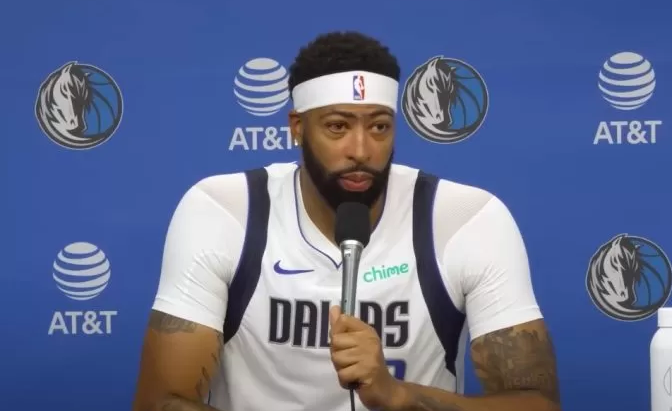
The Milwaukee Bucks have reached the phase of their season where intent matters almost as much as results. At 16–20, 11th in the Eastern Conference, they don’t have the luxury of waiting for the standings to be kind. They have to push. And according to reporting tied to The Athletic, Milwaukee has done exactly that, registering interest in a trade for Anthony Davis, even as league sources characterize an actual deal as unlikely.
It’s the kind of headline that sounds like fantasy until you read the second sentence. The same report notes why the Bucks are a long shot: a thin asset base and a shortage of sizable contracts that make a realistic trade package difficult to build.
That’s not a dismissal of Milwaukee’s ambition, it’s a description of the new NBA economy, where “interest” is easy and “matching the deal” is the whole war.
Still, the fact that the Bucks’ name is even in the Davis orbit is revealing. In a league increasingly split between teams hoarding flexibility and teams chasing the next high-end swing, Milwaukee is signaling it remains firmly in the second camp. That posture tracks with the franchise’s central responsibility: maximize the present around Giannis Antetokounmpo, because the Bucks’ window is defined by the years they have a top-five player in his prime and enough infrastructure to keep him believing.
The Bucks’ record is the backdrop, but it’s not the only pressure point. Milwaukee has been tied to a variety of “buyer” conversations in the run-up to the Feb. 5 trade deadline, widely viewed as a moment the front office must use to stabilize a season that has drifted into the middle of the conference.
The Davis connection simply represents the most extreme version of that approach: if you’re going to swing, swing at the top shelf.
Davis, in this rumor cycle, is not just a star; he’s a salary and a timeline. His 2025–26 base salary is $54,126,450, a number so large it dictates the structure of any plausible trade before basketball fit even enters the chat.
The reporting around Davis has also framed him as a player whose future with Dallas is not guaranteed, with multiple outlets summarizing that the Mavericks don’t feel forced to move him immediately, while Davis’ camp is not operating as if an extension is inevitable.
That kind of uncertainty doesn’t mean a deal is imminent; it means the phones stay warm.
For Milwaukee, the obstacle is straightforward: to trade for a $54 million player, you need some combination of (1) comparably large salaries going out, (2) attractive draft capital, and (3) young players another team actually wants. The Athletic-linked report points out the Bucks don’t cleanly check those boxes right now.
This is what “scarce assets” looks like in practice, years of win-now moves that made sense at the time, but which leave less flexibility when another star becomes available.
That’s why Milwaukee’s “interest” reads less like a near-future transaction and more like a declaration: the Bucks are canvassing every elite option that could plausibly elevate the roster next to Giannis. They’ve been connected to other significant names as well, recent reporting and rumor roundups have floated Milwaukee as a team monitoring big-ticket upgrades across the league, including higher-scoring wings and major contract pieces.
Even if Davis is a long shot, the throughline is consistent: they’re trying to buy ceiling, not just patch holes.
If the Bucks could somehow make the math work, the on-court idea is obvious enough to sell itself. A Giannis–Davis pairing would be a defensive statement before it’s anything else; two elite frontcourt forces who can erase mistakes, dominate the glass, and make the rim feel like restricted airspace. It would also be a stylistic gamble. Both are best when the paint is a resource, and building an offense around two interior-leaning stars requires high-level spacing, fast decisions, and a supporting cast that doesn’t freeze when the ball swings to the corners. That’s solvable, but it’s not automatic.
The deeper question is whether Milwaukee is even in position to build a credible offer without detonating everything around Giannis. Because the most painful part of most star trades isn’t the picks, it’s the depth that keeps a contender functional across an 82-game season. This Bucks team, already fighting from 11th, can’t afford to turn itself into a two-man theory with no runway behind it.
That’s where the report’s skepticism feels grounded rather than dismissive. “A deal appears unlikely” isn’t an evaluation of Davis’ talent; it’s an evaluation of Milwaukee’s tool kit.
And yet, this is still worth taking seriously, if only because “interest” is often the first breadcrumb in how front offices operate publicly. Teams register interest for all kinds of reasons: to gather intel on price, to test whether a situation is real, to create optionality, to signal aggression to their own locker room, and sometimes to remind the league they will not be passive while a season slips away.
In Milwaukee’s case, the signal is clear. Whether they can actually land a player in Davis’ financial stratosphere is another matter. But the Bucks don’t need this rumor to become a trade to reveal its meaning. It already has.
The deadline is February 5.
That’s the date when Milwaukee’s ambition has to become something more than phone calls.
