
The NBA’s second fan-vote returns for the 2026 All-Star Game landed with a familiar headline and a not-so-familiar undercurrent: the stars you’d expect are still leading, but the order beneath them is starting to tell you what kind of season this is becoming.
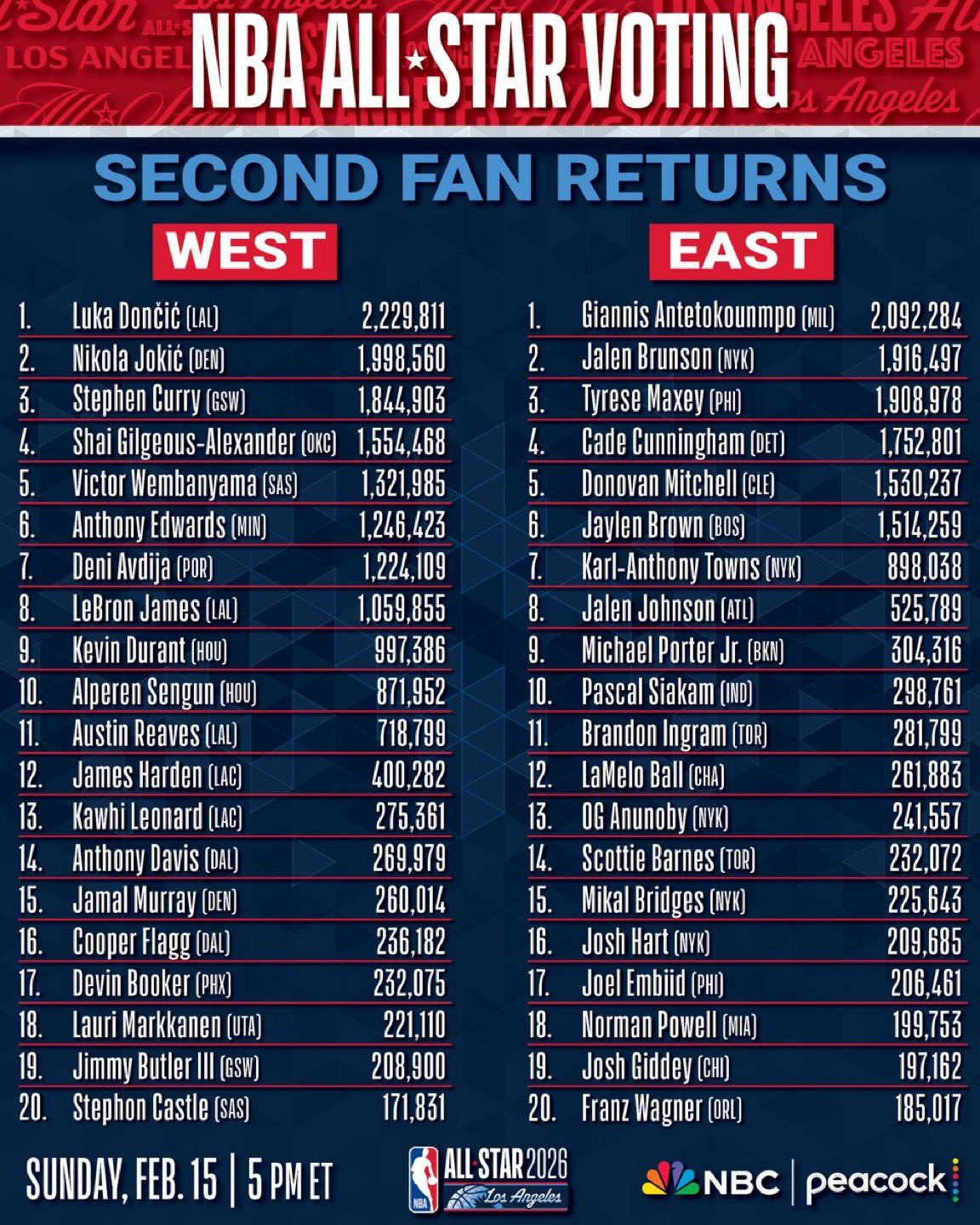
At the very top, nothing has changed. Luka Dončić continues to sit alone in the overall lead with 2,229,811 fan votes, maintaining a sizable cushion over the rest of the Western Conference field.
In the East, Giannis Antetokounmpo remains the conference leader at 2,092,284, still the pole position for a starting spot as voting tightens toward the finish line.
But these second returns aren’t really about who’s No. 1. They’re about who’s moving, who’s vulnerable, and which “safe” names are suddenly discovering that fan voting doesn’t care about reputation the way it used to.
In the West, Dončić’s lead is reinforced by a top five that stayed intact from the first returns. Nikola Jokić remains second at 1,998,560, Stephen Curry third with 1,844,903, Shai Gilgeous-Alexander fourth at 1,554,468, and Victor Wembanyama fifth with 1,321,985.
That’s a list that reads like a cross-era handshake: an MVP-caliber center, a generational shooter, a modern efficiency machine, and the league’s newest gravitational anomaly in Wembanyama.
If there’s a tell in those numbers, it’s that the West’s fan-vote “starter picture” is already forming a hard shell. The separation between the top group and the chase pack matters because the NBA is still using a blended starter formula, fans count for 50%, with players and media at 25% each, and this year’s starters are selected without regard to position.
A big early fan-vote advantage doesn’t automatically lock anything, but it builds a margin that player/media ballots have to work to erase.
The East, meanwhile, is where the second returns actually feel like a plot twist. Giannis is still the headliner, but the reshuffle behind him is the story. Jalen Brunson surged into second with 1,916,497 votes, narrowly ahead of Tyrese Maxey in third at 1,908,978. That gap is thin enough to flip with a good week, a hot national TV moment, or one of the NBA’s scheduled voting accelerators.
Right behind them comes one of the clearest signals that the fan ballot is reflecting the season’s mood, not last year’s résumé: Cade Cunningham sits fourth with 1,752,801, ahead of Donovan Mitchell at 1,530,237 and Jaylen Brown at 1,514,259.
If you’re looking for the pressure point, it’s that final slice of the top five. Mitchell and Brown are separated by less than 20,000 votes in these returns, and Brown is currently sixth, close enough to smell a starting spot, far enough to miss it if the next week doesn’t break his way.
And that’s where the annual All-Star paradox hits hardest: the vote is supposed to be a celebration, but it becomes a referendum. For players like Brown, it can feel like being graded on fame rather than performance. For players like Brunson and Maxey, it’s the opposite: a fan-vote rise is the public acknowledgment that their teams’ identities are built around them now, not someday.
The second returns also reinforce something the league has leaned into increasingly: All-Star weekend is global, and the vote reflects that. Dončić, Jokić, Giannis, Wembanyama, these aren’t just great players, they’re international tentpoles, and the fan totals keep proving that “market size” has less power than “player gravity.”
The calendar from here is straightforward and unforgiving. Fan voting runs through Wednesday, Jan. 14 at 11:59 p.m. ET, and the starters will be revealed Monday, Jan. 19 on NBC and Peacock.
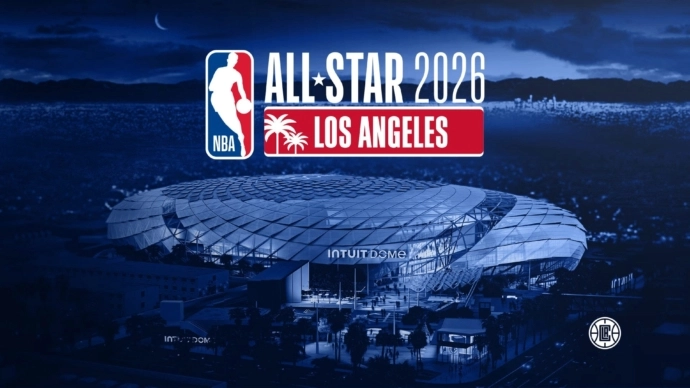
The game itself is set for Sunday, Feb. 15 at Intuit Dome in Inglewood, California, and it comes with a format change that will shape how people think about “All-Star” in the first place: a round-robin tournament featuring two teams of U.S. players and one international “World” team, played as four 12-minute games.
Which means these voting returns are more than a popularity snapshot. They’re effectively the early casting call for a new kind of showcase; one where “USA vs. World” isn’t just marketing, it’s the structural premise. And if the second returns are any indication, the World side won’t just be represented. It’s going to arrive with headline names and real leverage.
