
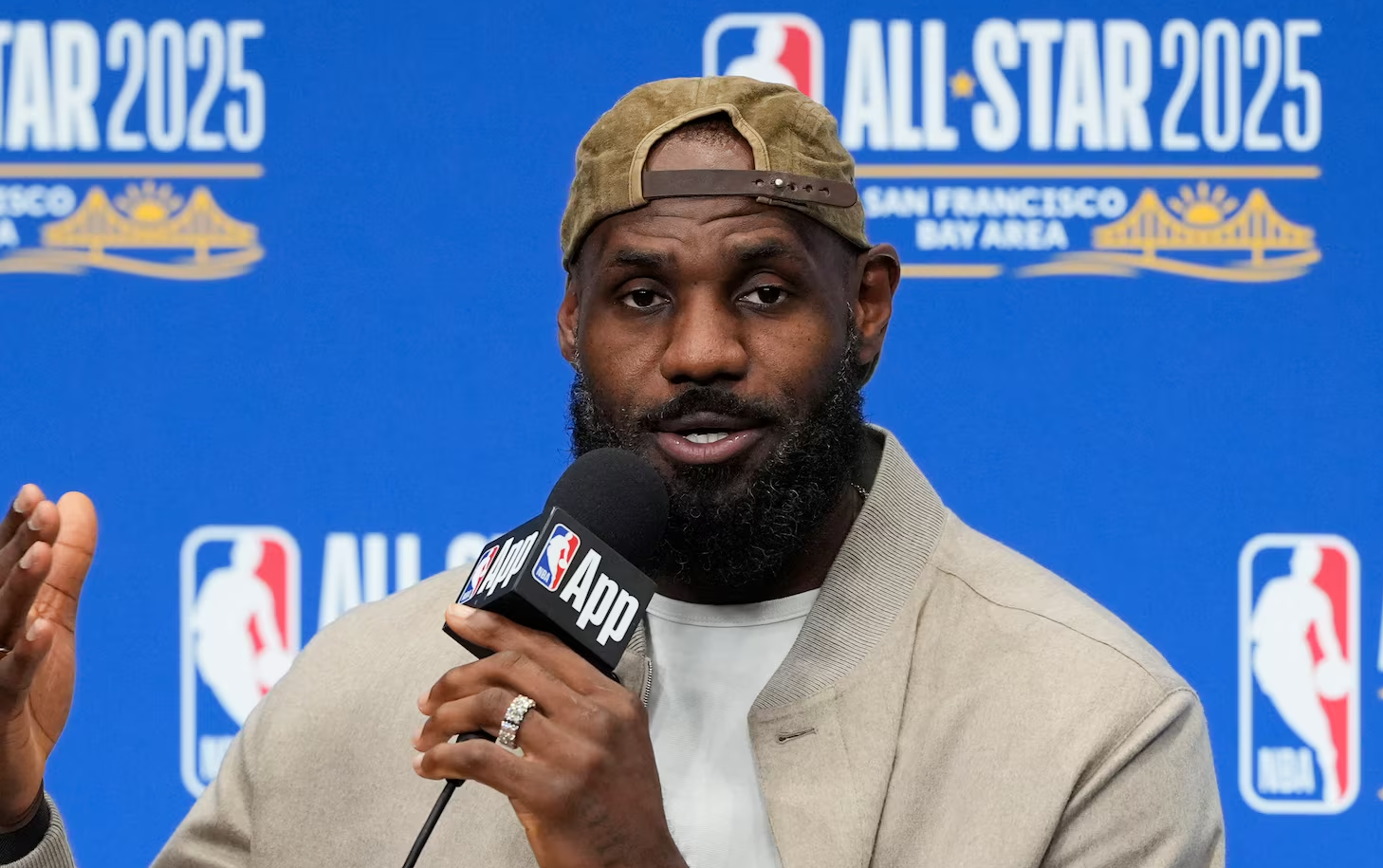
Draymond Green has never been subtle about league politics, and he wasn’t subtle this time either.
With LeBron James sitting uncharacteristically low in early fan-vote returns for the 2026 NBA All-Star Game, Green argued that the league should treat the situation less like a strict meritocratic math problem and more like a moment that demands common sense, and respect for a player who has defined an era.
“I know a lot of people are like ‘oh man he shouldn’t be an All Star’. Shut up. Yes he should. He’s been the face of the NBA for 20 years. Figure it out,” Green said.
Draymond wants Adam Silver to find a way to put LeBron in the All-Star game
“I know a lot of people are like ‘oh man he shouldn’t be an All Star’. Shut up. Yes he should. He’s been the face of the NBA for 20 years. Figure it out.”
(h/t @HeatCulture13)
pic.twitter.com/Slb5AWu6EO— NBACentral (@TheDunkCentral) December 31, 2025
The timing matters because the All-Star landscape is shifting in real time. In the first fan voting returns released Dec. 29, LeBron was listed ninth in the Western Conference with 536,555 votes, a jarring placement for a player who has lived at the top of All-Star voting for most of two decades.
It is seen as a potential “changing of the guard” moment, but even if LeBron’s starter streak ends, he could still be selected by coaches as a reserve.
What gives Green’s demand extra oxygen is that the league’s new 2026 All-Star format has a built-in mechanism that, in certain circumstances, does allow the commissioner to “figure it out.” The NBA and NBPA announced that the 2026 game at Intuit Dome will be a USA vs. World, three-team round-robin concept (two U.S. teams plus one World team), with All-Stars still selected as usual, five starters per conference via fan/player/media voting, and seven reserves per conference via coaches.
But the release also states that if the voting results don’t produce the minimum number of players needed for the format, 16 U.S. players and eight international players, then NBA Commissioner Adam Silver will select additional All-Stars to reach that minimum. In that scenario, at least one team would carry more than eight players.
That clause is designed as a structural safeguard, not a lifetime-achievement override, but it’s exactly the kind of wrinkle that makes Green’s point feel less like pure theater. The commissioner is explicitly empowered to add players if the format demands it.
Green is essentially arguing that the league shouldn’t wait for a technicality, that LeBron’s place in the event should be treated as non-negotiable on principle.
Green’s message to Silver, then, is less about bending rules than about protecting the spectacle. All-Star Weekend sells basketball, but it also sells continuity, the idea that the league can honor its present without pretending its past is irrelevant. In Green’s view, leaving LeBron out wouldn’t be a vote result. It would be a failure of imagination.
“Figure it out,” he said.
