
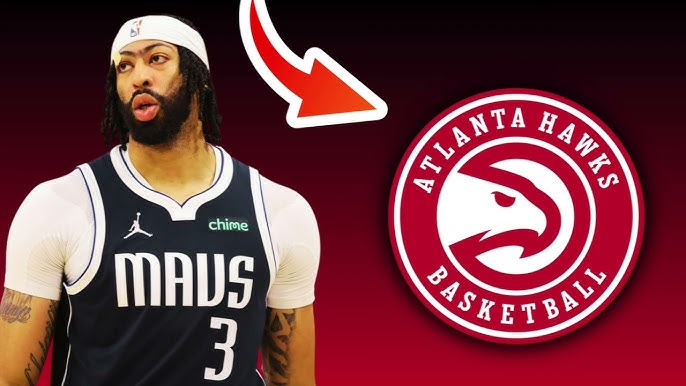
The Atlanta Hawks have spent December looking like a team stuck between timelines; too talented to punt the season, too flawed to pretend the current roster is a finished product. Now, if Marc Stein’s latest reporting is any indication, Atlanta is preparing to pick a direction with a hard turn of the wheel: the Hawks “appear to be the most determined suitor” for Dallas Mavericks star Anthony Davis.
The framework, as described across Stein’s reporting and related league chatter, is straightforward in concept and brutal in cost. Trae Young is not the outgoing centerpiece in this pursuit. If a deal comes together, it would not involve Trae Young. That forces the Hawks into the other currency of blockbuster trades: young talent, expiring money, and picks. And that’s where the most telling name surfaces: Zaccharie Risacher, the No. 1 pick the Hawks took just 18 months ago.
Stein wrote that it is “increasingly believed” Atlanta is willing to surrender Risacher “in the proverbial right scenario,” a striking pivot for any franchise so early in a top pick’s arc, and an even louder signal of how urgent the Hawks’ internal evaluation has become.
There are lines Atlanta still refuses to cross. Stein has been explicit; “Just to be clear once again,” he wrote: Jalen Johnson and the Hawks’ 2026 unprotected first-round pick acquired from New Orleans are “widely presumed to be untouchables.”
That pick, obtained in the draft-night Derik Queen deal, is the kind of asset front offices guard like oxygen: an unprotected 2026 first that can turn into real franchise leverage if the Pelicans (or the Bucks, depending on which is conveyed) bottom out.
So the outline of Atlanta’s position comes into focus: take the biggest swing possible without touching Young, Johnson, or the 2026 “gold bar” first-rounder. Whether that’s enough to move Dallas is the larger question, and it’s a question complicated by two realities that have defined Davis’ career and, increasingly, Dallas’ present tense.
The first is money. Davis is owed $58.5 million next season, and Stein noted the league expectation that Davis will be “eager” to pursue an extension when eligible in August. Any team trading real assets for him has to be comfortable not just acquiring Davis, but paying Davis.
The second is durability. Davis left Dallas’ Christmas Day game against Golden State with right groin spasms, another entry in a season that has already included missed time.
For an acquiring team, that matters not as narrative, but as calculus: how many picks and prospects do you attach to a superstar whose availability can swing wildly month to month?
For the Hawks, the appeal is obvious and immediate. Davis would solve problems that have haunted Atlanta all season: a reliable two-way anchor in the frontcourt, a rim protector who changes the geometry of the floor, and a playoff-level defensive backbone that doesn’t require perfection from the guards. Pairing Davis with Young would create a brutal pick-and-roll ecosystem; pairing Davis with Johnson would give Atlanta the kind of size-and-skill tandem the East’s best teams typically need to survive four rounds.
